Whole-Home Repiping
Replacing galvanised supply: materials, access planning and what the house looks like during the work.
Read more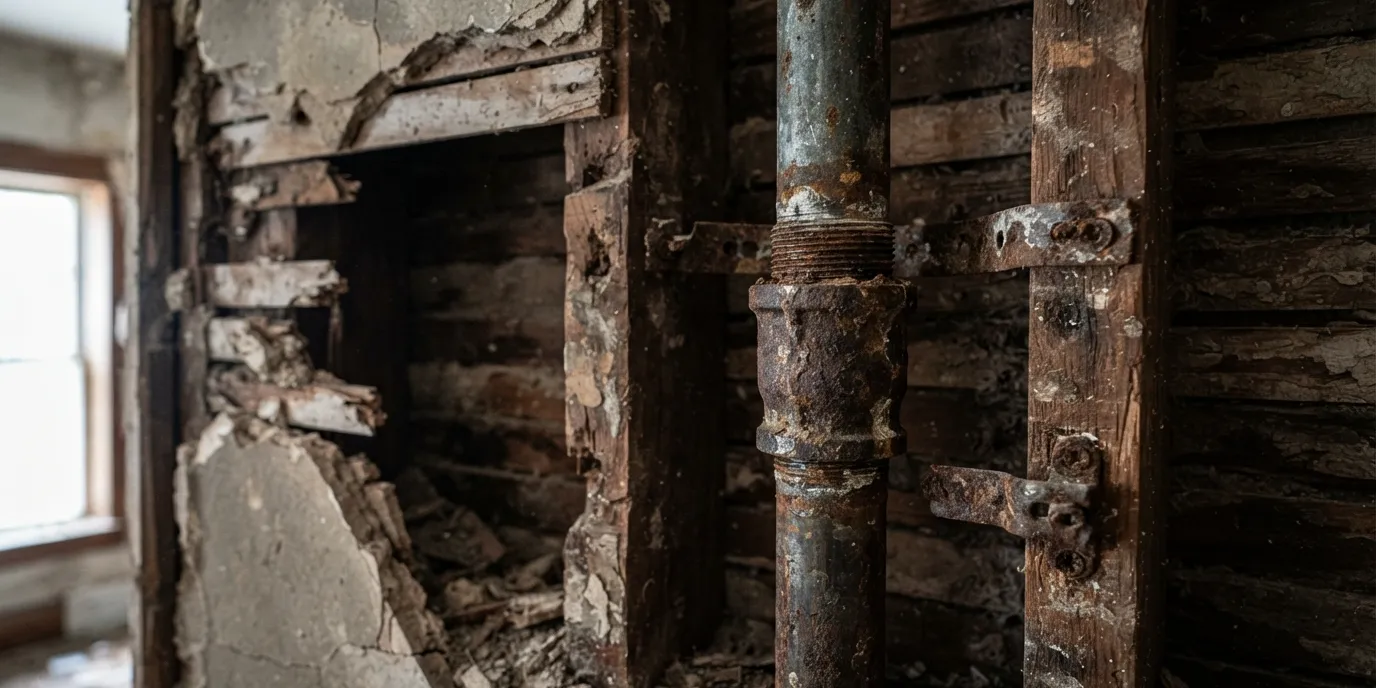
Older homes · Statewide
Virginia has more pre-1940 housing than almost anywhere in the country. The plumbing in those houses is not simply older. It is a different set of materials, with different failure modes, in walls that punish careless work.
Tell us roughly when the house was built and what the pipes look like where you can see them. That shapes the whole conversation.
Dollar ranges here are typical Virginia costs, given for planning only. They are not a quote. The independent plumber who takes your job sets the price and gives it to you before work begins.
Context
From Alexandria row houses to Richmond Fan District terraces, Norfolk bungalows and farmhouses across the Piedmont, a large share of the state's housing predates modern plumbing materials entirely.
A house built in 1925 has usually been plumbed three or four times over. The original system may have been galvanised steel supply and cast iron drainage. Somewhere in the 1950s a bathroom was added with copper. In the 1970s a kitchen was redone in copper with lead-tin solder. In 1994 someone ran polybutylene to a new laundry. By 2010 a section was patched with PEX. What is behind the plaster now is an archaeology of five eras, joined by transition fittings of varying quality, and nobody has a drawing of it.
That layering is the defining feature of older-home plumbing work, and it has three consequences. First, diagnosis takes longer, because the pipe you find in one wall tells you very little about the pipe in the next. Second, every repair involves a material transition, and transitions between dissimilar metals are themselves a failure point. Third, the cost of any given repair is dominated not by the plumbing but by getting to it and putting the house back afterwards.
None of that means an old house is a bad house. Well-built pre-war construction, full-dimension framing, generous joist depth, real plaster, is often easier to work in than a 1990s tract house, because runs are more accessible and the structure tolerates the work. It just needs a plumber who has done it before and who understands that the plaster is part of the asset.
Older houses also sit on older infrastructure. Clay sewer laterals, galvanised or lead service lines from the street, and mature trees over both are standard. Before spending money inside, it is worth knowing what is under the front yard. A sewer camera inspection answers that in an hour.
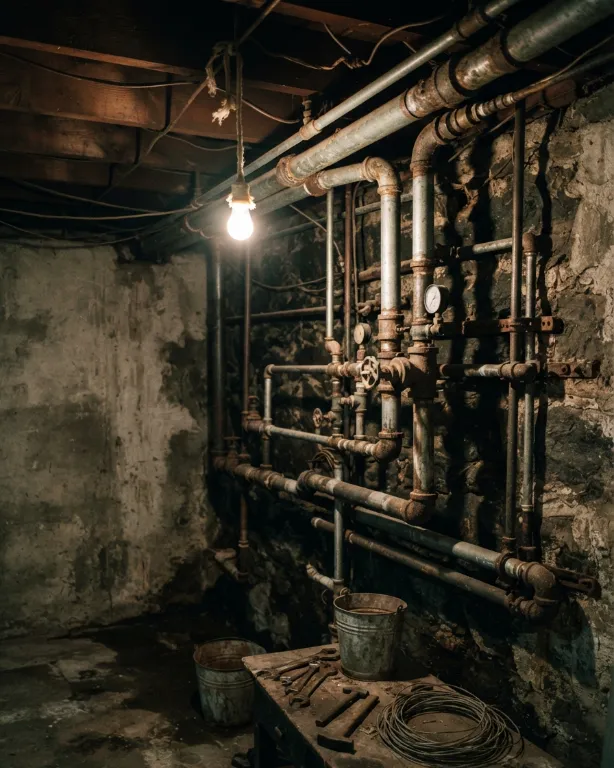
On a house over sixty years old, an hour spent documenting what materials exist where saves far more than it costs. It changes the order of the work and often the budget.
One visit, every material identified, a written order of work.
Materials
Six things turn up repeatedly in Virginia houses built before 1960. Each behaves differently.
| Material | Era | Where | How it fails | Typical action |
|---|---|---|---|---|
| Galvanised steel supply | 1900. 1960 | Whole-house supply | Interior rust scale closes the bore; threads rust through | Replace. repipe |
| Cast iron drainage | 1900. 1975 | Stacks, main drain, under slab | Rusts from inside, bottom of the pipe channels out | Replace or line in sections |
| Lead-tin solder on copper | pre-1986 | Joints on copper supply | Leaches lead into standing water | Test water; replace joints or repipe |
| Lead service line or bends | pre-1930 | Street to house, closet bends | Soft, deforms, leaches lead | Replace. main water line |
| Clay sewer lateral | pre-1970 | Yard to street | Joints open, roots enter | Line or replace. trenchless |
| Orangeburg (bituminous fibre) | 1945. 1972 | Yard to street | Deforms into an oval and collapses | Full replacement only |
Two of those deserve extra emphasis. Galvanised steel is the reason so many old houses have poor pressure: the pipe does not leak for decades, it just closes up. A three-quarter-inch galvanised line sixty years old can have an effective bore of a quarter inch, choked with rust tubercles. You will find that no amount of pressure adjustment helps, because the restriction is the pipe itself.
Lead is a health question rather than a leak question. Lead service lines were used in some Virginia cities before about 1930; lead-tin solder was legal on copper joints until 1986; brass fixtures made before 2014 can contain up to eight per cent lead. If the house predates 1986 and has children in it, a water test is worth doing before anything else, and the answer may reorder your whole priority list.
Cutting, sanding or aggressively flushing a lead line can spike lead in the water. If you suspect a lead service line, soft grey metal, no threads, a bulge where it meets the meter, get it identified before it is worked on, and check whether your locality has a replacement programme.
One visit, all materials identified, a written order of work. That is the cheapest thing you can buy on an old house.
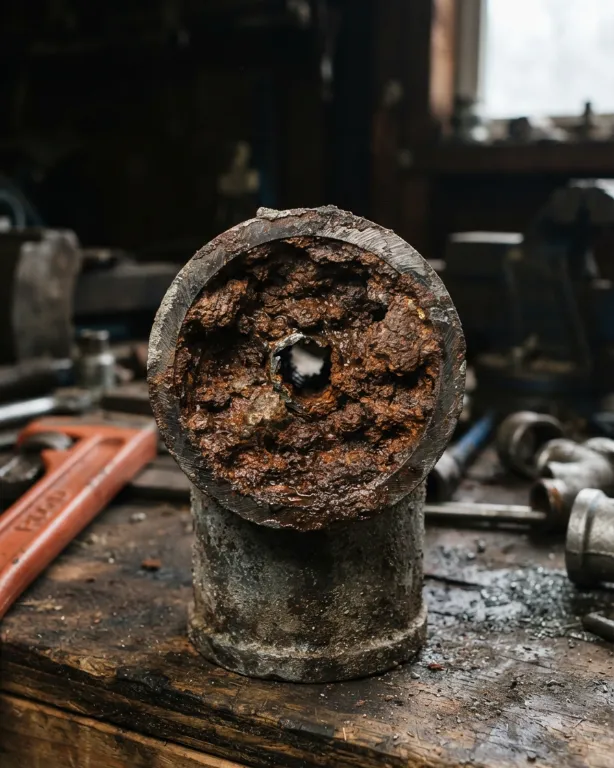
That is galvanised pipe shedding scale after standing overnight. It is the clearest signal that the supply system is at end of life.
Failure modes
Old plumbing rarely announces itself with a burst. It degrades in ways that are easy to live with and easy to misread.
Cast iron deserves its own note. It fails from the inside and from the bottom: waste flowing along the invert erodes the metal until the lower third channels away entirely, leaving a pipe that looks intact from the side but has no floor. Under a slab that means soil washing in and settlement above. In a stack it means a wall cavity that has been quietly wet. Camera inspection is the only reliable way to grade it.
In houses with a basement or a crawl space, most of this is visible without cutting anything. An hour with a torch under an old house tells you more than any amount of speculation upstairs.
Method
On an old house, the plumbing is the cheap part. Access and restoration are where the money and the damage go.
Basements, crawl spaces, closets, and the backs of built-in cabinets get you to most runs without touching a finished wall. A plumber who opens the hallway first has not looked hard enough.
It cracks in sheets, keys break away from the lath beyond the cut, and matching a three-coat plaster finish is a skilled trade. Cuts should be scored, small, and made with the lath direction in mind. Never let anyone punch a hole in plaster.
Old houses have redundant chases. Abandoned flues, dumbwaiter shafts, laundry chutes, boxed-in corners. These are the highways for a repipe and they are why old houses often need fewer openings than 1990s ones.
A true 2x10 joist is generous, but drilling and notching rules still apply and old framing may already have been notched by four previous trades. Structural review matters where a main run crosses joists.
Original baseboard, casing and picture rail cannot be bought. It should be removed carefully, labelled and refitted, not cut through and replaced with a modern profile.
"Patched" on plaster can mean anything from a rough fill to a matched three-coat repair. Decide before work starts who does plaster, who paints, and what the standard is.
One more thing specific to Virginia: many older neighbourhoods sit inside local historic districts, and a few of those have review requirements that touch exterior work. Interior plumbing is generally outside design review, but anything that changes the exterior, a new vent penetration on a visible roof slope, an exterior cleanout, a trench across a front yard, a tankless unit's wall vent, may need approval. Ask the locality before ordering equipment, not after.
Tell us what the walls are made of. It changes the plan more than the pipe does.
Sequence
Almost nobody does everything at once. The order matters, because some work makes other work cheaper.
The one sequencing mistake we see most: a beautiful bathroom renovation finished on top of sixty-year-old galvanised supply. Two years later the pressure is still poor, a joint fails behind new tile, and the repipe now costs three times what it would have during the remodel. If you are opening walls anyway, do the pipe.
Money and permits
Old-house work is priced by access, not by pipe length. Here is how the common jobs tend to land.
| Work | Typical range | What drives the number |
|---|---|---|
| Materials survey and written plan | $150. $450 | Size of house, basement or crawl access |
| Water quality and lead test | $60. $250 | Lab panel scope |
| Galvanised repipe, 2 bath, crawl space | $7,000. $14,000 | Plaster restoration standard |
| Galvanised repipe, 3 bath, two storeys | $11,000. $22,000 | Number of openings, trim removal and reuse |
| Cast iron stack replacement, one stack | $3,500. $9,000 | Storeys, wall finish, tile |
| Clay lateral lining, 50. 80 ft | $6,000. $16,000 | Access pits, depth, permits |
| Lead service line replacement | $3,000. $9,000 | Locality programme, road cut, restoration |
Permits: supply repipes, drainage replacement, water heater changes and service line work are all permitted in Virginia localities, with rough and final inspections. For an older house this is genuinely useful rather than bureaucratic. The inspection record is the only documentation you will have of what is behind the plaster, and it is what a buyer or insurer will ask for.
Phasing is normal and sensible. A workable pattern is: survey and test in year one, sewer lateral and any lead in year one or two, supply repipe in year two or three combined with whichever bathroom is next, stacks and fixtures after that. Write the plan down with prices attached, then work through it. What you are avoiding is the alternative. A decade of emergency repairs, each one paid at emergency rates, each one leaving a patch in a different piece of plaster.
Questions
Usually, but not by adjusting anything. In a pre-1960 house, poor pressure is almost always galvanised steel supply pipe that has closed up internally with rust scale. No valve, pump or regulator setting can open that bore back up. The pipe has to be replaced. The good news is that repiping typically restores full pressure immediately and permanently.
Lead is soft, dull grey, has no threads, and usually has a rounded bulge (a wiped joint) where it connects at the meter. Scratching it with a key reveals bright silver metal; a magnet will not stick. Houses plumbed before about 1930 are the candidates. Many Virginia localities keep service-line material inventories and some run replacement programmes, so ask your water utility as well as a plumber.
It can contribute lead to water that has been standing in the pipes, particularly the first draw in the morning. Lead-tin solder was permitted on potable joints until 1986, so any copper installed before then may have it. A water test tells you whether it is actually an issue in your house; running the tap for thirty seconds before drinking is a reasonable interim measure, and a repipe removes the question.
Sometimes. If the pipe is scaled but structurally sound, descaling followed by a lining can extend its life considerably. If the invert has channelled away, the bottom of the pipe eroded through, lining has nothing to bond to and replacement is the only option. A camera inspection is what settles it, and it is cheap relative to the decision it informs.
A careless one will. Lath and plaster does not behave like drywall: it cracks beyond the cut and the keys break away from the lath. Ask specifically how access will be planned, whether the plumber has worked on plaster before, and whether they will work from basements, crawl spaces and closets in preference to finished walls. Also agree in writing what "restored" means and who is doing the plaster and paint.
Interior plumbing generally sits outside design review. Anything visible from outside may not. A new vent stack on a street-facing roof slope, an exterior cleanout, a tankless vent penetration, or a trench across a front garden. Check with the locality before you order equipment, because a rejected vent location can change which water heater you can install.
If the current system is galvanised, usually yes. Poor pressure and rusty water are immediately obvious at a showing, and inspectors flag galvanised supply as a remaining-life issue. A permitted repipe is a document you can hand a buyer. The same logic applies to polybutylene, which has its own page.
Largely, yes. Work is normally sequenced zone by zone so water is off for parts of the day and restored overnight. Older houses often make this easier, because they tend to have accessible basements and generous chases to work through.
Assume it is clay or, if the house was worked on between 1945 and 1972, possibly Orangeburg. Both fail. Clay opens at the joints and admits roots; Orangeburg deforms and collapses and cannot be lined. An hour of camera inspection tells you which you have and how urgent it is. See sewer camera inspection.
Everything that needs those walls open. Replace the supply lines serving that bathroom back to the trunk, add proper shutoffs, replace any lead or galvanised sections within reach, check the vent, and if the stack is cast iron and scaled, deal with it now. The premium for doing this during a renovation is small. The cost of doing it afterwards is the renovation again.
Related work
Older houses touch several of these at once. Most owners work through them in sequence rather than all at once.
Replacing galvanised supply: materials, access planning and what the house looks like during the work.
Read moreWhat is actually under the front yard, clay, cast iron or Orangeburg, and how bad it is.
Read moreIf the house was replumbed in the 1980s, the newer pipe may be the bigger problem.
Read moreStart with a survey
On a house over sixty years old, an hour of documentation changes the order of the work and usually the budget. Then you can phase it sensibly instead of reacting to failures.
(866) 683-0244Statewide, 24 hours. Independent licensed professionals.