Sewer Camera Inspection
The survey that decides whether trenchless is even possible.
Read more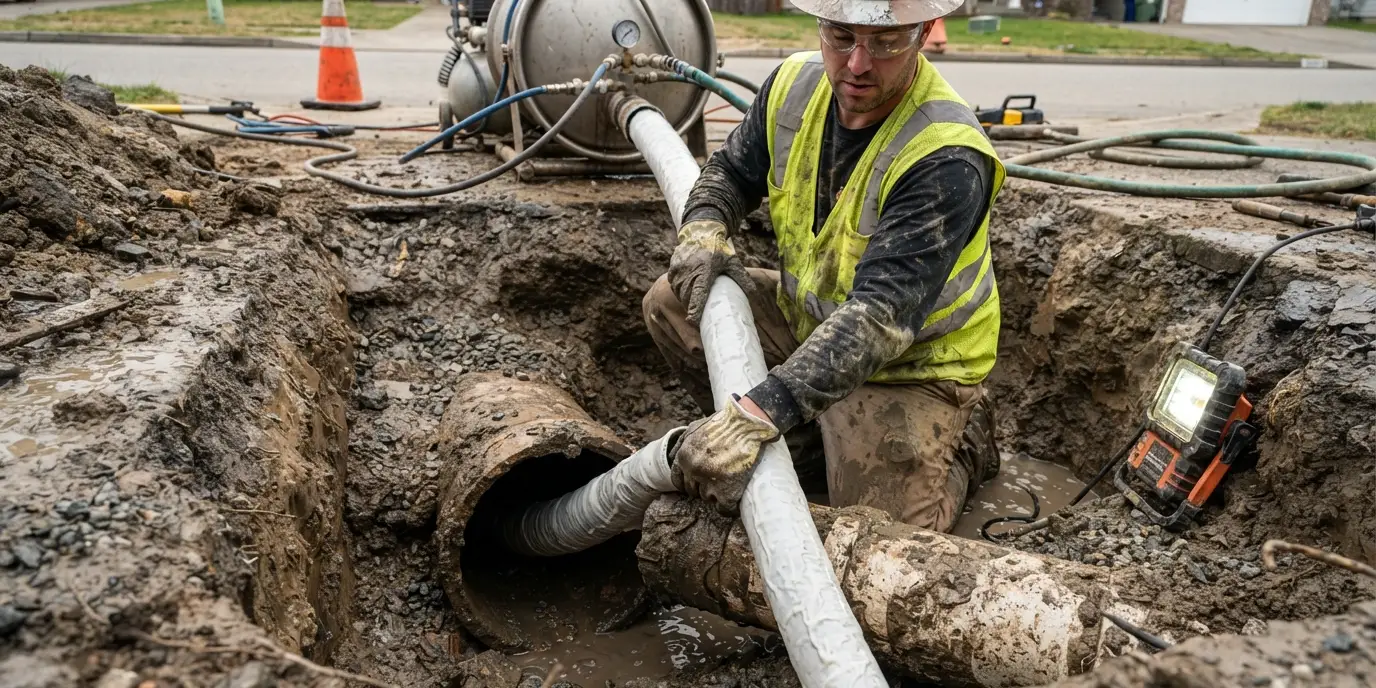
No trench across the yard
Lining and bursting rebuild a failed lateral from two small access pits. The oak stays, the brick walk stays, and the work is usually finished inside a day.
It is not right for every pipe, and we will tell you plainly when it is not.
The trade-off
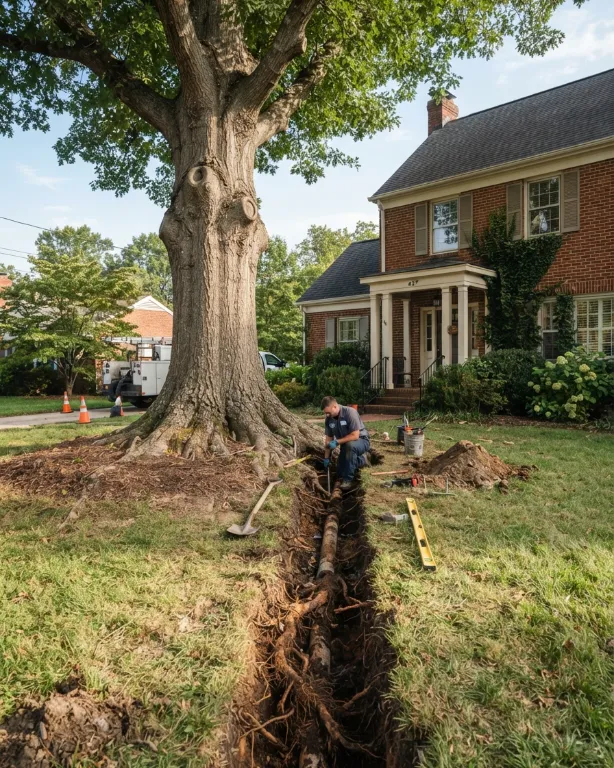
On most sewer replacements the pipe is a small fraction of the cost. What is expensive is everything that sits between the excavator and the pipe: a concrete driveway, a brick path laid by a previous owner, a forty-year-old oak whose root plate cannot be cut without killing it, a boxwood hedge, a historic streetscape in Old Town Alexandria where the surface reinstatement is regulated.
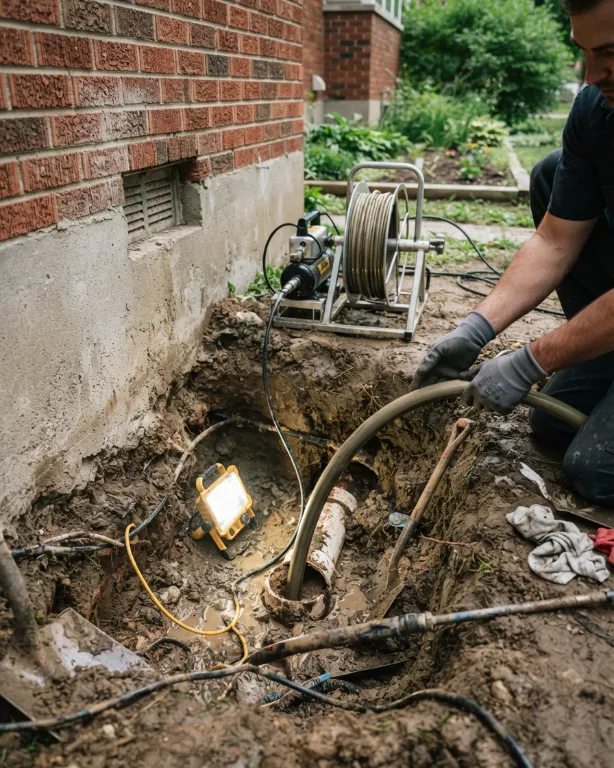
Trenchless methods change the arithmetic. Instead of an open trench along the whole run, the work happens from two pits, one near the house and one near the connection, and the new pipe is created inside or in place of the old one along the length between them. The yard above is untouched.
It is not free, and it is not always cheaper per foot than digging. On a short, shallow lateral under a plain lawn, open-cut is often the sensible and economical choice, and we will say so. Trenchless earns its price when what is above the pipe is worth protecting.
Send us the camera footage if you have it, or we will produce it.
Two techniques
They solve different problems, and the difference matters when you are comparing quotes.
A resin-saturated felt or fibreglass liner is inverted or pulled into the host pipe and cured in place, usually with hot water or steam. The result is a jointless pipe within a pipe, with no joints left for roots to enter.
A bursting head is winched through the existing line, fracturing it outward into the surrounding soil while towing a new HDPE pipe in behind it. The new pipe can be the same size or larger.
A short liner set over a single defect. Useful and economical where the camera shows exactly one bad joint in an otherwise sound pipe.
Lining needs a host pipe that is continuous and roughly round. Bursting handles a pipe that has partly collapsed, and is the usual answer for deformed Orangeburg.
A liner reduces internal diameter slightly, which the smoother wall largely offsets. Bursting can upsize a four-inch lateral to six where that is worth doing.
Where a branch joins the lateral, a liner covers the opening and it has to be reinstated by a cutter. Confirm this is in the scope.
The footage answers it. We are happy to review a survey done by someone else.
Honest limits
Trenchless is marketed hard, and there are situations where it is simply the wrong recommendation. A contractor who never mentions the limits is selling rather than advising.
Where the camera shows a mix, one bellied section and forty feet of otherwise sound clay, a hybrid is common and sensible: dig the belly, line the rest. It is worth asking for that option explicitly, because it does not always appear on a quote unprompted.
Dig only what has to be dug, and line the rest.
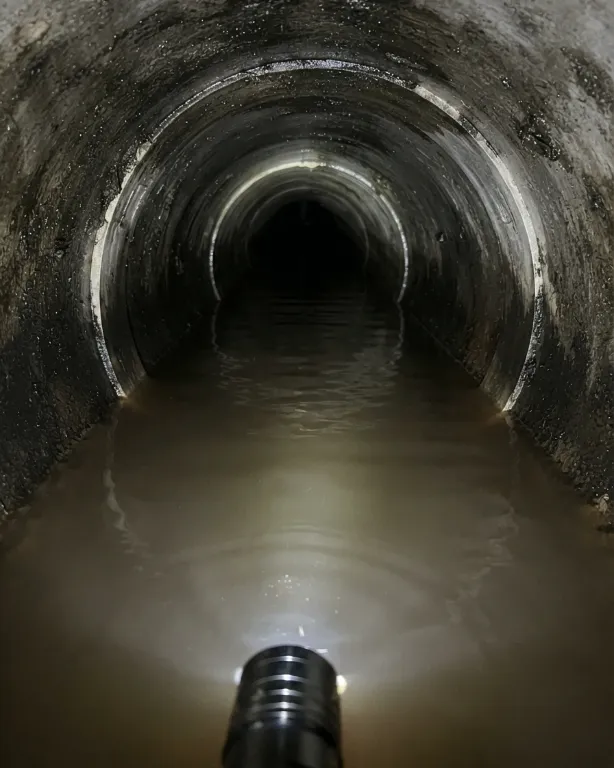
If a quote proposes a full-length liner and the survey shows standing water in a sag, ask directly how that section will be corrected.
On the day
Most domestic lining jobs start and finish between breakfast and late afternoon, with water use suspended for part of it.
The measure of a good trenchless job is that a week later there is nothing to see except two small patches of new turf.
| Stage | Roughly how long | What you will notice |
|---|---|---|
| Clean and camera the host pipe | One to two hours | A jetter running from the cleanout; the line must be genuinely clean to line |
| Excavate access pits | One to three hours | Two small pits, generally under a square metre each |
| Measure and wet out the liner | One hour | Resin mixed and saturated into the liner on site, on a clean sheet |
| Install and cure | Two to four hours | Quiet. Water use is suspended for this period |
| Reinstate branch connections | Under an hour | A robotic cutter, where the lateral has branches |
| Final camera and handover | Half an hour | Footage of the finished liner, which you keep |
| Backfill and restore pits | One to two hours | Compacted backfill, topsoil and seed or sod |
Survey first, then a scheduled date and a realistic idea of the day.
Comparing quotes
The two are frequently compared on the headline figure alone, which is the wrong comparison. What matters is the total cost of getting back to where you started.
Compare restoration, not just pipe. An open-cut quote that looks cheaper often ends at backfill and rough grade. Add a replaced driveway apron, a re-laid brick path and a mature shrub that does not survive, and the gap closes or reverses.
Count the trees. A large hardwood within the trench line is not a landscaping item. Losing an established oak or maple measurably affects both the property and the summer cooling load, and it cannot be put back.
Consider the disruption. Open-cut in a townhouse or a city lot in Richmond or Norfolk may mean losing access to a shared drive or blocking a street for days, with permits attached to each.
Then check the pipe is suitable. All of the above is irrelevant if the line has a belly or a collapse. Suitability first, economics second.
Where both are viable we will quote both, with restoration itemised on each.
The single most common source of surprise on sewer invoices is surface reinstatement. Get it itemised on both quotes before choosing.
Afterwards
A lined pipe should outlast the mortgage. The paperwork should reflect that.
Footage, warranty terms and permit close-out should all be part of the job.
Common questions
Per foot it is typically higher than open-cut pipe replacement, but the total is frequently lower once surface restoration is counted. On a lateral under a lawn with easy access, digging often wins. Under a concrete driveway, a mature tree or a city sidewalk, trenchless usually wins comfortably. The only fair comparison is two quotes with restoration itemised on both.
For the right pipe, yes. A cured-in-place liner is a structural pipe in its own right with a design life in the region of fifty years, and because it is jointless it is considerably more root-resistant than the clay it replaced. Pipe bursting is a genuine replacement. The new HDPE line is entirely new pipe.
Most domestic lining jobs are a single day on site. Pipe bursting is typically one to two days. Excavation of access pits, curing time and reinstatement all sit within that, though permits and scheduling can add elapsed days before the crew arrives.
No, and this is the question to press any contractor on. Lining needs a host pipe that is continuous and roughly round. A significant belly, a full collapse or severe deformation rules it out, and in those cases the affected section has to be excavated. Frequently the best answer is a hybrid: dig the bad section, line the rest.
A liner reduces the internal diameter slightly. Commonly a few millimetres of wall thickness on a four-inch lateral. Because the liner wall is far smoother than aged clay or scaled cast iron, measured flow capacity usually stays the same or improves. Pipe bursting can increase diameter if there is a reason to.
Two small access pits, typically one near the house and one near the property line or the connection. Each is usually under a square metre. Everything between them is left undisturbed, which is the entire point of the method.
Yes. Sewer lateral work is permitted and inspected in Virginia jurisdictions regardless of method, and work at the connection to the public main will be inspected. The permit and its close-out should be part of the contractor’s scope, and you should be given the signed paperwork.
In the lined section, yes. There are no joints for them to enter through, which is why lining is the durable answer to recurring root intrusion. Roots can still enter at an unlined section or at a branch connection that was reinstated. See root intrusion removal.
Sometimes. Orangeburg that is still round enough can occasionally be lined, but badly deformed Orangeburg usually cannot, and pipe bursting is the more reliable trenchless answer. Either way the camera survey decides, and the honest answer on some Orangeburg laterals is open-cut replacement.
Not until it is clear. The host pipe has to be thoroughly cleaned first, normally by hydro jetting, because resin will not bond to a greased or root-filled wall. Cleaning is a standard first stage of the job rather than an extra.
Related work
Trenchless is a conclusion, not a starting point. These pages cover what leads to it.
The survey that decides whether trenchless is even possible.
Read moreOpen-cut repair and replacement, and what drives the price.
Read moreThe cleaning stage that has to happen before any liner goes in.
Read moreMature yard, failing pipe
Lining and bursting rebuild a failed lateral from two small pits, usually in a day. One call reaches an experienced local trenchless professional in your part of Virginia.
(866) 683-0244Camera survey first, then a straight recommendation.