Burst Pipe Repair
When the thaw reveals a split. Containment, repair and checking the rest of the run.
Read more
Frozen pipe repair · Statewide · Winter priority
No water at one tap, or none at all? Thawing is the easy half. Finding the split that appears when the ice lets go is the half that saves your ceiling.
In a cold snap we prioritise no-water and burst-line calls over everything else.
If it is frozen right now
A frozen pipe is a problem you have some control over. Right up until it thaws. What you do in the next twenty minutes decides whether this is an inconvenience or a claim.
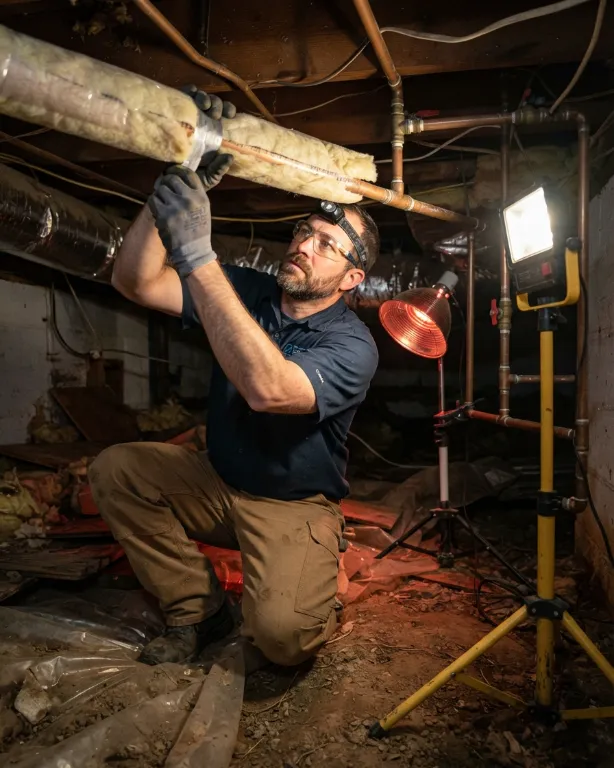
Tell us which fixtures have flow and which do not. That alone narrows down where the ice is.
A middling winter is the dangerous kind
Houses in genuinely cold states are built for it: plumbing runs inside the thermal envelope, crawl spaces are conditioned, and everyone owns a pipe sleeve. Virginia houses are built for a climate that is mild about eleven months of the year, so the plumbing lives in places that are fine until the one night it is not.
The pipe does not burst because the water froze. It bursts because the ice plug pressurised the water on the other side of it.
That last point is worth understanding, because it explains almost everything about frozen pipe damage. Water expands roughly nine per cent as it freezes, but a pipe rarely splits at the ice itself. What happens is that the ice forms a plug, and as it grows it drives the water between the plug and the closed tap into a smaller and smaller space. Pressure in that trapped section climbs until the weakest point in the run, often a fitting or an old solder joint several feet away, gives out. Open the tap and that pressure has somewhere to go, which is why an open faucet is the single most effective thing a homeowner can do.
Regionally, the exposure varies more than people expect. Northern Virginia and the Shenandoah Valley see the most sustained sub-freezing spells, and the Valley in particular gets wind that strips heat out of a crawl space fast. The Piedmont and Southside get sharp overnight drops with milder days, which produces repeated freeze-thaw cycles that work joints loose over several winters. Hampton Roads freezes less often but has the least prepared housing stock, so the cold snaps that do arrive produce a disproportionate number of calls. Nowhere in our 180-community service area is exempt.
Tell us where your pipes run and we will tell you which parts are exposed.
Where the ice forms
Freezes are boringly predictable. In fifteen years of cold-snap calls, the same six locations account for the overwhelming majority.
Supply lines run under the floor in open air, often with vents open to the outside and insulation that fell down years ago. Wind through a vented crawl space is the mechanism. It is not the air temperature so much as the moving air stripping heat off bare copper or CPVC. The runs furthest from the centre of the house go first.
The basement itself usually stays above freezing, but the lines that leave it do not. Pipes running through the rim joist, into an attached garage, or up an exterior wall to a second-floor bathroom are the ones that go. An uninsulated garage with a door left open on a cold night is a reliable way to lose a laundry line.
With no crawl space, supply lines in many slab-built subdivisions run up into the attic and back down to fixtures. An attic in a Virginia cold snap is essentially outdoors. Kitchen lines in a north-facing exterior wall are the other recurring failure, particularly behind a sink cabinet that keeps warm air out.
The most common freeze failure in the state, and the one people discover in April. A garden hose left connected traps water in the bib and in the pipe behind it, defeating even a frost-free spigot. Disconnect the hose. See outdoor hose bib and spigot repair.
A pump house or an unheated corner of a barn is a freeze waiting to happen, and losing the pressure tank takes the whole supply out rather than one fixture. Common across the Piedmont, the Valley and Southside.
Lake houses, properties on the market, and homes whose owners winter elsewhere. A split line in an occupied house runs for minutes. In an empty one it runs until someone happens to visit, and the difference is measured in tens of thousands of dollars.
A walkthrough before the first hard freeze costs a fraction of one burst line.
Method matters
Thawing is not complicated, but the wrong method turns a no-water morning into a fire or a flood. This is the part where doing nothing is genuinely better than doing the wrong thing.
| Method | Verdict | Why |
|---|---|---|
| Raising room temperature | Best first move | Slow, even and safe. Works on hidden runs you cannot reach, which is most of them. Combine with an open tap. |
| Hair dryer on low, moving | Acceptable, with care | Only on exposed, accessible pipe. Work from the tap end back toward the ice so meltwater can escape. Never leave it unattended. |
| Heat lamp or space heater at a distance | Acceptable, with care | Good for warming a crawl space corner. Keep well clear of joists, insulation and anything combustible, and never run it unsupervised overnight. |
| Electrical heat tape | Prevention, not rescue | Excellent installed correctly in autumn. Improvising it on a frozen line in the dark is how it gets wrapped over itself and overheats. |
| Propane torch or open flame | Never | Causes house fires every winter, and superheats one spot until the pipe splits or a solder joint lets go. There is no version of this that is a good idea. |
| Boiling water poured over the pipe | No | Thermal shock cracks CPVC and stresses old copper joints, and you have now added water to a space that is about to have more. |
Most frozen pipes in Virginia are inside a wall, under a floor or in a vented crawl space, which means there is no safe DIY method at all, only warming the space and waiting. That is the point at which a plumber with a proper thawing setup and a camera is not an indulgence, it is the cheaper option.
Controlled heat, the whole run checked, and someone watching when the flow returns.
The second half of the job
This is the part homeowners are not warned about often enough. A frozen section that has cracked will not leak while it is frozen, because the ice is sealing its own damage. Flow returns, everyone relaxes, and forty minutes later water is coming through a kitchen ceiling.
So a proper frozen pipe call does not end when water runs again. The plumber brings the system back up to pressure and then checks the whole exposed run, not just the section that was iced, because the split is frequently several feet away at a fitting, where the trapped pressure went. On copper, look for a longitudinal bulge or a hairline split along the pipe. On CPVC, a clean crack or a separated joint. On PEX, often nothing at all, because PEX expands and usually survives, but the brass fittings at each end do not.
If a split is found, the repair is straightforward: cut out the damaged section, replace it, pressure-test, and then deal with the reason it froze. If nothing is found, the run is still worth watching for a day, and any wet insulation should come out rather than be left to sit against a joist all winter.
Thawing without checking for splits is half a job, and the expensive half is the other one.
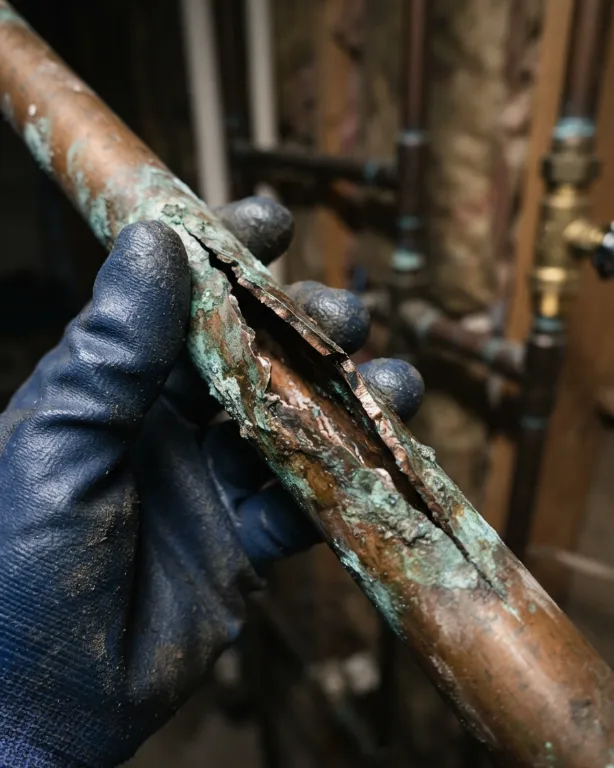
After a thaw, check the ceiling under any pipe run for staining or a soft patch, and check the crawl space floor for fresh wet ground. Both show up long before a drip does.
Cheap now, expensive later
A pipe that froze has told you precisely where your building envelope is weak. Acting on that is an hour of work and it holds for years.
Foam sleeves on every accessible line in a crawl space, garage, attic or rim joist. Cheap, fast, and effective. Provided it actually covers the joints and elbows rather than stopping short of them, which is where most DIY insulation fails.
Insulation slows heat loss; air sealing stops the wind that causes it. Closing crawl space vents in winter, sealing the gap where a line passes through a rim joist, and fixing a garage door that no longer seals often matter more than the sleeve itself.
Disconnect every hose, shut and drain the interior valves that feed exterior spigots, and replace any bib that already weeps. Then, in a hard freeze, drip the fixtures on the most exposed runs and open the cabinets beneath them.
For a full walkthrough of what to insulate, where heat tape genuinely earns its place, and how to winterise a property that sits empty, see pipe insulation and freeze protection. If your line has already burst rather than merely frozen, go straight to burst pipe repair.
Autumn is the cheapest month of the year to buy plumbing, and the most useful.
Cold weather questions
Every winter, in every part of the state. Virginia does not get Minnesota cold, and that is exactly the problem. Houses here are built with less margin, more plumbing runs through unconditioned crawl spaces and garage walls, and nobody expects it. A single night in the teens with wind is enough to freeze an exposed line in a Roanoke crawl space or a Fairfax garage wall.
The classic signs are one fixture with no flow while the rest of the house is fine, a trickle that will not build, frost or condensation on an exposed pipe, and a strange smell from a drain. If the whole house has lost water in freezing weather and you are on municipal supply, the freeze is likely at the point where the line enters the building or in an unheated crawl space.
Sometimes, carefully, on an exposed and accessible pipe. Working from the fixture end back toward the frozen section with the tap open. What you must never use is an open flame, a propane torch or a heat gun on full. Torch thawing is a leading cause of house fires in cold snaps, and rapid uneven heating can split a pipe that would otherwise have survived.
Because ice expanding inside a pipe often cracks the wall without the water escaping. The ice itself is plugging the hole. The leak appears the moment the plug melts, which may be hours after you have gone back to bed thinking the crisis passed. That is why a thawed line should be watched under pressure, not just declared fixed.
Anything in unconditioned space. Crawl space runs are the biggest single category statewide, followed by garage walls, exterior-wall kitchen and laundry lines, attic runs in houses with upstairs bathrooms, and hose bibs left connected to a garden hose. In older homes, uninsulated lines against a north-facing exterior wall are a recurring offender.
Almost certainly, unless something changes. A pipe that froze once has told you exactly where the weak point in the building envelope is. The fix is usually cheap, insulation, an air seal, sometimes heat tape or rerouting a short run, and much cheaper than repeating the emergency. See pipe insulation and freeze protection.
A slow drip on the fixtures served by the most exposed runs genuinely helps, because moving water is much harder to freeze and a dripping tap relieves the pressure that actually splits pipes. It is not a substitute for insulation, and it does nothing for a line that has already frozen solid.
Vacation homes around Smith Mountain Lake, hunt-country properties and houses on the market are where the worst freeze damage happens, because nobody is there when it starts. Either keep the heat on at a genuine minimum rather than off, or have the system properly winterised and drained. A burst line in an empty house runs for days.
Yes. On a well, the vulnerable points are the pressure tank and the exposed pipework around it, often sitting in an unheated basement corner, a well house or a crawl space. Freezing there can take out the whole water supply and, if the pump keeps trying to run against a blockage, damage more than the pipe. See well pump and water system service.
No water at all in freezing weather is a call-now situation, yes, both because the household needs water and because an unattended freeze becomes a burst. If it is one fixture, the house is warm and you can isolate it, a morning appointment is usually fine and cheaper.
Related work
Frozen pipe calls rarely arrive alone. These are the pages homeowners read next.
When the thaw reveals a split. Containment, repair and checking the rest of the run.
Read moreThe autumn work that makes next winter uneventful.
Read moreNo water at all, or water you cannot stop. Answered around the clock.
Read moreWhere most Virginia freezes happen, and where the repair actually takes place.
Read moreThe fixture most likely to have split over winter and be discovered in April.
Read morePressure tanks and well houses are their own freeze risk on rural properties.
Read moreCold snap, any county
An unattended freeze becomes a burst, and a burst in an empty room runs for hours. Call and we will get a local pro to you with the right equipment.
(866) 683-0244Winter no-water calls are prioritised across all six Virginia regions.