Hydro Jetting
Strips roots back into the joint and flushes the debris away.
Read more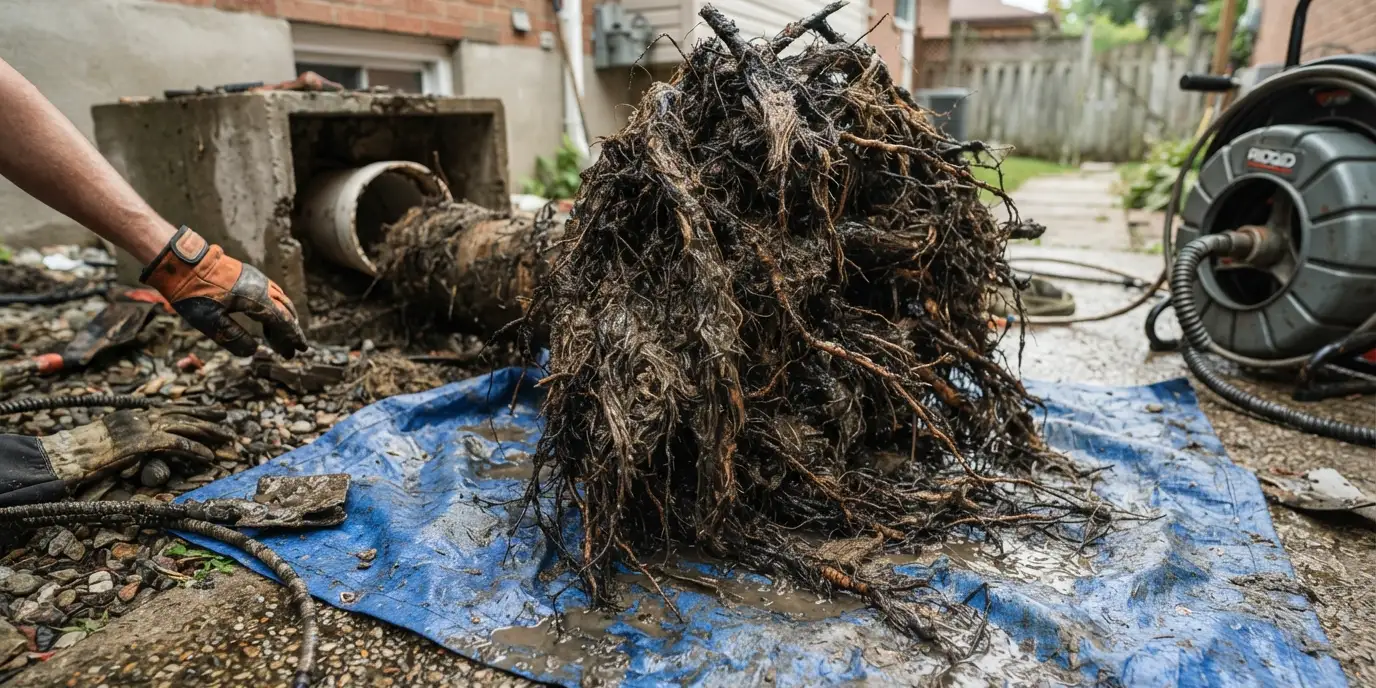
Spring and autumn, every year
Roots are the most common reason a Virginia sewer line fails, and cutting them back is an annual subscription unless somebody deals with the joint they are entering through.
Same-day clearance when it is blocking. The permanent conversation can wait until it is flowing.
How it happens
This is the thing most people have backwards. A tree root cannot penetrate sound pipe wall. What it does is find a joint that is already imperfect, a mortar joint in old clay that has degraded, a rubber gasket that has hardened, a coupling that has shifted a few millimetres with the ground, and grow through the gap.
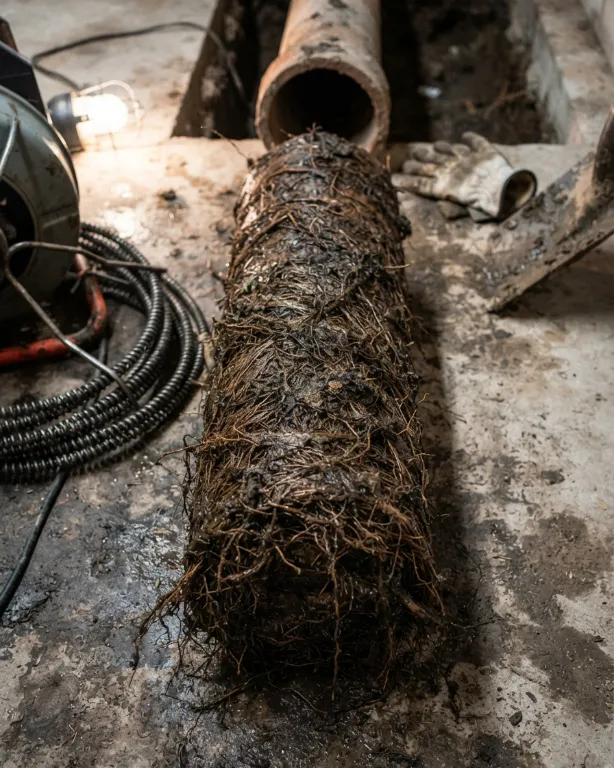
What draws it there is water vapour. A sewer line carries warm, humid, nutrient-rich air, and in a Virginia summer that plume leaking from a joint is the most attractive thing in the soil profile for several metres around. A single hair root arrives, finds ideal conditions, and thickens. Within a few years it is a mass shaped like the inside of the pipe, catching every solid that passes.
Which is why cutting is temporary. Shearing the mass off at the wall leaves the root system outside entirely intact and the joint exactly as open as it was. It regrows, usually faster than before, because a pruned root responds by putting out more growth. The line blocks again in twelve to eighteen months, and often sooner.
Clearance first if it is blocking. Then a conversation about not doing this again next spring.
Usual suspects
It is rarely the tree directly above. Root systems commonly extend two to three times the canopy width.
Water-seeking, fast-growing and utterly indifferent to what is in the way. A willow within fifty feet of a lateral will find it.
Common in older Virginia neighbourhoods and a frequent cause. Surface-rooting, which puts the root plate at lateral depth.
Less aggressive than maple, but a mature oak has an enormous root system and decades of patience. Very common in Piedmont and Northern Virginia yards.
Widely planted through the 1970s and 1980s across suburban Virginia and now mature. Dense fibrous roots at exactly the wrong depth.
Both put on volume quickly and both are found along older Virginia streets and creek-adjacent lots.
A large boxwood, holly or privet hedge over the line contributes more than people expect, particularly to shallow laterals.
The species and its distance narrow down where the entry point is likely to be.
Diagnosis
Root intrusion has a distinctive pattern, and it is usually recognisable from the history alone before anyone puts a camera down the line.
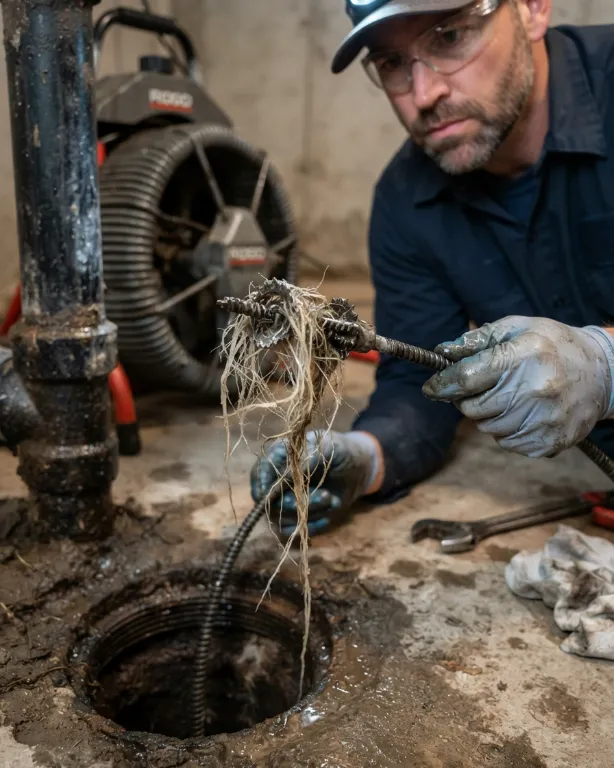
A camera survey confirms it and, more importantly, locates the specific joint. That distance reading is what turns roots from a recurring annoyance into a fixable, priced problem.
The entry point, the distance and the depth. Then you can decide properly.
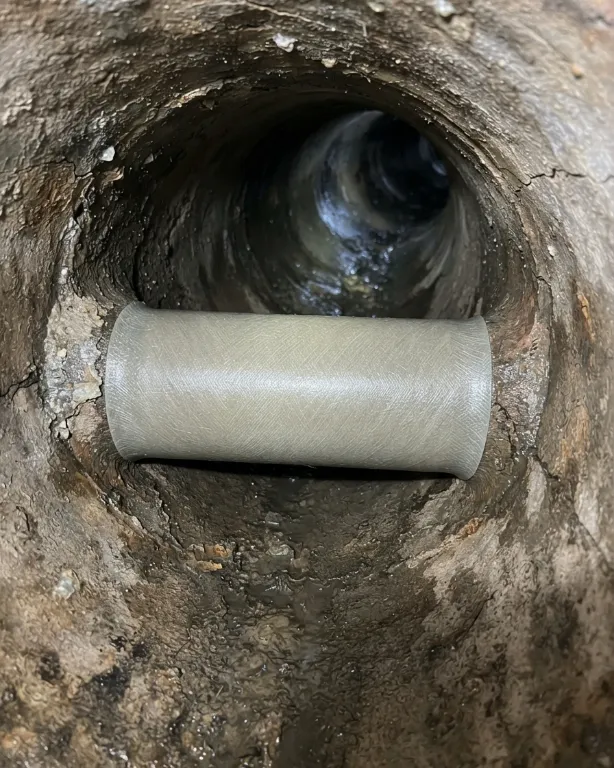
Most root problems are a single failed joint, not a whole degraded line. That makes the permanent fix much cheaper than people fear.
Getting it flowing
All three restore flow. None of them stops the roots coming back, and you should be told that at the time.
Cutting roots is maintenance. It is a perfectly reasonable choice, as long as you know that is what you are buying.
| Method | How it works | Typical interval before it returns |
|---|---|---|
| Cable with a cutting head | A rotating blade shears the mass off at the pipe wall | Twelve to eighteen months |
| Jetting with a root nozzle | Strips roots back into the joint and flushes the debris out | Eighteen months to three years |
| Mechanical root saw | A larger powered cutter for a heavily established mass | Twelve to twenty-four months |
| Foaming root treatment | A herbicide foam that kills root tissue in contact with the pipe | Twelve to twenty-four months; not permitted everywhere |
| Lining the joint | Seals the entry point so nothing can enter | Permanent for the lined section |
We will get it flowing today and give you the options in writing afterwards.
The permanent answer
There are only two durable solutions, and both work on the same principle: remove the opening. A root cannot enter a joint that no longer exists.
Sectional lining. Where the camera shows one bad joint in an otherwise sound pipe, a short cured-in-place liner is set across it. The joint is sealed permanently, the rest of the line is untouched, and the job is frequently done in a day from a single access point. For a single-joint problem this is usually the best value repair in the whole sewer catalogue.
Full-length lining. Where multiple joints have failed, common in an old clay lateral where every joint is the same age and in the same condition, a full liner converts the entire run into a single jointless pipe. Nothing left to enter. See trenchless sewer repair.
Replacement. Where the pipe is deformed, collapsed or bellied as well as root-invaded, the section comes out. Modern PVC with solvent-welded or properly gasketed joints is far less vulnerable, though not immortal. See sewer line repair.
What does not work permanently: copper sulphate crystals down the toilet, rock salt, foaming treatments used as a standalone strategy, and removing the tree. That last one surprises people. The roots remain in the ground and the joint is still open, so a different tree simply finds it later.
Sectional lining on a single joint is often cheaper than three more clearances.
The joint stays open and the roots stay in the ground. Take a tree out for tree reasons, not as a plumbing repair.
Practical
Most people do not want to lose a mature oak to protect a pipe, and they should not have to.
Three to five years on a clay lateral with mature trees is the sensible rhythm.
Common questions
They do not break through sound pipe. They find an existing gap, a degraded mortar joint in old clay, a hardened rubber gasket, a shifted coupling, and grow through it, drawn by the warm, humid, nutrient-rich air escaping from the line. That is why the fix is always about the joint rather than about the tree.
A cabling visit with a cutting head is priced like a standard main line clearance. Jetting with a root nozzle is higher but lasts considerably longer. A sectional liner over the offending joint is a four-figure job, and it is the only one of the three you should expect to pay for once.
Typically twelve to eighteen months after cabling, and eighteen months to three years after jetting. The interval shortens over time, because each cut prompts the root to regrow more densely and the joint continues to degrade. If you are on an annual cycle, the arithmetic already favours the permanent fix.
Marginally, and not as a solution. It kills root tissue it comes into direct contact with, but sewage flows along the bottom of a pipe and most of the mass is never wetted by it. It also does nothing about the open joint. Some Virginia localities restrict its disposal into the sewer system; check before using it.
Rarely, as a plumbing decision. The roots already in the ground remain, the joint stays open, and another tree or shrub eventually exploits it. Removing a mature tree is a significant loss to a property and it does not repair a pipe. Deal with the joint instead.
Willow by a distance, then silver maple, poplar and sycamore. Bradford pear, planted along enormous numbers of Virginia streets in the 1970s and 1980s, is now mature and a frequent culprit. Oaks are slower but their sheer size makes them a common finding. Large hedges contribute more than most people expect.
Yes, by removing the opening. A cured-in-place liner across the joint, or a full-length liner, leaves nothing for a root to enter through. Within the lined section the problem is genuinely over. See trenchless sewer repair.
Generally not. Standard homeowner policies treat root intrusion as a maintenance issue rather than sudden damage. Some insurers offer a service line endorsement that may respond, and some water utilities offer optional lateral protection plans. Worth reading your declarations page rather than assuming.
The pattern gives it away: seasonal, recurring on a fairly regular interval, affecting the whole house rather than one fixture, and the cable comes back with root hair on it. A camera survey confirms it and locates the joint, which is the piece of information you actually need.
In most of Virginia, yes. If the line is backing up into the house we treat it as an emergency and respond around the clock. The permanent repair is a separate, scheduled conversation once the water is going the right way again.
Related work
Roots sit at the intersection of three services. These are the ones that matter.
Strips roots back into the joint and flushes the debris away.
Read moreFinds the joint they are entering through, and how far along it sits.
Read moreLining the joint, which is the only permanent answer.
Read moreSame blockage every spring?
We will clear it today and price the permanent fix afterwards, with footage showing exactly which joint is the problem. One call, anywhere in Virginia.
(866) 683-0244Same-day clearance, 24/7 for backups.