Whole-Home Repiping
The full repipe process, material comparison, and what a house looks like during the work.
Read more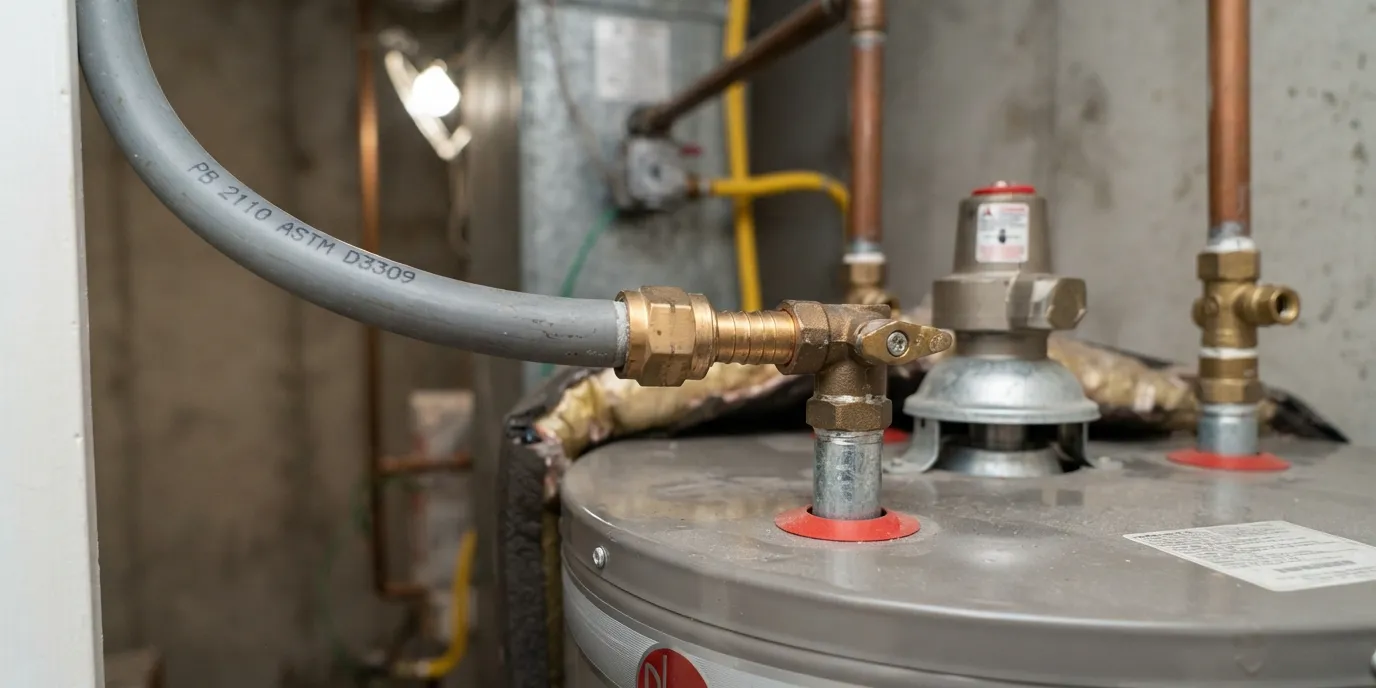
Repipe · Statewide
If your house was built or plumbed between about 1978 and 1996, there is a real chance the grey plastic pipe behind your walls is polybutylene. It does not wear out evenly. It fails suddenly, usually at a fitting, usually with no warning at all.
Tell us the year the house was built and what colour the pipe is at the water heater. That is usually enough to narrow it down on the phone.
Dollar ranges here are typical Virginia costs, given for planning only. They are not a quote. The independent plumber who takes your job sets the price and gives it to you before work begins.
The material
Polybutylene was a good idea on paper. It was cheap, flexible, quick to install, and it did not corrode. What nobody accounted for was what chlorinated municipal water does to it over fifteen or twenty years.
Polybutylene is a soft grey or, less often, silver-grey plastic, typically half-inch or three-quarter-inch, usually marked PB2110 along its length. It was joined with acetal plastic or copper crimp fittings held by aluminium or copper crimp rings. Between roughly 1978 and 1996 it went into somewhere between six and ten million American homes, and Virginia, with a building boom across Northern Virginia, the Fredericksburg corridor and the Richmond suburbs during exactly those years. Took a very large share of it.
The failure mechanism is oxidative. Chlorine and chloramine in treated water attack the inner wall of the pipe and the acetal fittings, breaking the polymer chains. Microscopic cracks form on the inside surface and propagate outward. From the outside, the pipe looks entirely fine, no green corrosion, no staining, no bulging. Inside, it is becoming brittle. Then a fitting lets go, or a length splits, and a half-inch line at fifty-five psi puts several hundred gallons an hour into a wall cavity.
The fittings usually go first. Acetal plastic insert fittings are the weakest point in the system, and aluminium crimp rings compound the problem by corroding where they contact the fitting. Systems installed with copper insert fittings and copper rings have lasted noticeably better, but "better" here means later, not indefinitely. Every polybutylene system installed in the 1980s is now thirty-five to forty-five years old and past any reasonable service expectation.
There is no repair that restores it. You cannot line it, treat it, or reduce the chlorine enough to stop the process. Patching a failed section leaves you with the same pipe everywhere else, at the same age, in the same condition. That is why the answer to polybutylene is a repipe and not a repair.
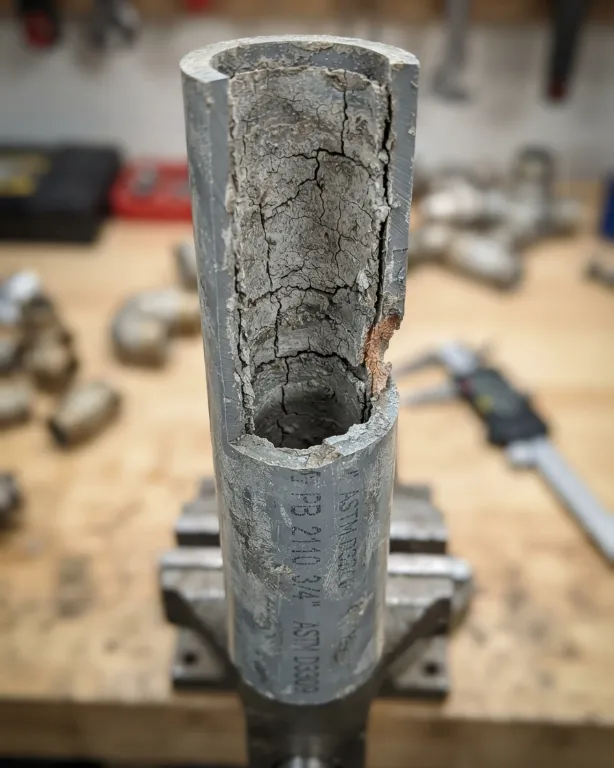
Do not judge polybutylene by appearance. A pipe that looks new can be within months of splitting. Age and material are the only useful indicators.
If you know the pipe is grey plastic, the next call is about scheduling rather than diagnosis.
Identification
Four places to look, none of which require opening a wall.
Supply and return lines at the water heater are almost always exposed. Polybutylene there is grey, slightly flexible, and stamped PB2110. Copper is obvious. White or red-and-blue plastic is PEX, which is a different and entirely sound material.
Follow the line from the meter or the main shutoff where it enters the house, often in a basement, a utility closet, or a crawl space. Grey plastic at the entry point means the whole distribution system is probably the same.
Stub-outs at fixtures were often changed out over the years, so copper under one sink does not clear the house. But grey plastic at a stub-out is conclusive the other way.
Some Virginia homes have polybutylene service lines from the meter to the house as well as interior distribution. A blue or grey plastic service line is worth identifying separately. See main water line repair.
That window is the strongest single predictor. Houses built after 1996 will not have it. Houses built between 1985 and 1993 in fast-growing Virginia counties have the highest incidence of all.
PEX is white, red, blue or occasionally orange, and is a current, code-approved material. CPVC is cream or off-white and rigid. Neither is a polybutylene problem. If a previous owner repiped, you may find a mix, and a partial repipe leaves partial risk.
| Material | Colour | Feel | Markings | Action needed |
|---|---|---|---|---|
| Polybutylene | Grey, silver-grey, occasionally blue or black outdoors | Soft, flexible, dents under a thumbnail | PB2110 | Full repipe |
| PEX | White, red, blue, orange | Flexible, springs back | PEX-A / PEX-B, ASTM F876 | None. Current material |
| CPVC | Cream, off-white | Rigid, brittle if old | CPVC 4120 | Monitor; ages but not defective |
| Copper | Copper or green-patinated | Rigid metal | Type L / Type M stamp | Monitor for pinholes |
| Galvanised steel | Dull grey metal, threaded joints | Rigid, heavy, rusty at threads | None typically | Plan replacement. See historic-home plumbing |
Describe what you see at the water heater and we will tell you whether it needs a repipe or a watch.
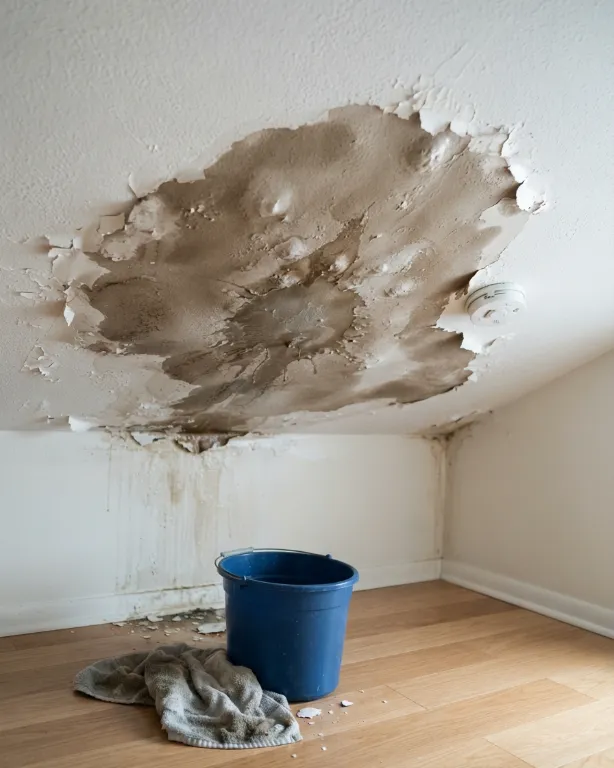
Shut the main off at the meter or the interior shutoff before anything else, then call. A polybutylene failure is an emergency plumbing call, and the priority order is stop the water, then dry the structure, then plan the repipe.
Symptoms
There is often no warning period. When there is, it is short.
The classic polybutylene failure is a fitting separating inside a wall or ceiling cavity while nobody is home. The first sign is a stain, a bulging patch of drywall, or water running down a wall from above. Because the pipe is under constant pressure the volume is large. A half-inch supply line discharges roughly six to ten gallons a minute, so an eight-hour absence puts thousands of gallons into a floor structure.
Where there is a warning, it tends to be one of these:
Because the water is clean and pressurised, it travels. A failure in a second-floor wall commonly shows first as a stain on a first-floor ceiling ten feet away, and the break is nowhere near the wet drywall. That is what leak detection is for. Acoustic and thermal work narrows the opening from a whole wall to a two-foot square before anything is cut.
Slab-on-grade homes with polybutylene under the slab are a separate case. There the water may not appear indoors at all; it shows as a warm patch on the floor, a running sound with all fixtures off, or a soft spot in landscaping outside. See slab leak repair.
Ownership and resale
This is where polybutylene stops being a plumbing question and becomes a property question.
The class-action settlement that once funded polybutylene replacement. Cox v. Shell Oil. Closed to new claims in 2009. There is no manufacturer money available now. Replacement is a homeowner cost.
Insurance treatment varies by carrier and has hardened over the last decade. Practical patterns worth knowing:
| Situation | Common outcome | What helps |
|---|---|---|
| Applying for a new homeowner policy | Some carriers decline, some surcharge, some require replacement within a set period | A dated repipe invoice and permit record |
| Renewal on an existing policy | Usually continues, but a paid claim can trigger non-renewal | Documented repair history |
| Claim for water damage from a PB failure | Damage is often covered; the pipe itself is not | Prompt mitigation and photographs before demolition |
| Selling the house | Virginia residential disclosure practice means known material defects should be disclosed; buyers and their inspectors routinely identify PB | A completed repipe removes the negotiation entirely |
| Buyer requesting a credit | Credits are commonly negotiated at or above true repipe cost | Getting the work done and priced yourself |
| Home inspection before purchase | PB is flagged, usually with a recommendation for full replacement | A sewer camera inspection and supply-material check before closing |
The pattern we see most often: a homeowner intends to deal with it "eventually", a fitting fails, the claim is paid, the policy is not renewed, and the repipe happens anyway. After the water damage rather than before it. Doing it on your own schedule is materially cheaper than doing it on the pipe's schedule, because you are paying for pipe rather than for pipe plus drywall, flooring, cabinetry and remediation.
Buyers price polybutylene into their offer. A finished repipe takes that lever away.
The work
A whole-house repipe replaces every supply line from the point of entry to every fixture. Drains are not touched.
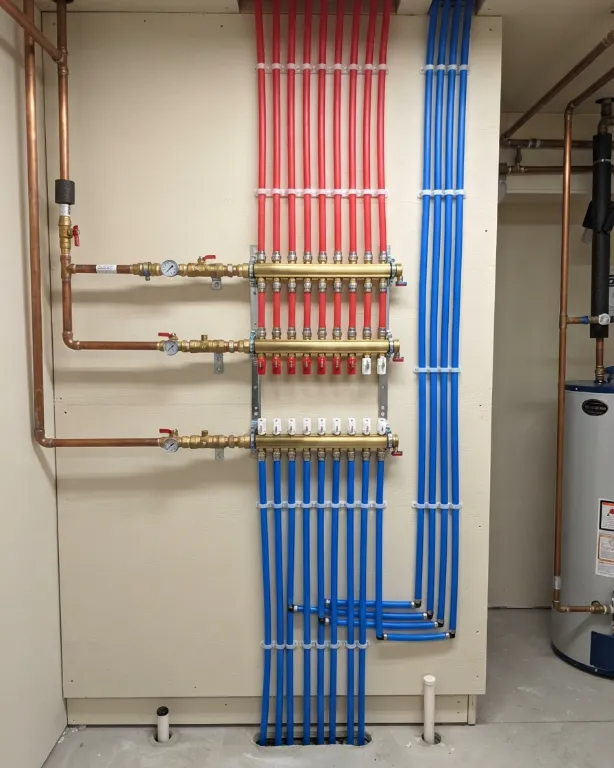
A repipe under a slab or in a sealed cavity leaves dead polybutylene in place. That is fine, it is depressurised and harmless, but it should be written into the scope so nobody is surprised at resale.
While walls are open it is cheap to add shutoffs at every fixture, replace a failing pressure regulator, relocate a laundry box, or run a line for a future bathroom. Bundling saves a second round of access holes.
Cost and timeline
Ranges below are typical Virginia figures for planning. A walkthrough produces the real number.
| House | Fixtures / baths | Typical range | Days on site |
|---|---|---|---|
| Single-storey, slab, 1,200. 1,600 sq ft | 1. 2 baths | $4,500. $8,500 | 2. 3 |
| Single-storey with crawl space, 1,600. 2,200 sq ft | 2 baths | $5,500. $10,000 | 2. 3 |
| Two-storey with basement, 2,000. 2,800 sq ft | 2.5. 3 baths | $8,000. $15,000 | 3. 4 |
| Two-storey, slab, 2,400. 3,200 sq ft | 3 baths | $10,000. $18,000 | 4. 5 |
| Larger or multi-zone, 3,200+ sq ft | 3.5+ baths | $14,000. $25,000+ | 4. 6 |
What moves the number: slab construction versus crawl space or basement (slab is dearer, because routing has to go up and over rather than underneath), number of bathrooms, whether the house is single or multi-storey, plaster versus drywall, tile and stone surfaces near stub-outs, and whether drywall finishing and paint are inside the quote or outside it. Ask specifically where the quote stops. "patch" and "paint-ready" and "painted" are three different prices.
You will be without water for parts of each day, generally not overnight. Most households stay in the house through a repipe. Expect dust, expect furniture moved away from walls, and expect a day or two of drywall work after the plumbing is signed off.
Afterwards, pressure often improves, polybutylene systems are frequently restricted at the fittings, and you may find you need a pressure regulator checked or set, because the new system passes what the street actually delivers. It is also a sensible moment to look at the water heater: if it is over ten years old, replacing it while the connections are already open avoids paying twice for the same access.
Questions
Look at the pipes entering and leaving the water heater and at the main shutoff. Polybutylene is grey (occasionally silver-grey), soft enough to dent with a thumbnail, and usually stamped PB2110 along its length. Houses built or replumbed between 1978 and 1996 are the ones at risk. If those spots show copper, white or red-and-blue PEX, or cream-coloured CPVC, you do not have a polybutylene problem.
An individual failure can be repaired. The split section is cut out and a proper transition fitting joins new pipe to old. But that leaves the rest of the system at the same age and in the same condition, and repeat failures are the norm rather than the exception. Repairs make sense as a stopgap to stop water today; they are not a substitute for a repipe.
It is no longer an approved material under current plumbing codes, so it cannot be installed in new work. Existing installations are not illegal and you are not required to remove them. The pressure to replace comes from insurers, buyers and the failure rate, not from a legal order.
Almost never. Homeowner policies cover sudden accidental water damage, not the replacement of a pipe system that is failing because of its material. Some carriers will decline to write or renew a policy on a house with polybutylene, which is a strong practical reason to replace it, but the pipe cost itself sits with the owner.
No. The Cox v. Shell Oil settlement closed to new claims in 2009. Anyone offering to file a claim on your behalf is describing a programme that no longer exists.
Far less than people expect. A planned repipe routes through attics, basements, crawl spaces and closets, and cuts small access openings only where a line has to turn or terminate. A typical two-storey house sees fifteen to thirty openings, most of them the size of a sheet of paper, high on the wall or inside a cabinet.
Water is off for parts of each working day and generally back on overnight. Most families stay in the house for the whole job. Tell the plumber in advance if someone works from home, if there is a baby in the house, or if anyone has a medical need for uninterrupted water. The sequencing can usually be adjusted around it.
PEX is the standard choice for repipes and for good reason: it is flexible enough to pull through existing cavities with fewer access holes, it does not corrode, it tolerates a freeze far better than copper, and it costs less. Copper still makes sense for exposed runs and short sections at the water heater. The comparison is set out in full on our whole-home repiping page.
No. A whole-house repipe replaces distribution inside the house from the point of entry onward. The service line from the meter to the house is a separate job. See main water line repair. Some Virginia homes have polybutylene service lines as well, in which case both are worth doing at once while the excavation is open.
It depends on the market you are in, but the arithmetic usually favours repiping. Buyers and their inspectors will find the pipe, and negotiated credits tend to land at or above the true cost of the work, while a completed, permitted repipe removes the issue from the inspection report and from the conversation. Get a quote before you list so you at least know both numbers.
Related work
Polybutylene sits inside a wider set of supply and pressure questions. These are the pages homeowners read alongside it.
The full repipe process, material comparison, and what a house looks like during the work.
Read moreA new system passes what the street delivers. Pressure often needs setting afterwards.
Read moreFinding a pressurised leak inside a wall before anything is cut open.
Read moreNext step
A five-minute look at the water heater and the main shutoff settles the material question. From there it is a scheduling conversation, not a diagnosis.
(866) 683-0244Statewide, 24 hours. Independent licensed professionals.