Water Heater Repair
Relief valve discharge, thermal expansion and what pressure does to a tank.
Read more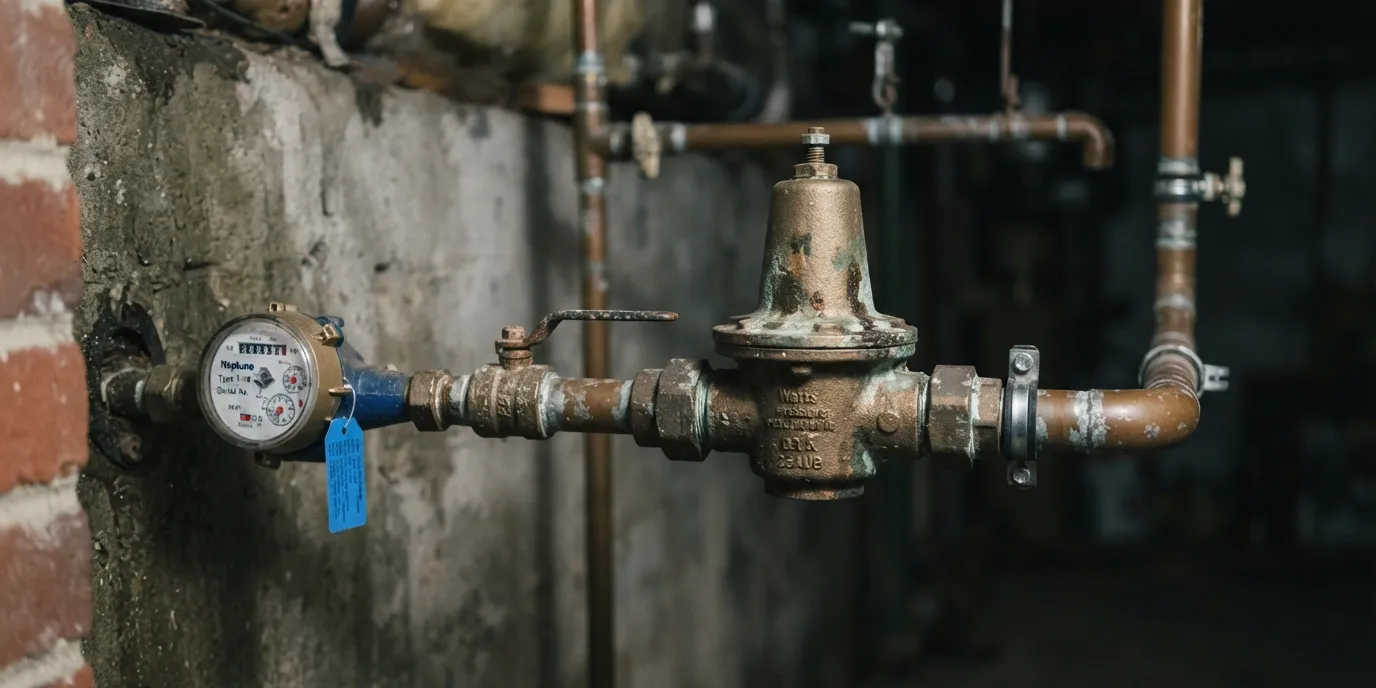
Pressure · Statewide
Most homeowners think about water pressure only when there is not enough. The expensive problem is the opposite: too much. Pressure above eighty psi shortens the life of everything downstream of it, and the valve that is supposed to prevent that is a wearing part with a fifteen-year life.
A $12 gauge on an outside hose bib gives you the number in thirty seconds. Tell us what it reads and we can be specific.
Dollar ranges here are typical Virginia costs, given for planning only. They are not a quote. The independent plumber who takes your job sets the price and gives it to you before work begins.
The stakes
Pressure is the one plumbing variable that acts on every fixture, joint and appliance in the house simultaneously, every second of the day.
Municipal water systems do not deliver a comfortable domestic pressure. They deliver whatever the distribution network needs to reach the top of the highest building and to supply fire flow. Commonly 80 to 150 psi in Virginia, and higher in parts of hilly localities where the main serves properties well below the storage tank. Some Northern Virginia and Shenandoah Valley neighbourhoods see street pressure well above 120 psi.
The plumbing code caps static pressure at fixtures at 80 psi, and requires a pressure reducing valve where street pressure exceeds that. Eighty is a ceiling, not a target. Most houses are comfortable between 50 and 65 psi, and every psi above that is doing damage you will pay for later:
The reverse case, genuinely low pressure, is far more often a pipe problem than a regulator problem. If pressure is poor and the house is older, read historic home plumbing first: galvanised steel that has closed up internally cannot be fixed at the valve.
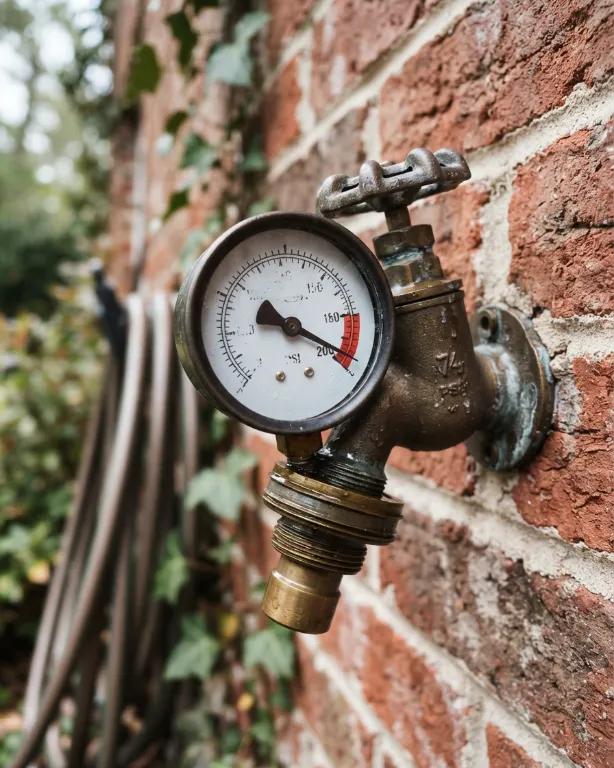
50 to 65 psi static, measured with all fixtures off. Under 40 feels weak. Over 80 is out of code and is shortening the life of everything in the house.
If you have a reading, tell us the number. If you do not, we will bring a gauge.
Diagnosis
This is the rare plumbing diagnostic a homeowner can do completely, accurately, and for the price of a sandwich.
| Static reading | Interpretation | Action |
|---|---|---|
| Below 40 psi | Low. Restriction, undersized service line, or a regulator failing closed | Investigate pipe and service line before the valve |
| 40. 50 psi | Adequate but unremarkable | Optional adjustment upward if a regulator is present |
| 50. 65 psi | Ideal domestic range | None |
| 65. 80 psi | High, still within code | Consider adjusting down to extend fixture life |
| 80. 100 psi | Out of code | Install or replace a regulator |
| Over 100 psi | Actively damaging | Regulator work, and check the expansion tank |
| Overnight max far above daytime | Thermal expansion in a closed system, or nightly municipal rise | Regulator plus expansion tank |
Daytime static and overnight maximum. Those two figures identify the problem more reliably than anything else.
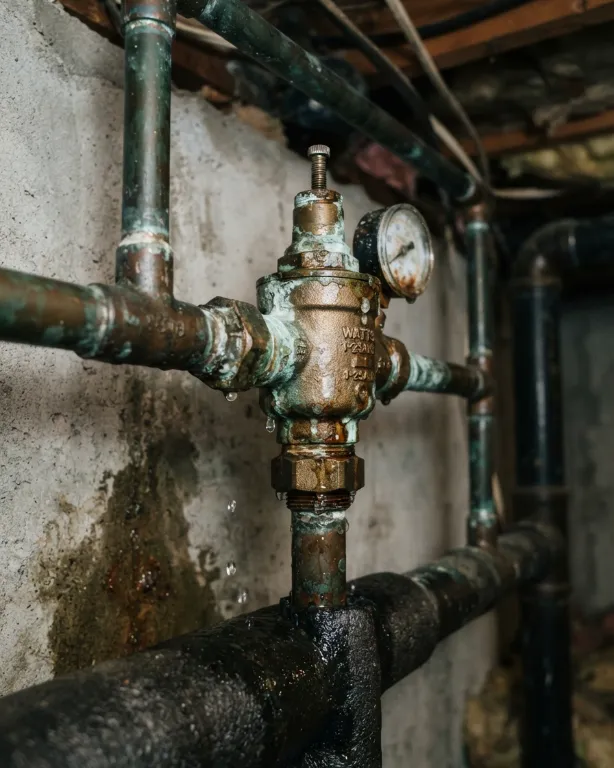
A regulator that fails open dumps full street pressure into the house without warning. If pressure suddenly feels much stronger, or fixtures start hammering, test it that day. This is how water heaters and washing machine hoses fail.
Symptoms
Regulators fail in two directions, and the two present completely differently.
Failing open. The diaphragm or seat wears and the valve stops restricting, so street pressure passes straight through. You will notice:
Failing closed. Internal parts scale up or the spring loses tension and the valve chokes flow. You will notice:
Weeping or seized is the third pattern. Older brass regulators corrode at the bonnet and begin to weep; some seize entirely, so adjustment does nothing. If turning the adjustment screw produces no change on the gauge after a few minutes of running water, the valve is done.
One important distinction: whole-house low pressure that developed slowly over years is usually pipe, not valve. Whole-house pressure change over days or weeks is usually valve. And low pressure at one fixture only is neither. That is an aerator, a cartridge or a supply stop, and it belongs on faucet and fixture installation.
Mechanism
Knowing what is inside explains why it wears out and why adjustment is not always the answer.
A spring pushes down on a diaphragm. The adjustment screw compresses or relaxes that spring, which sets the outlet pressure the valve will hold. Springs lose tension with age, which is why a valve that held 55 psi for a decade drifts.
Outlet pressure acts on the underside of the diaphragm. When downstream pressure reaches the set point, the diaphragm lifts and closes the valve against the seat. Diaphragms perforate; seats erode from grit and chlorine. This is the usual failure.
Most regulators have an internal screen. In areas with sediment or after main work, the screen loads up and the valve behaves as if it has failed closed. Some models allow cleaning; many do not.
Once a regulator is fitted, water cannot push back into the street main. Heated water then has nowhere to expand, so pressure spikes every time the water heater fires. This is why a regulator without a thermal expansion tank causes relief valve discharge and tank stress.
A regulator belongs immediately downstream of the main shutoff, before any branch. Fitted after a branch, part of the house stays on street pressure. A surprisingly common error found on older installations and DIY work.
You can adjust a healthy valve. You cannot adjust a perforated diaphragm, an eroded seat, or a seized bonnet. If the gauge does not respond to the screw, adjustment is not the fix.
Two things are routinely conflated with the regulator and are not it. A backflow preventer stops contaminated water re-entering the supply and does not control pressure. A thermal expansion tank absorbs the volume increase of heated water and does not reduce street pressure. A correctly configured Virginia house with high street pressure has all three concerns addressed: a regulator to reduce, an expansion tank to absorb, and appropriate backflow protection at irrigation and hose connections.
The work
Three levels of intervention, and how to tell which one you need.
| Situation | Right answer | Why |
|---|---|---|
| Pressure at 72 psi, valve under 8 years old, gauge responds to the screw | Adjust to 55. 60 | Healthy valve, simply set high |
| Pressure at 95 psi, valve responds but drifts back within weeks | Replace | Spring or diaphragm is losing its ability to hold |
| Gauge does not respond to adjustment at all | Replace | Diaphragm, seat or bonnet has failed |
| Valve weeping at the bonnet | Replace | Brass corrosion at the body; rebuild kits rarely address it |
| Low pressure, valve over 15 years old, sediment in area | Replace | Loaded strainer plus worn internals |
| No regulator present, street pressure over 80 psi | Install | Code requirement and immediate fixture protection |
| Regulator present but downstream of a branch | Relocate | Part of the house is unprotected |
Replacement is a straightforward job on an accessible main: water off at the meter, section of pipe cut out, new valve fitted with unions so the next one is easier, pressure set on a gauge with water running, then a hold-and-check. Half a day at most where the main is exposed in a basement or utility area. It becomes a bigger job where the valve sits in a meter pit, in a tight crawl space, or is buried behind finished work, which is an argument for having it done before it fails rather than after.
Ask for three things in the scope: unions on both sides, a gauge port or a tee for future testing, and the pressure set and demonstrated to you on a gauge before the plumber leaves. A valve installed without the pressure being set is a coin toss.
If the same visit is going to include a repipe or a water heater installation, do the regulator and expansion tank at the same time. All three touch the same few feet of pipe.
Half a day on an accessible main, and it protects every fixture in the house.
Cost
Small numbers relative to what high pressure costs you over a decade.
| Work | Typical range |
|---|---|
| Pressure test and adjustment of a healthy valve | $95. $200 |
| Regulator replacement, accessible basement main | $350. $700 |
| Regulator replacement, crawl space or tight access | $500. $950 |
| New regulator installed where none existed | $450. $1,100 |
| Thermal expansion tank added | $250. $550 |
| Regulator and expansion tank together | $600. $1,300 |
| Regulator in a meter pit or buried location | $900. $2,200 |
Set against that: a water heater cut short by five years, a set of faucet cartridges, three toilet fill valves and one burst washing machine hose will exceed the cost of a regulator and expansion tank several times over. Before counting the water damage from the hose.
If a regulator is fitted or replaced and the water heater is in a closed system, an expansion tank belongs in the same scope. Without one, thermal expansion produces exactly the pressure spikes the regulator was installed to prevent.
Localities replace mains, adjust zone pressures and change pump schedules. A house that read 58 psi three years ago can read 90 today without anything inside changing. Testing annually costs nothing once you own the gauge.
After a repipe or a polybutylene replacement, the system finally passes what the street delivers. Pressure should be re-tested and set as the last step of that job.
Questions
Between 50 and 65 psi static, measured with all fixtures off. The plumbing code allows up to 80 psi at fixtures but that is a maximum, not a goal. Below 40 psi feels weak at showers and when two fixtures run at once; above 80 psi is out of code and shortens the life of every valve, hose and appliance in the house.
Buy a brass hose-thread pressure gauge for about $12, thread it onto the exterior hose bib nearest where water enters the house, turn everything else off, and open the bib fully. That gives you static pressure. Then leave the gauge on overnight with the maximum-reading needle set. Night-time municipal rise and thermal expansion spikes are invisible during the day and are often the real problem.
It is a bell- or cone-shaped brass valve, usually four to six inches long with an adjustment screw and locking nut on top, fitted on the main line just after the main shutoff. Look where the water enters the house: a basement wall, a utility closet, a garage, a crawl space, or occasionally in the meter pit at the kerb. Many houses on lower-pressure streets have none at all, which is legitimate if street pressure is under 80 psi.
Ten to fifteen years is the usual working life, sometimes less in areas with sediment or aggressive water chemistry. They are wearing parts with a rubber diaphragm and a spring, and they fail gradually. If yours has an install date on it and that date is more than fifteen years ago, budget for it whether or not it is misbehaving yet.
On a healthy valve, yes, carefully: loosen the lock nut, turn the adjustment screw clockwise for more pressure and anticlockwise for less, a half turn at a time, with a gauge fitted and a tap briefly run between adjustments so the reading settles. Retighten the lock nut when finished. If the gauge does not respond, stop. The valve has failed internally and turning the screw further will not help.
Most often thermal expansion in a closed system. Once a regulator is fitted, heated water cannot expand back toward the street, so pressure spikes each time the heater fires and the relief valve does its job. The fix is a thermal expansion tank sized for the heater, not a new relief valve, though a valve that has discharged repeatedly often needs replacing too because it stops reseating cleanly.
Possibly, but check the pipe first. A regulator can fail closed or clog at its strainer, which produces gradual whole-house pressure loss. But in houses built before 1960, low pressure is far more often galvanised steel supply pipe that has closed up with internal rust. Test at the hose bib nearest the meter: if the pressure is fine there and poor inside, the problem is the pipe, not the valve.
A pressure reducing valve is required where the static street pressure exceeds 80 psi, which covers a great many Virginia neighbourhoods. Replacement is permitted work in most localities. If your street pressure is comfortably under 80, no regulator is required, though many owners fit one anyway to hold a steady 55 psi.
Yes, measurably. Flow through any opening increases with pressure, so identical behaviour at 100 psi uses noticeably more water than at 55 psi. Every shower, every tap, every flush. Reducing pressure to a sensible range is one of the few plumbing changes that pays for itself on the utility bill as well as in fixture life.
Yes, if there is a storage water heater in the house. The regulator closes the system, the closed system needs somewhere for heated water to expand, and the expansion tank provides it. Fitting the regulator alone commonly produces relief-valve dripping and pressure spikes within weeks. The two together are one visit and one set of connections.
Related work
Pressure touches most of the system. These are the pages it connects to most directly.
Relief valve discharge, thermal expansion and what pressure does to a tank.
Read moreWhen low pressure is the pipe rather than the valve, and what replacement involves.
Read moreHigh pressure accelerates hidden leaks. Finding them before the damage shows.
Read moreThirty seconds of work
Buy a gauge, thread it on the hose bib, read the number. If it is over 80, or if the overnight maximum is, call us and we will sort the valve.
(866) 683-0244Statewide, 24 hours. Independent licensed professionals.