Leak Detection
Finding the leak before opening anything. Meter tests, acoustic listening and thermal imaging.
Read more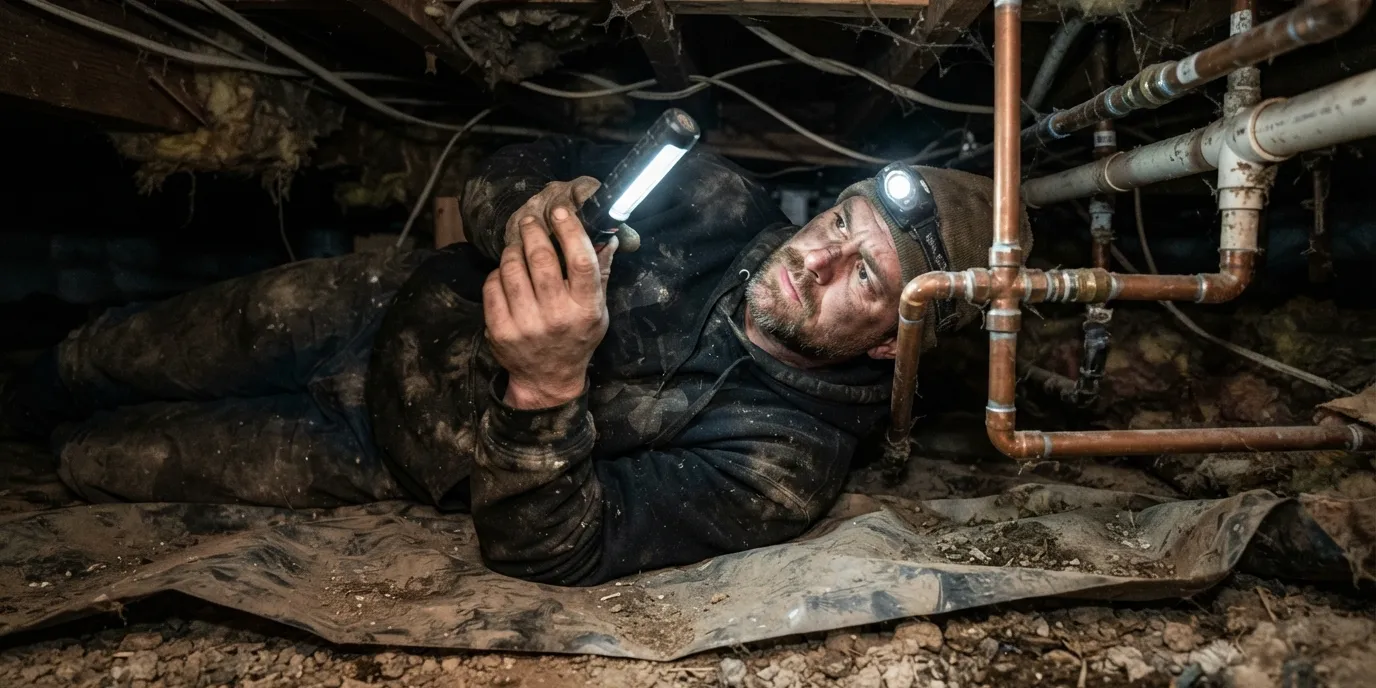
Crawl space plumbing · The most common Virginia foundation
Crawl space construction is standard across most of Virginia, and it is where a small leak can run onto bare ground for weeks before anything upstairs feels wrong.
A musty smell, a soft floor or an unexplained bill is usually the first sign.
Why it matters here
Drive through almost any Virginia county outside the dense Northern Virginia and Richmond cores and the housing stock is overwhelmingly crawl space built. Franklin and Bedford counties, the Shenandoah Valley towns, the Southside communities around Martinsville and Rocky Mount, the older parts of Spotsylvania and Stafford, and a great deal of Chesterfield and Henrico. In all of them, the supply lines and drain lines run in the open air beneath your floor.
That has one real advantage and one real disadvantage. The advantage is access: once a plumber is under there, everything is reachable, and repairs that would mean opening a wall or breaking a slab are a matter of cutting and replacing a section of pipe. The disadvantage is discovery. A crawl space leak has no audience. It drips onto earth, makes no mark on a ceiling, and does its damage to joists, subfloor and indoor humidity rather than to anything you can see.
So crawl space plumbing is really two services: fixing what has failed, and finding what is failing quietly. Most homeowners call for the first and get considerably more value from the second.
A proper inspection takes under an hour and settles a lot of arguments.
Reading the house
Nobody finds a crawl space leak by seeing it. They find it because the house started behaving oddly, and eventually somebody went and looked.
By the time a crawl space leak is obvious from upstairs, it has usually been running for a month.
A water bill up by a third with no change in household habits is a supply leak until proven otherwise. On municipal water, check the meter with every fixture off, if the low-flow indicator is turning, something is running. See leak detection.
Musty, earthy, or the particular sour smell of wet timber, strongest near floor registers and in rooms above the affected area. Crawl space air rises into the house continuously, so what it smells like down there is eventually what the house smells like.
A spot that gives slightly underfoot, hardwood that has cupped or gapped in one area, vinyl lifting at a seam, or carpet that feels cool and never quite dries. All point to sustained moisture in the subfloor beneath.
Windows fogging, an air conditioner running longer than it used to, doors that stick in a way they did not last year. A wet crawl space pushes moisture into the whole building.
Standing water and damp timber attract everything. A sudden insect or rodent problem in a house that never had one is worth investigating from below rather than treating from above.
A failed drain line under the floor spills waste water onto the ground rather than backing up into the house, so the only symptoms are sluggish fixtures and, eventually, an unmistakable smell.
Bill, smell or floor. Each points somewhere slightly different, and it helps us send the right equipment.
The usual failures
Crawl space failures are repetitive, which is good news. A plumber who works this housing stock knows where to look before they get under there.
| What fails | How it presents | Typical fix |
|---|---|---|
| Supply pinholes | Wet patch on the ground under one point, rising bill, sometimes a faint hiss | Cut out and replace the section. If there are several, the material itself is the issue. |
| Freeze splits | No water at a fixture in a cold snap, then a leak when it thaws | Replace the damaged run, then insulate and air-seal so it does not recur. |
| Failed drain joints | Sluggish fixtures, smell, wet ground under a drain run | Re-joint or replace the section; check the fall along the whole run while under there. |
| Sagging drain lines | Recurring blockages in one fixture group that clear and return | Re-support to restore fall. Cleaning a sagging line only buys time. |
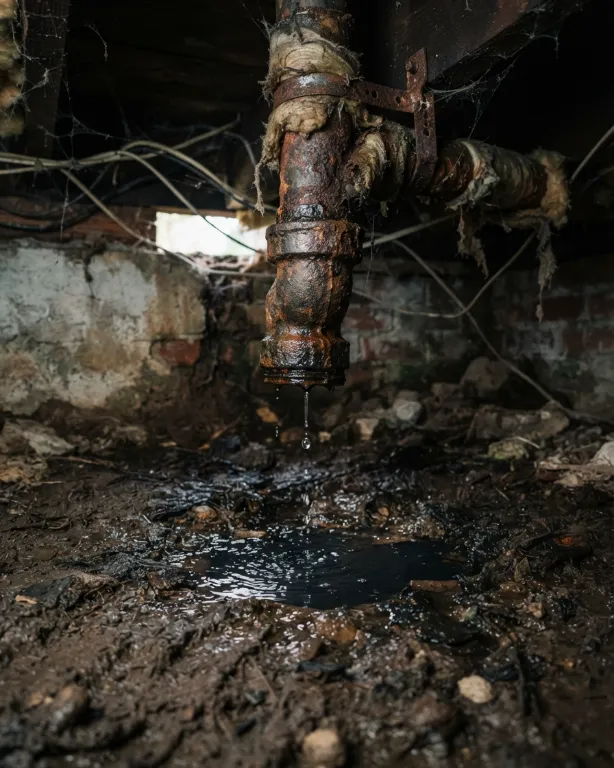
| Corroded cast iron | Rust flakes, a rotted underside on older drain pipe, seeping rather than spraying | Replacement in PVC with proper transitions. Usually section by section rather than all at once. |
| Unsupported or rubbing pipe | Water hammer, a wear mark, eventually a leak at the contact point | Re-strap and isolate from the timber. Cheap, and prevents a repeat. |
| Rodent-damaged PEX | Sudden leak in an otherwise modern system | Replace the damaged run and address the entry point, or the same thing happens again. |
| Fallen insulation | Wet batts on the ground, pipes freezing that never used to | Remove the wet material, sleeve the pipes properly, seal the air paths. |
Most crawl space repairs are a single visit once someone is actually under there.
The question we get every July
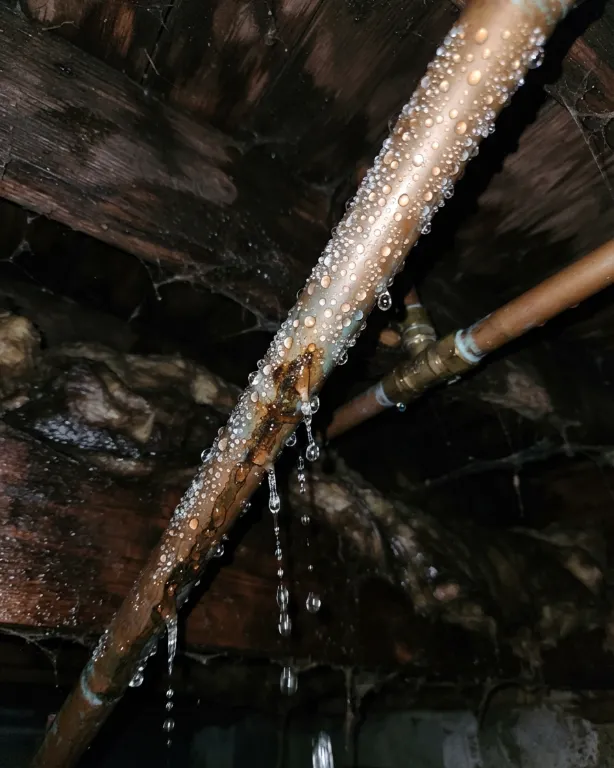
In a humid Virginia summer, cold supply lines in a crawl space sweat hard enough to drip steadily, and every year homeowners find that dripping, assume the worst, and call. Sometimes they are right. Often they are not, and knowing the difference before you pay for a repair is worth a paragraph.
Condensation forms along the entire length of a cold pipe, not at one point. It appears in humid weather and vanishes in winter. The ground beneath is generally damp over a wide area rather than soaked in one spot. Critically, it happens on the cold line only, if the hot supply is also wet, that is not condensation.
A leak behaves differently. It is localised to a joint, a fitting or a defect. It persists in dry weather and in January. It makes a defined wet patch, often with a small channel washed into the soil. And on a municipal supply it shows on the meter with every fixture in the house closed.
The fix for condensation is not a plumbing repair at all. It is insulation on the cold lines and, if the space is chronically damp, a ground vapour barrier. The fix for a leak is a repair. Confusing the two costs money in both directions.
A meter check and twenty minutes under the house tells you which of the two you have.
On municipal water, note the meter reading, use no water for two hours, and read it again. Any movement at all means something is running. It is free, and it saves a call-out for condensation.
What you are paying for
Every accessible run followed end to end: joints, elbows, valves and the points where pipe passes through or rests on timber. Material identified, condition assessed, and anything weeping or corroded flagged with a photograph.
Fall checked along each run, supports checked, joints inspected, and the underside of any cast iron examined. That is where it rots first and where a torch beam from above will miss it.
Standing water, ground moisture, the state of the vapour barrier if there is one, wet or fallen insulation, air paths from vents, and the condition of the timber above. This is what tells you how long something has been going on.
You should come away with photographs, a plain description of what was found, a clear separation between "this needs fixing now", "this needs watching" and "this is fine", and a price for the work before any of it starts. If someone comes out of your crawl space with a verbal list and no pictures, ask for pictures.
You should see what is under your own house without having to go down there.
Practicalities
Access is most of the cost of crawl space work, so it is worth knowing what makes a job straightforward and what makes it slow.
Clearance and hatch size on the phone means the right person arrives with the right kit.
Common questions
The signs arrive indirectly. A water bill that climbed with no change in habits, a musty or earthy smell that gets stronger near floor vents, a floor that feels slightly soft or springy in one spot, cupping hardwood, a section of carpet that stays cool and damp, or unusually humid air in one part of the house. Any of those is worth a look under the floor.
Both look identical and both drip. Condensation forms along the whole length of a cold supply line in humid weather and disappears in winter; a leak is localised, persists in dry conditions, and leaves a wet patch on the ground directly beneath one point. A plumber checks by drying the pipe and watching where water reappears, and by looking at the ground beneath it. A leak makes a defined wet spot, condensation makes a general dampness.
Usually yes, and it is common across Virginia. Low clearance changes the time a job takes rather than whether it can be done, and any honest quote reflects that. What genuinely stops work is standing water, an active rodent or snake problem, exposed live wiring, or debris that makes the space unnavigable. Those need dealing with first, and you should be told so rather than have someone attempt it anyway.
Because there is nothing to notice. A pinhole spraying onto bare earth makes no sound you can hear upstairs, causes no stain on a ceiling, and drains away. In a basement the same leak is on the floor in front of you within an hour. That asymmetry is why crawl space leaks are usually found by their consequences, the bill, the smell, the soft floor, rather than by the water itself.
Nothing good, and it happens slowly. Persistent moisture raises humidity throughout the house because air moves upward from the crawl space, and that shows up as musty smells, condensation on windows and hardwood that cups or gaps. Sustained wetting of joists, sill plates and subfloor invites rot and, in Virginia’s climate, mould. Wet insulation stops insulating and starts holding water against timber.
A ground vapour barrier is close to universally worthwhile in Virginia and inexpensive. Full encapsulation, sealed vents, wall insulation, a conditioned or dehumidified space, is a bigger investment that makes real sense for houses with chronic moisture problems and pays back in comfort and energy as well as plumbing. Both are outside the plumbing trade, though a plumber who has just spent two hours under your house is well placed to tell you whether it is warranted.
Considerably more, and it is the single largest freeze category we see across the state. The space is unconditioned, the vents let winter wind move straight through, and the pipe runs furthest from the centre of the house sit closest to the outside air. See pipe insulation and freeze protection.
Yes, everything from the fixtures down to where the line leaves the property is the homeowner’s. In crawl space homes, drain lines are often the older and more neglected half of the system. Cast iron that has rusted through at the bottom of the pipe, sagging runs that have lost their fall and now hold standing waste, and joints that were adequate in 1968 and are not now.
Expect it to take longer for the same repair, because access is most of the job. A pinhole that is a twenty-minute fix on an exposed basement pipe might be ninety minutes under a house with eighteen inches of clearance. The repair itself is not more expensive; the time to reach it, work on it lying down, and get out again is.
Related work
Crawl space visits pair naturally with these.
Finding the leak before opening anything. Meter tests, acoustic listening and thermal imaging.
Read moreCrawl spaces are the biggest freeze category in Virginia. Fix it in autumn.
Read moreWhen the crawl space run has already frozen.
Read moreWhere the drain problem is beyond the crawl space and out in the yard.
Read moreCrawl space homes are the easiest and cheapest houses to repipe.
Read moreCommon alongside crawl space construction across rural Virginia.
Read moreUnder the floor, across Virginia
Crawl space work is routine for the local pros we connect you with. Low clearance, long runs and old cast iron included. Photographs, a plain assessment and a price before work starts.
(866) 683-0244Serving 180 communities across Virginia.