Sewer Camera Inspection
The footage that has to come before any sewer quote.
Read more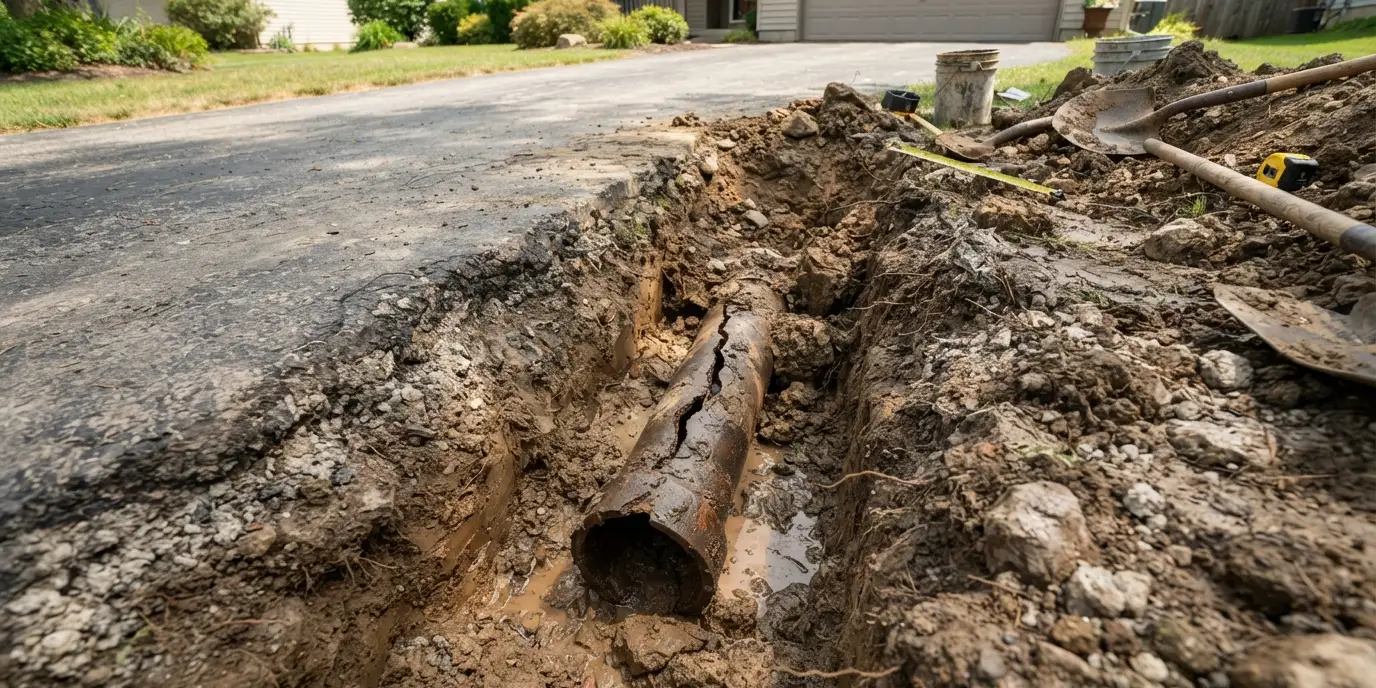
The lateral from house to street
The pipe between your house and the main is yours to maintain, and it is the one piece of plumbing most likely to be quoted from a guess. We start with footage.
Sewage in the house is an emergency. Say so when you call and it gets treated as one.
Whose pipe is it
In almost every Virginia jurisdiction the sewer lateral, the run from the house to the public main under the street, belongs to the homeowner for its entire length, including the part beneath the sidewalk and the road. Local rules vary at the connection point, and it is worth confirming with your county or city before work starts, but the general position is that the whole line is yours.
It is also the pipe nobody thinks about. It is buried, it has no maintenance schedule, and in a great many Virginia houses it is made of vitrified clay laid in short sections with mortar or bituminous joints, or of Orangeburg fibre pipe if the house went up between the 1940s and the early 1970s. Both materials work well for decades and then stop working, and both fail at the joints long before they fail in the middle of a length.
Which is why the first thing that should happen is a camera, not a quote. A sewer repair is a four-figure decision at minimum and can be considerably more, and it is entirely reasonable to expect the evidence for it on a screen before you agree to anything.
Camera survey, a recording you keep, and a written explanation of what it shows.
Symptoms
Rarely all at once. Usually a sequence, over months, that is easy to explain away individually.
A basement floor drain, a ground-floor shower or a first-floor toilet fills when you use anything else. That is the main line, and it is not a plunger problem.
A lateral that needs cabling on a schedule has a defect. The clearance is treating the symptom of something the camera would identify in twenty minutes.
A persistent sewer smell in the yard, strongest after rain, generally means the line is leaking into the ground rather than carrying to the main.
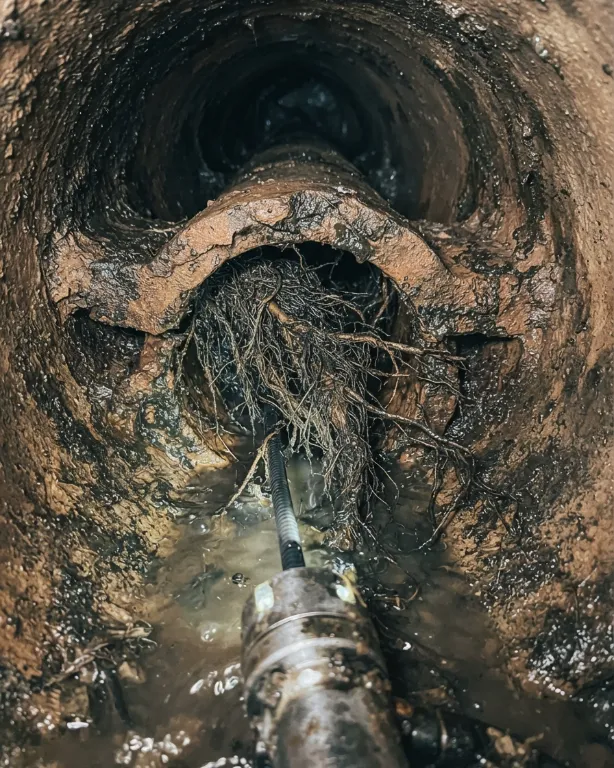
Grass directly over the lateral growing faster and greener than everything around it is being fertilised. Follow the strip and you have found the leak.
Rats travel sewer lines and enter houses through breaks in them. A sudden rodent problem in an older neighbourhood is worth a camera survey.
A home inspector rarely cameras the lateral unless asked. On any Virginia house built before 1975 with mature trees, it is money extremely well spent.
Most of these are recognisable on the phone before anyone comes out.
Root causes
Sewer laterals fail in a small number of well-understood ways, and the camera distinguishes between them quickly. The distinction matters because it decides whether you are looking at a spot repair or a full replacement.
Occasionally the camera finds something more straightforward: a heavy grease plug, a wipes mass, or a lost object. Those are a jetting job, not a repair, and it is a relief to everyone when that is the answer.
Twenty minutes of footage separates a cleaning job from a repair job.
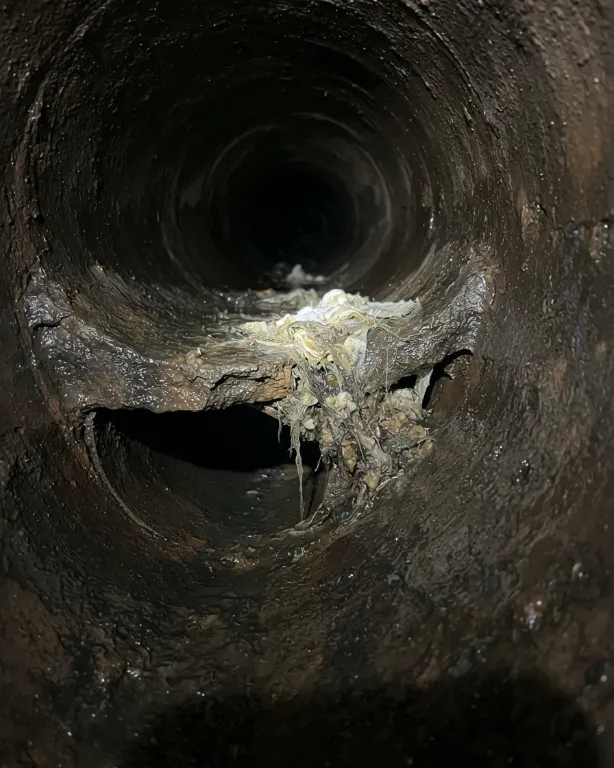
A good survey records how far along the line each defect sits, measured from the access point. That number decides where anyone digs, and it should be in your report.
The decision
Three genuinely different jobs with very different prices. The footage decides which is appropriate, not the sales conversation.
One bad joint is a spot repair. Six bad joints in forty feet of clay is a replacement, and paying for six spot repairs is the expensive way to arrive at one.
| Approach | Right when | Not right when |
|---|---|---|
| Spot repair | A single defect at a known depth, with the rest of the line sound | The camera shows multiple failures, or the material is Orangeburg |
| Pipe lining (CIPP) | The host pipe is continuous and roughly round, with mature landscaping or a driveway above | The line has collapsed, is badly deformed, or has a significant belly |
| Pipe bursting | A full-length replacement is needed but the surface above should stay intact | There are utilities crossing at close quarters, or the line runs under a structure |
| Open-cut replacement | Access is easy, the run is short, or a belly needs re-grading | Restoring the surface above would cost more than the pipe work itself |
| Clean and monitor | Roots only, in a structurally sound line, on a young household budget | The line is already deformed. Deferral just costs more later |
We will price the realistic ones and explain why the others are not on the list.
Straight talk
Sewer quotes vary enormously between houses, and the variation is real rather than opportunistic. These are the factors that move the number, and any quote worth trusting will reference them.
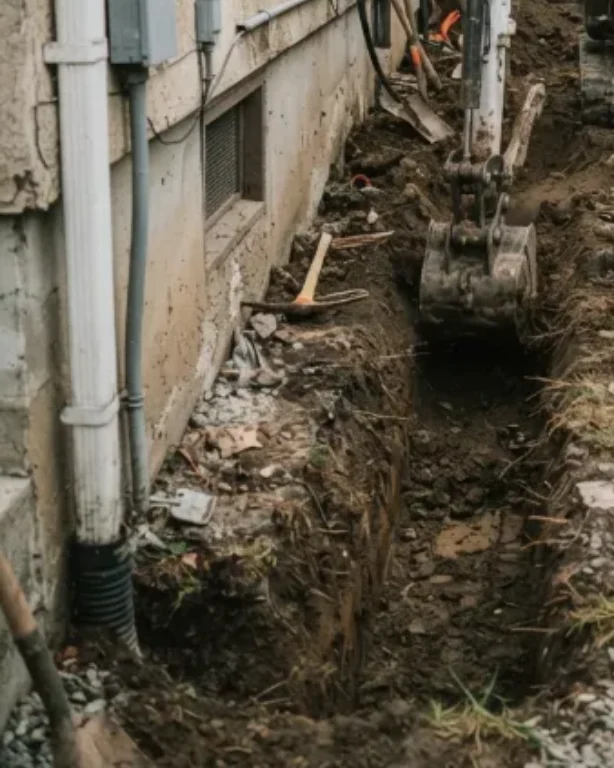
Depth. The single biggest factor in an open-cut repair. A lateral three feet down is straightforward. The same repair at nine feet needs shoring, a larger excavator and considerably more time.
What is on top. Lawn is cheap to reinstate. A brick walkway, a mature tree, a concrete driveway or a public sidewalk each add cost, and the sidewalk and roadway usually add a permit and an inspection as well.
Length. A townhouse lateral may be fifteen feet. A rural property set back from the road can run well over a hundred, and on septic the run out to the tank is its own consideration. See septic system plumbing.
Permits and inspection. Sewer work is permitted work in Virginia jurisdictions, and connection to a public main is inspected. That is a cost and a scheduling constraint, and it is not optional.
Restoration. Ask explicitly what the quote includes. Backfill and rough grade is not the same as topsoil, seed and a repaired driveway apron, and the gap between those two is significant.
Restoration is where sewer quotes most often differ. Get it in writing.
A firm price given before anyone has seen footage or established depth is not a quote. It is an opening position, and it usually moves once the ground is open.
What to expect
From first call to a reinstated lawn, a typical open-cut repair is a two to four day sequence.
Every one of these steps depends on knowing what is down there first.
Common questions
In most Virginia jurisdictions the homeowner owns the lateral for its full length, including the portion under the sidewalk and street, up to the connection with the public main. A few localities take responsibility at the property line or at the main. It is worth one phone call to your county or city utility department before commissioning work, and we will tell you what we typically see in your area.
A spot repair on a shallow, accessible line is a low four-figure job. A full replacement of a long or deep lateral under a driveway runs into the high five figures in the worst cases. The spread is genuinely that wide, and it is driven by depth, length and surface restoration rather than by the pipe itself. This is why the camera comes first.
Yes, and you should decline any quote written without one. The footage establishes material, defect type, defect location and depth, which are the four things that determine both the method and the price. See sewer camera inspection.
Often, yes. Cured-in-place lining and pipe bursting both work from access pits at either end rather than an open trench, which protects mature landscaping, driveways and hardscaping. Neither works on every line. A collapsed or badly bellied pipe has to be dug. Full detail is on the trenchless sewer repair page.
A trenchless lining job is frequently a single day. An open-cut spot repair is one to two days of work plus restoration. A full replacement under a driveway with permits and inspections can span a week or more of elapsed time, though not all of that is work on site.
Usually not while the line is open, which is typically part of one working day. You will be told clearly when water use has to stop and when it can resume. On a multi-day job the line is normally made usable overnight.
Standard policies generally exclude it, treating a failing lateral as wear and maintenance. Some insurers offer a service line endorsement, and some Virginia water utilities offer optional lateral protection plans through third parties. Worth checking your declarations page before assuming either way.
That is the signature of root intrusion. Roots grow most actively in those seasons, and the bore narrows enough to catch solids. Cabling shears them off and the cycle restarts. See root intrusion removal for what actually stops it.
Orangeburg is a bituminised wood-fibre pipe used widely in American construction from the 1940s to the early 1970s, including across a great deal of Virginia. It softens and deforms into an oval with age. If your house dates from that window and the lateral has never been replaced, it is a real possibility, and a camera settles it in minutes.
For repair or replacement of a sewer lateral, in effectively every Virginia jurisdiction, yes. Connection work to a public main is inspected. A contractor proposing to skip the permit is proposing to leave you with an unpermitted repair to disclose at sale.
Related work
Diagnosis, no-dig options and the roots that caused it in the first place.
The footage that has to come before any sewer quote.
Read moreLining and bursting, without a trench across the front yard.
Read moreThe most common reason a Virginia lateral fails.
Read moreBacking up again?
We camera the line, record it, and explain what it shows before anyone talks about price. One call reaches an experienced local sewer professional anywhere in Virginia.
(866) 683-0244Sewage indoors is an emergency. We answer 24/7.