Frozen Pipe Repair
Safe thawing and finding the split that appears when the ice lets go.
Read more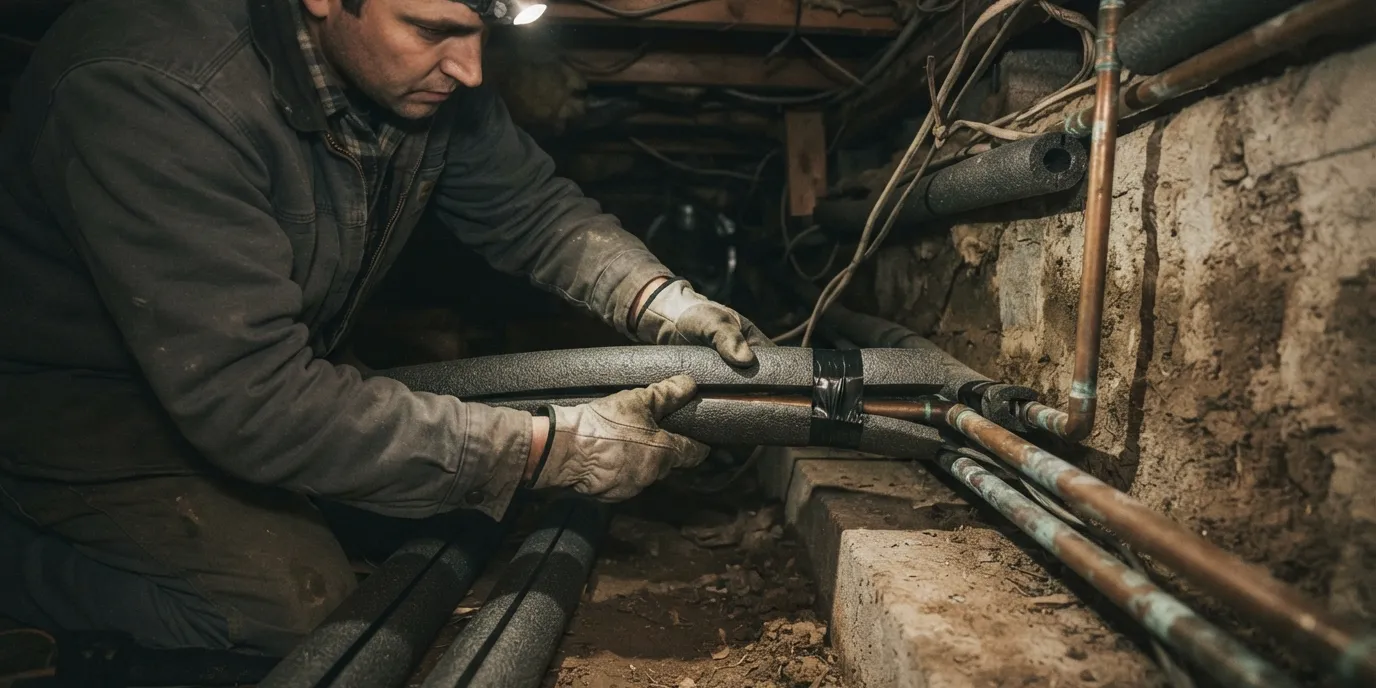
Freeze protection · Statewide · Autumn work
An hour of insulation, air sealing and hose disconnection in October prevents the 2am call in January. This is the one page on this site that is entirely about not needing us.
Autumn appointments are the quietest and the least expensive of the year.
The economics are absurd
Every winter we take the same calls from the same places: a crawl space run in Roanoke County, a garage wall in Fairfax, a kitchen line behind a north-facing cabinet in Culpeper, and hose bibs everywhere. In nearly every case the failure point was visible, reachable, and could have been sleeved in ten minutes the previous autumn.
Freeze protection is unglamorous and it is the single highest-return work in residential plumbing. It is also seasonal in a way most plumbing is not. There is a window between the end of the humid season and the first hard night, roughly late September to mid November, when it is easy, cheap and quick. After that it becomes an emergency measure performed in the cold, in the dark, in a hurry.
What follows is what actually matters, in the order it matters, for the housing stock we see across our 180-community Virginia service area.
One visit covers the crawl space, the outdoor lines and the exposed runs.
Do these first
Not everything on a winterisation list earns its place. This is the order we would do it in on our own houses.
| Measure | Effort | Why it ranks here |
|---|---|---|
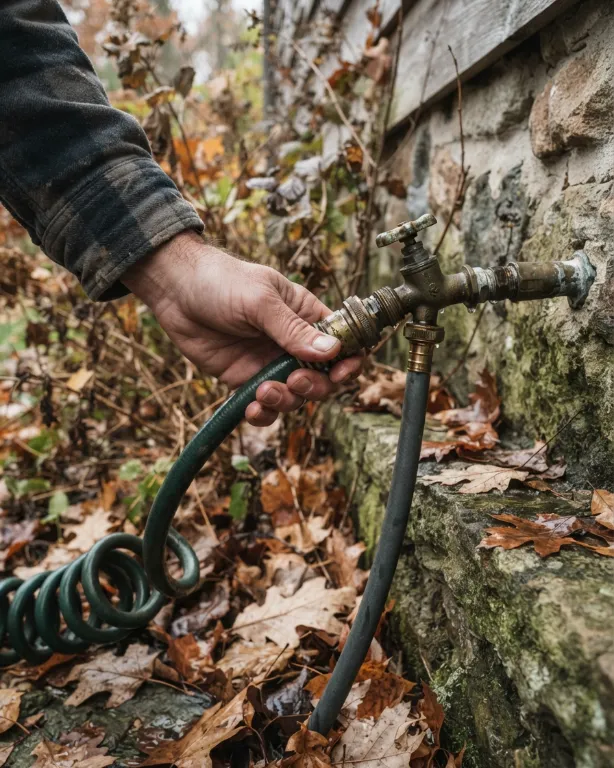
| Disconnect every garden hose | Two minutes | The most common freeze failure in Virginia. A connected hose traps water in the bib and defeats even a frost-free spigot. |
| Block crawl space vents | An hour | Wind through a vented crawl space is the mechanism behind most crawl space freezes. Stopping the air movement matters more than the foam. |
| Sleeve the exposed runs | Half a day | Crawl space, garage, rim joist, attic and unheated utility spaces. Must cover elbows and joints, which is where DIY jobs stop short. |
| Shut and drain exterior spigot feeds | Twenty minutes | If there is an interior isolating valve for each outdoor line, closing it and draining the bib removes the risk entirely. |
| Seal penetrations and gaps | An hour | Where a pipe passes through a rim joist or an exterior wall there is usually a hole letting cold air straight onto it. |
| Heat tape on genuine trouble spots | Half a day | Well houses, outbuilding runs, pipes crossing a vent. Effective and targeted; not a whole-house strategy. |
| Reroute a chronically freezing run | A day | If the same line freezes every year, moving it inside the thermal envelope is a permanent fix rather than an annual gamble. |
One autumn visit, in the order that actually prevents winter calls.
Where most of it happens
Crawl space construction is the most common foundation type across the state, and it puts most of a house's supply plumbing into a space that is, thermally speaking, outdoors. The floor above is insulated, the ground below is cold, and the vents on each side let winter air move straight through. That moving air is what does the damage. A still crawl space at thirty degrees is far less dangerous than a windy one at thirty-five.
Doing this properly means looking at four things rather than one. First, the vents: whether they close, whether they seal, and whether the crawl space has a moisture situation that makes closing them unwise without addressing it. Second, the existing insulation: a great many Virginia crawl spaces have batt insulation that fell off the joists a decade ago and is now lying wet on the ground, doing nothing. Third, the pipe runs themselves, particularly the long runs to the far corners of the house and anything within a foot of a vent. Fourth, the access hatch, which is often a sheet of plywood with a two-inch gap around it.
While a plumber is under there, it is also the natural moment to look for the leaks that crawl spaces hide so well. See crawl space plumbing repair for what that inspection covers.
Vents, insulation, exposed runs and a leak check in the same trip under the house.
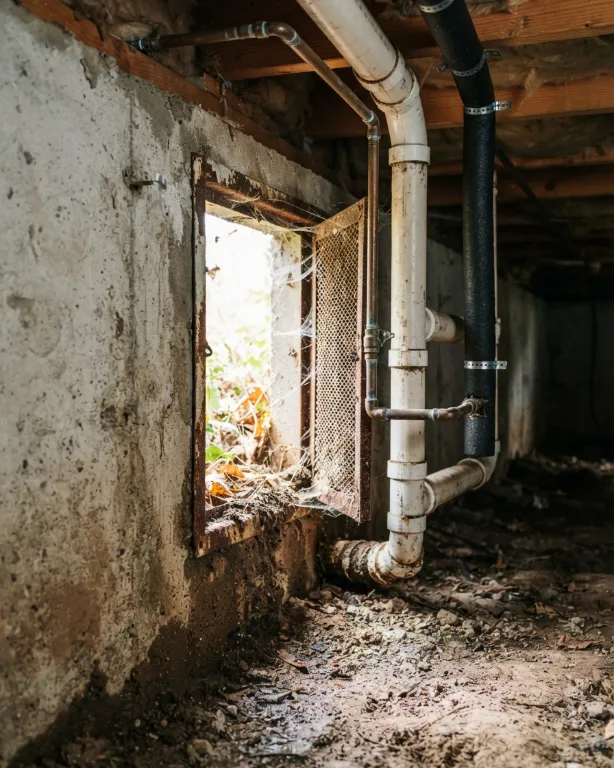
Sodden batt insulation holds moisture against joists and pipework and provides no thermal benefit at all. If yours is on the ground, it should come out rather than be pushed back up.
What to use where
Three different products get called "pipe insulation" in hardware stores, and they solve three different problems.
Split polyethylene or rubber tubing that snaps over the pipe. Cheap, fast, and the right default for every accessible run in an unconditioned space. Its weakness is workmanship: gaps at elbows, tees and valves are where freezes start, so the joints matter more than the straight runs. Rubber holds up better than cheap polyethylene in a damp crawl space.
Not insulation at all, but frequently the higher-value half of the job. Foam or caulk where a pipe passes through a rim joist or exterior wall, sealed vent covers, a properly fitted crawl space hatch, and a garage door that actually meets the floor. Stopping the cold air is what makes the foam work.
Draws power in proportion to how cold it is and adds real heat to the pipe. The right answer for a well house, an exposed run to an outbuilding, or a line that has frozen repeatedly despite insulation. Needs a reliable protected outlet, correct installation without overlapping the cable on itself, and insulation over the top of it to work efficiently.
Seal the air first, insulate second, add heat only where the first two cannot win. Doing it in the opposite order means paying for electricity all winter to heat a crawl space through an open vent.
Different houses need different answers. Describe yours and we will be specific.
The worst claims we see
A burst line in an occupied house runs for minutes. In an empty one it runs until somebody happens to visit, and Virginia has a great many houses that nobody visits between November and March.
Set the thermostat to a genuine minimum rather than off. Warm enough that interior spaces stay comfortably above freezing even during a cold snap and a power blip. Leave interior doors and under-sink cabinets open so air circulates to exterior-wall plumbing. Shut off the main supply at the house anyway, so that if something does let go it empties one line rather than the whole water service.
Then arrange for someone to physically look at the property during and after any hard freeze. A neighbour, a property manager, a friend. A low-temperature or water alarm on a phone is cheap and worth every penny for lake houses around Smith Mountain, Piedmont second homes and hunt-country properties.
Supply shut off at the main, every fixture opened and the system drained from the lowest point, the water heater isolated, drained and switched off, and the toilets emptied. Non-toxic antifreeze goes into every trap and toilet bowl so the drains do not freeze and the traps do not dry out and let sewer gas in.
Done properly this is a genuinely secure state and it is what we would recommend for anything empty for a full season. Done as a half-measure, supply off but the system left full, it is worse than doing nothing, because there is still water in the pipes and now nobody is watching them.
Seasonal homes, rentals between tenants, and houses on the market.
Print this bit
Half of this is a homeowner job and half of it is not. Do the first list yourself; call about the second.
One visit in October, and the winter usually passes without incident.
Common questions
For the accessible runs in a basement or a garage, plenty of homeowners do it themselves and do it well. Where it is worth paying for is a vented crawl space, because the job is not just sleeving pipe, it is deciding which vents to close, where the air is actually coming from, whether the existing insulation is wet, and whether a run should be moved rather than wrapped. That judgement is what you are buying.
Slow it down, honestly. Insulation has no heat of its own; it reduces the rate at which a pipe loses heat to the surrounding air. On a normal Virginia cold night that is enough, because the freeze never gets started. In a prolonged deep freeze in an unheated space, insulation alone will eventually lose, which is where air sealing and, occasionally, heat tape come in.
Self-regulating heating cable run along a pipe and plugged into a protected circuit. It genuinely earns its place in a handful of situations: a well house, a pipe crossing an open crawl space vent, an exposed run to a barn or outbuilding, and lines in properties that sit empty in winter. It is not a general substitute for insulation, it needs a working outlet, and it must be installed to the manufacturer’s instructions rather than wrapped over itself.
In most of Virginia, yes, and it is one of the highest-value freeze measures there is. Wind moving through a vented crawl space is what strips heat off the pipes. Vent covers or foam blocks in November, removed in spring, cost very little. If the crawl space has a moisture problem, closing vents without addressing that can trade one issue for another, which is why it is worth a look rather than a blanket rule.
A great deal. Disconnecting every garden hose, fitting foam sleeves on the accessible runs, blocking crawl space vents, sealing the obvious gap where a pipe passes through a rim joist, and locating your main shutoff is a single Saturday. That list alone prevents most of the freeze calls we take.
Those are handled by keeping warm air on them rather than by insulation. Open the cabinet doors under sinks on exterior walls during a cold snap, keep interior doors open so the heat circulates, and do not turn the thermostat down to nothing overnight in freezing weather. If a specific in-wall run keeps freezing, the real answer is usually rerouting it, which is a small job done once.
Either heat it or winterise it. The half-measure is what causes disasters. Heating means a genuine minimum, not off, plus someone checking on it. Winterising means shutting the supply, draining the system, draining the water heater, and putting antifreeze in the traps. Lake and hunt-country properties across Virginia produce a steady stream of catastrophic freeze claims every year for exactly this reason.
More than on municipal supply, because the vulnerable equipment is concentrated in one place. A pressure tank and its pipework in an unheated well house, garage corner or crawl space is a single point of failure for the entire property. Insulating that space, and in many cases adding a small thermostatically controlled heat source, is standard practice on rural Virginia properties.
October, before the first hard night. Autumn is the quietest season for plumbing and the cheapest time to buy it, and freeze protection installed in mild weather takes a fraction of the time it does in January when everything is already cold, wet and urgent.
Related work
The pages for when the freeze already happened.
Safe thawing and finding the split that appears when the ice lets go.
Read moreContainment, permanent repair, and checking the rest of the run.
Read moreThe most common freeze casualty in the state.
Read moreWhere most Virginia freeze damage happens and hides.
Read moreProtecting the pressure tank and well house on rural properties.
Read moreNo water in a cold snap is a call-now situation.
Read moreBefore the first hard night
Insulation, air sealing, outdoor lines and a crawl space assessment. Done in mild weather, at the quietest time of the plumbing year.
(866) 683-0244Available across all 180 Virginia communities we cover.