Burst Pipe Repair
What happens after the shutoff: finding the split, cutting it out, and checking the rest of the run.
Read more
Emergency plumbing · Statewide · 24/7
Burst lines, sewage backing up, no water in a cold snap. One call reaches an experienced local plumbing pro who covers your community. Nights, weekends and holidays included.
If water is running and you can reach the main, shut it off first, then call.
First things first
Almost every plumbing emergency gets cheaper the moment the water stops moving. A half-inch supply line under pressure can put hundreds of gallons into a house in an hour, and most of the cost of a burst pipe is not the pipe. It is the ceiling below it, the flooring around it and the insulation that has to come out. If you do one thing before you dial, close the main.
After that, the useful thing is a clear description. Where the water is, what it sounds like, when it started, whether it is clean or foul, and whether you have shut anything off. That is usually enough for us to work out whether you need a plumber with a camera, a plumber with a jetter, or a plumber with a torch and a length of copper, and to send the right one the first time.
We cover all 180 communities in our Virginia service area, from Arlington basements to Franklin County crawl spaces. The response window is not the same everywhere and we will not pretend it is; what is the same everywhere is that a human answers and tells you the truth about timing.
Describe it in plain words. We will stay on the line if you need help finding a shutoff.
Call now, or call Monday
We would rather talk you out of an after-hours rate than take a call you did not need to make. Here is the line we draw, and it is the same line a good plumber draws.
If you genuinely cannot tell, call and describe it. Two minutes on the phone with someone who does this all day will settle it, and there is no charge for the conversation. The worst outcome is a small leak running under a house for a week because nobody wanted to bother anyone.
We will tell you plainly whether it needs tonight or Tuesday.
Before help arrives
If you cannot find your shutoff, say so first. That is the fastest thing we can help with.
Know your house
Before anyone opens a toolbox, what is under your floor decides how fast the problem is found, how much damage it has already done, and what the repair looks like.
A leak in a basement announces itself in minutes. The same leak in a crawl space can run for a month.
Common across most of the state. Lines run under the floor in open air, so once a plumber is under there the repair itself is usually straightforward. The problem is discovery: a pinhole can drip onto the ground for weeks before a floor feels soft. Emergencies here are often found by smell, by a water bill, or by a floor that has finally started to sag. See crawl space plumbing repair.
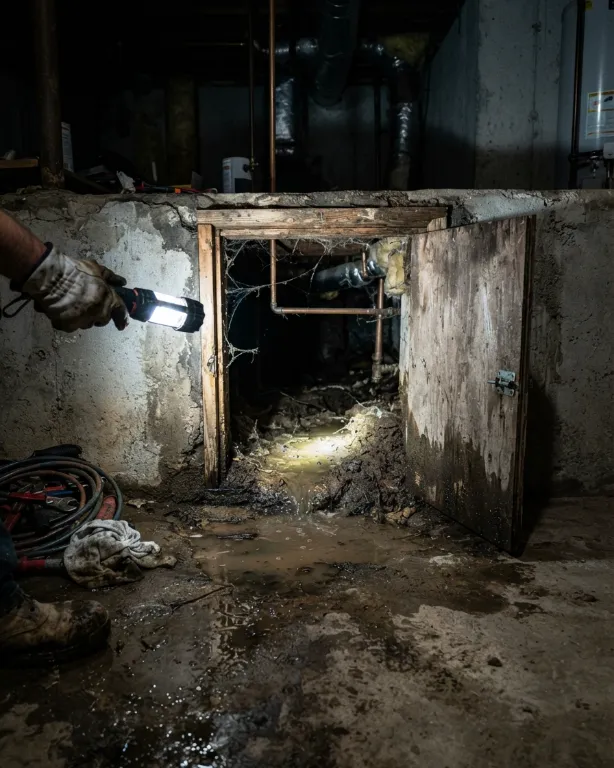
Widespread in Northern Virginia and parts of the Piedmont, and common in older Richmond neighbourhoods. Most plumbing is visible at standing height, so finding the fault is quick. The trade-off is that a failure fills a finished room in front of you, and the water heater and main shutoff are usually inside living space. See basement plumbing and leak repair.
Dominant in newer subdivisions and common in parts of Hampton Roads. Lines can run inside or beneath the concrete, so the emergency presents as a warm patch of floor, a running sound with every tap closed, or an inexplicable bill. Locating it takes acoustic and thermal equipment rather than a flashlight. See slab leak repair.
Tell us your foundation type if you know it. If you do not, describe the house and we will work it out.
Money, plainly
We do not publish a fixed emergency price, because a fixed price quoted sight unseen is either padded to cover the worst case or quietly revised upward once someone is standing in your hallway. Both are worse than a straight conversation.
What genuinely moves the number is the time of day, the drive, the diagnosis and the parts. A 9pm call twenty minutes from a plumber's home in Henrico is a different job from a 2am call forty-five minutes out in Floyd County, even if the repair itself is identical. Holiday weekends cost more again, for the obvious reason.
What you should always get before a plumber is dispatched is the pricing basis: whether there is a call-out or diagnostic charge, whether it applies to the repair if you go ahead, and roughly what band the likely repair sits in. Then, on site, you get a real price for the actual work before it starts, not an invoice afterwards.
Some emergency calls turn into two jobs: the stabilising fix tonight, and the proper repair in daylight. A plumber who says "I can stop this now and do it properly Thursday for less" is giving you good advice, not upselling you.
| Time of day | Overnight, weekend and holiday response carries a premium over a scheduled weekday appointment. |
|---|---|
| Distance | Rural Southside, Shenandoah and Piedmont calls involve a real drive, and the drive is part of the job. |
| Diagnosis needed | A visible burst is quick. A slab leak or a hidden crawl space leak needs locating equipment before anything is repaired. |
| Access | A two-foot crawl space with standing water, or a finished ceiling that has to be opened, adds time before the repair even starts. |
| Parts on the truck | Common copper, PEX and CPVC repairs are stocked. An unusual valve or an obsolete fitting may mean a temporary fix now and a return. |
| Scope discovered | Sometimes the burst is the symptom. If the pipe is failing everywhere, you will be told, and repiping becomes a separate, planned conversation. |
Be wary of anyone who quotes a firm repair price over the phone for a leak nobody has seen. Either they are guessing high, or the number will change. Upfront pricing means the price is agreed before work starts on site, not that a stranger can price your house from a description.
You will get the pricing basis before anyone is dispatched, and a real price before work begins.
Four real seasons
Emergency volume is not evenly spread across the year, and knowing what season you are in tells you a lot about what has probably gone wrong.
The busiest stretch by a wide margin. Exposed crawl space runs, garage walls, exterior-wall kitchen lines and hose bibs left connected to a hose. A cold snap that reaches the Valley and Southside produces a wave of no-water calls, then a second wave of burst calls when it warms. See frozen pipe repair.
January splits announce themselves once water moves again. Heavy rain lifts the water table, pushes groundwater into cracked sewer laterals and turns any excavation into a mud job. Root growth resumes and the drain line that limped through winter finally stops.
Full houses, guests, irrigation tie-ins and heavy laundry find every marginal drain. Cold lines sweat hard in crawl spaces and basements, so some "leaks" are condensation. Telling the difference on the phone saves a call-out.
The cheapest plumbing you will ever buy. Flushing a water heater, clearing a slow drain, insulating crawl space runs and shutting off outdoor lines takes an hour and prevents the 1am January call. If you book plumbing once a year, book it in October.
Autumn appointments are the cheapest way to avoid a winter emergency.
On arrival
Water off if it is not already, pressure released, and a quick read of how far the water has travelled. If the ceiling below is holding water, that gets relieved deliberately rather than left to come down on its own.
Visible bursts are quick. Hidden leaks get acoustic listening, thermal imaging or a camera down the line. The point is to open one small hole in the right place rather than three in the wrong ones.
You are told what was found, what the options are, and what each costs. Before work starts. Then the repair, and a check of the pressure and the surrounding pipe so tonight's fix is not next week's call.
Nights, weekends and holidays. One number for all 180 communities we cover.
Before you call
Anything where waiting costs you more than calling. Water you cannot shut off, a burst supply line, sewage coming up through a floor drain or tub, no water at all during freezing weather, a water heater leaking from the tank body, and any smell of gas. A dripping faucet, a single slow drain or a running toilet are unpleasant but they are Tuesday-morning jobs, and we will tell you so rather than sell you an after-hours rate.
Inside the Northern Virginia, Richmond and Hampton Roads metros, an emergency call is usually the next thing a plumber reroutes to, so the window is short. In the Shenandoah Valley, the Piedmont and Southside the drive itself can be forty minutes or more, and honest scheduling matters more than an optimistic promise. We will give you a realistic window on the phone and tell you if the nearest available pro is further out than you would like.
Yes, and anyone who says otherwise is hiding it somewhere else. Overnight, weekend and holiday response carries a premium because it pulls a plumber out of bed and away from a scheduled day. You will be told the pricing basis before a plumber is dispatched, not after the work is done.
If water is actively running and you can reach the main safely, yes. Do that first, then call. Every minute of running water is drywall, insulation, flooring and, in a finished basement, potentially electrics. If you cannot find the shutoff, call anyway and we will walk you through the likely locations for your foundation type while a plumber is being dispatched.
Tell us, but do not cancel automatically. A leak that stops is often a leak that has found somewhere else to go, and a blockage that suddenly clears may just have shifted further down the line. A short diagnostic visit the same day is much cheaper than the same problem at 3am on Sunday.
Yes. A great many emergency calls come from landlords, property managers and people whose parents live two counties away. We will need someone able to give access and a working phone number for whoever is on site, and the plumber will confirm scope and price with whoever is authorising the work.
The plumbing cause is ours. Clearing the blockage, cameraing the line and finding out why it happened. Cleaning and drying a contaminated room is remediation work and a different trade. A good plumber will tell you clearly where the line between those two sits so you are not paying one to do the other badly.
Shut the cold supply valve on top of the heater. If it is electric, cut the breaker; if it is gas, turn the control to off or pilot. Then call. Do not stand in standing water to reach an electrical panel, and do not try to drain a full tank of hot water yourself.
Yes. That is the whole point of the line. Burst pipes and sewage do not observe office hours, and a homeowner standing in an inch of water at 3am should not be filling in a contact form and waiting for an email.
Where you are, what you can see or hear, when it started, whether you have shut anything off, and whether the house is on municipal water or a well. If you know your foundation type, crawl space, basement or slab, say that too. Those five answers are enough to send the right person with the right equipment.
Still unsure? Describing it out loud usually gets you an answer in two minutes, and there is no charge for the conversation.
Related work
Most emergency calls started as something small that nobody looked at. These are the pages worth reading in daylight.
What happens after the shutoff: finding the split, cutting it out, and checking the rest of the run.
Read moreThawing safely, and why the damage usually appears after the ice lets go.
Read moreA meter that will not stop turning, a stain that keeps coming back, a bill with no explanation.
Read moreWhen the backup is not a clog but a collapsed or root-filled lateral.
Read moreLeaking at the base, rumbling, or no hot water at all.
Read moreWarm floors and running water under concrete, located before anything is opened.
Read moreAnywhere in Virginia, any hour
Nights, weekends and holidays included. Pricing basis before dispatch, a real price before work begins, and a plumber who knows the houses in your community.
(866) 683-0244One number covers all 180 communities we serve.