Water Heater Installation
Replacement sizing, fuel type, venting, permits and what a new unit costs installed.
Read more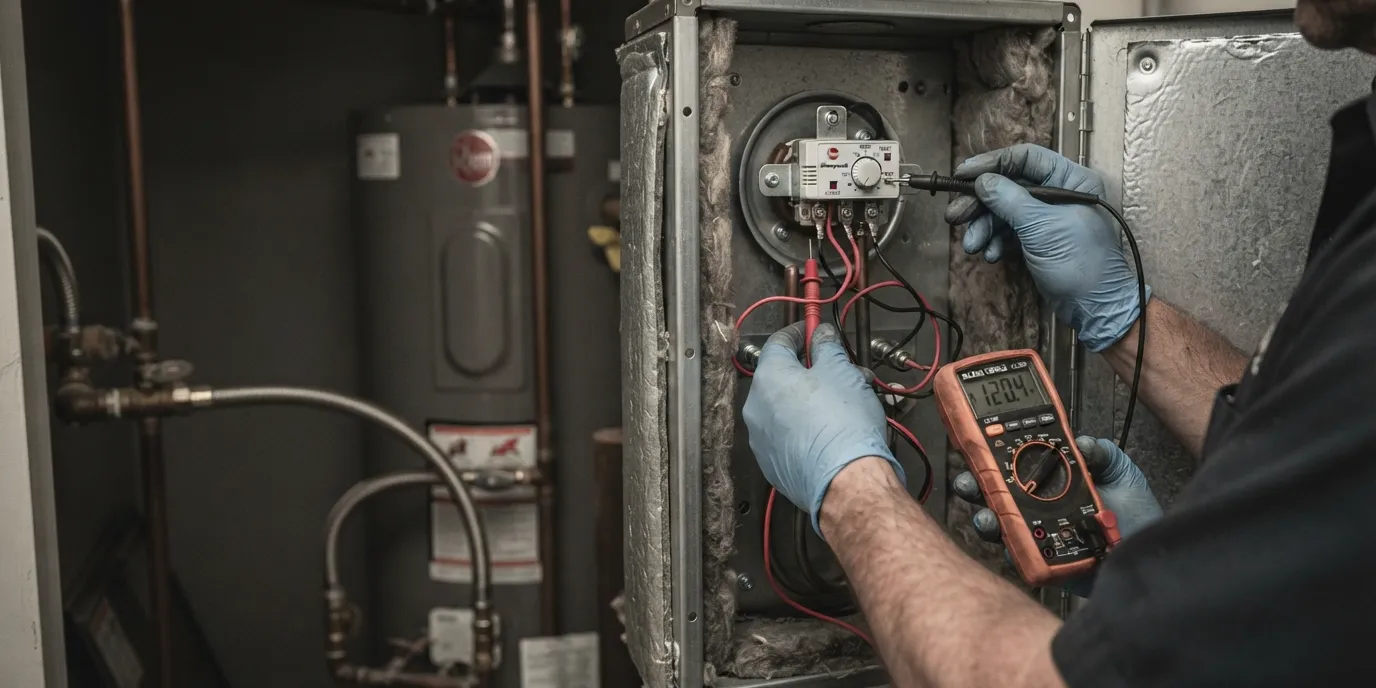
Water heaters · Statewide
Most water heater faults are one of six things, and four of them are genuinely worth repairing. The decision that matters is not which part failed. It is how old the tank is, because past a certain age you are repairing something that is about to leak anyway.
Have the age and fuel type ready. The serial number on the label gives the manufacture date, and it decides most of the conversation.
Dollar ranges here are typical Virginia costs, given for planning only. They are not a quote. The independent plumber who takes your job sets the price and gives it to you before work begins.
Diagnosis
Start here. The symptom narrows it to two or three causes before anyone opens a panel.
| Symptom | Likely causes | Usually |
|---|---|---|
| No hot water at all (electric) | Tripped high-limit, failed upper element, failed thermostat, breaker | Repairable |
| No hot water at all (gas) | Pilot or igniter, thermocouple, gas valve, thermal switch | Repairable |
| Runs out much faster than it used to | Sediment volume, failed lower element, dip tube | Repairable |
| Lukewarm only | Failed lower element, crossed connection, thermostat | Repairable |
| Rumbling or popping when heating | Sediment on the tank floor | Flush; often late-stage |
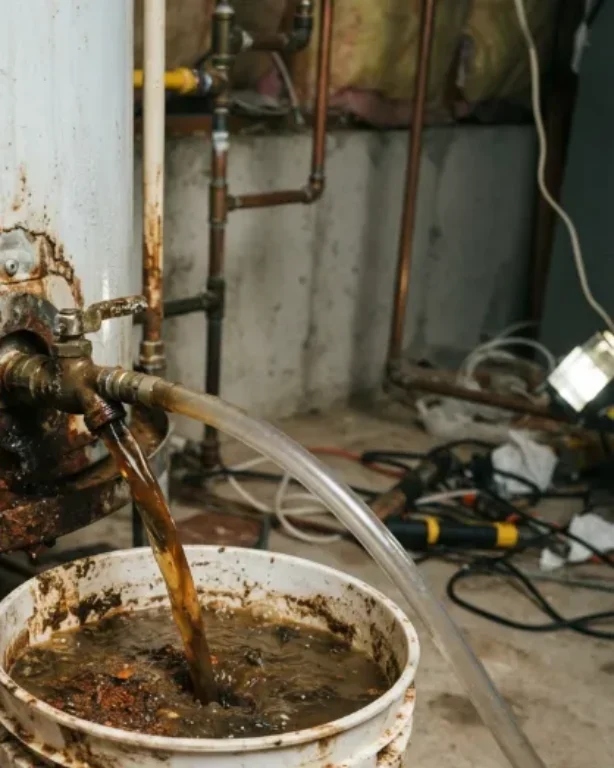
| Rusty or brown hot water | Depleted anode rod, tank corrosion | Anode if early; tank if not |
| Rotten-egg smell in hot water | Bacteria reacting with the anode rod | Anode swap and disinfection |
| Water at the base of the tank | Fitting, relief valve, drain valve, or the tank | Depends entirely which |
| Relief valve dripping | Thermal expansion, high pressure, or overheating | Fix pressure. See regulator |
| Pilot will not stay lit | Thermocouple, draft, dirty pilot assembly | Repairable |
A $280 element in a five-year-old tank is good money. The same repair in a thirteen-year-old tank buys an unknown number of months before the tank itself leaks.
Tell us what you are seeing and how old the unit is. We will say honestly whether it is worth repairing.
The decision
A storage water heater has a predictable life. Knowing where yours sits in it converts a difficult judgement into a simple one.
Find the label on the side of the tank. The serial number encodes the manufacture date. Most manufacturers use a format where the first two or four digits are the year and week or month, and a quick search of the brand and serial format confirms it. Do not rely on the installation date if the unit was bought as stock; use the manufacture date.
| Age | Position | Guidance |
|---|---|---|
| 0. 5 years | Well within life, possibly in warranty | Repair. Check the warranty first. Parts are often covered. |
| 6. 8 years | Mid-life | Repair, and start flushing annually. Replace the anode rod if it has not been done. |
| 9. 11 years | Late life | Repair only if the fault is cheap and simple. Get a replacement quote at the same time. |
| 12+ years | Past expected life | Replace. Any repair is money spent on a tank that is statistically due to leak. |
| Any age, tank itself leaking | Terminal | Replace. A leaking tank cannot be repaired. |
Two adjustments to that table. Water chemistry matters: hard water and aggressive water shorten tank life, so a well-water house in the Piedmont may see eight years where a city-water house sees fourteen. And maintenance matters more than most owners expect. A tank that has been flushed annually and had its anode rod replaced once at around year six routinely reaches fifteen years, while an unmaintained tank in the same house does not see eleven.
If you land in the replace column, the choice is not only like-for-like. This is the natural moment to consider a tankless unit, a heat-pump tank, or a change in capacity if the household has grown. The comparison is on our water heater installation page.
Ask for the repair price and the replacement price in the same visit. With that pair in front of you the decision is usually obvious.
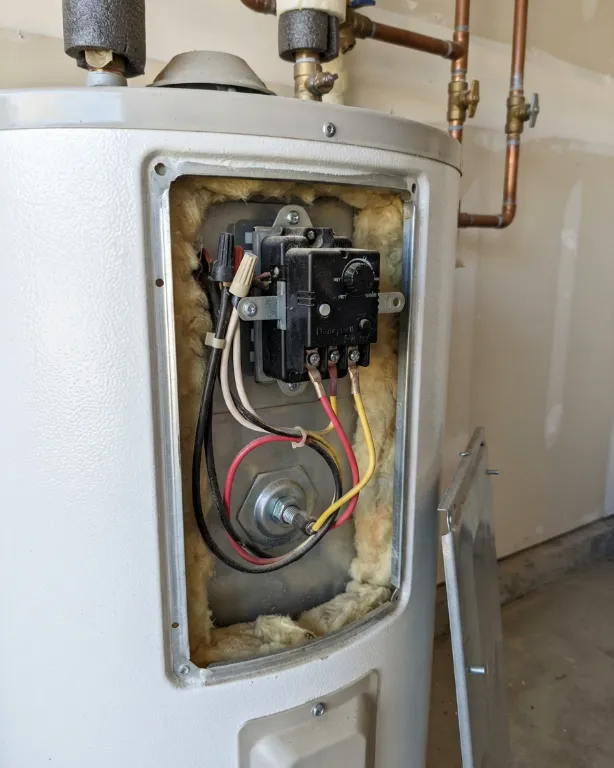
Electric water heater elements run at 240 volts. If you are opening an access panel for any reason, the breaker goes off first and gets tested dead. This is the single most common way homeowners are hurt by plumbing work.
Electric
Electric tanks have few moving parts, which makes them predictable.
Element and thermostat replacement is a well-defined, modestly priced job, typically $180 to $450 depending on part and access. It is sound money on a tank under nine years old and a gamble on the steel at twelve.
On set temperature: 120 degrees is the usual recommendation, balancing scald risk against bacterial growth. Households with immunocompromised members sometimes run 140 with anti-scald mixing valves at fixtures. Do not simply turn a tank to maximum to compensate for a capacity problem. That is treating a fault with a burn hazard.
Gas
More components, more failure points, but nearly all of them are replaceable parts rather than tank problems.
The pilot lights but will not stay lit, or drops out after a few minutes. The thermocouple tells the gas valve the pilot is burning; when it weakens, the valve shuts for safety. A cheap, common, entirely repairable fault.
On newer sealed-combustion units, an electronic igniter replaces the standing pilot. Failures show as clicking with no ignition, or an error code at the control. Usually a part swap.
No ignition at all despite a good pilot and a working thermocouple, or wildly wrong temperature. A dearer part, often $250 to $500 fitted, and worth weighing against tank age.
Sealed-combustion tanks have a thermal switch that trips if the burner chamber overheats, usually because lint, dust or debris has blocked the air intake screen. Clean the screen; if it trips again, something else is wrong.
Backdrafting shows as condensation on the tank, a scorched draft hood, soot, or a pilot that keeps blowing out. This is a combustion safety issue, not a comfort one, and it needs attention immediately.
A yellow, lazy or noisy flame instead of a crisp blue one means a dirty burner or poor air supply. Cleaning restores efficiency and recovery rate.
If you smell gas, do not test switches or look for the source. Leave the building, call the gas utility from outside, and then call a plumber. The same applies to any suspicion of combustion products spilling into the house. See emergency plumbing.
Carbon monoxide deserves a sentence of its own. Any atmospherically vented gas appliance in a house should be accompanied by a working CO alarm on each level. If a water heater is backdrafting, the CO alarm is the difference between a repair and an emergency.
Leaks
Water on the floor around a heater is either a $150 problem or a $2,000 one, and telling them apart takes two minutes.
A tank that has begun to leak from the shell will not stop, and it can go from a seep to a full-bore discharge with no warning. Forty to eighty gallons onto the floor, plus whatever the supply keeps delivering. If the heater sits in a finished space, an attic, or above living space, treat this as urgent. Where a tank is above a finished ceiling, ask about a pan with a piped drain and a leak sensor as part of the replacement; it is a small cost against the alternative.
Water damage from a heater failure often shows up first somewhere else entirely. A stained ceiling, a damp baseboard, a musty smell in a basement. If the tank is dry now but there is evidence of past water, find out what happened before it repeats.
Shut off the water supply to the heater and the power or gas, then call. This one does not wait.
Cost
Typical Virginia ranges, and the maintenance that changes the arithmetic.
| Repair | Typical range |
|---|---|
| Diagnostic visit | $90. $175 |
| Thermocouple replacement (gas) | $150. $320 |
| Igniter or pilot assembly (gas) | $200. $400 |
| Gas control valve | $300. $600 |
| Heating element (electric, one) | $180. $400 |
| Thermostat (electric) | $160. $350 |
| Anode rod replacement | $180. $400 |
| Tank flush | $100. $250 |
| T&P relief valve | $150. $320 |
| Thermal expansion tank | $250. $550 |
| Dip tube | $150. $300 |
| Tank replacement (for comparison) | $1,400. $3,200 |
Maintenance
A tank that has never been flushed and now rumbles and runs cold quickly is often substantially recoverable. Worth doing before deciding the unit is finished, but if it is over twelve years old, get a replacement quote alongside it.
Questions
Eight to twelve years for a conventional storage tank, with maintenance and water chemistry moving that range substantially in either direction. An annually flushed tank with a replaced anode rod often reaches fifteen; a neglected tank on hard water may not see nine. Tankless units are rated for twenty years or more, which is a large part of their case.
Read the serial number on the label on the side of the tank. Most manufacturers encode the manufacture year and week or month in the first four digits. Search the brand plus "serial number date code" to decode yours. Use the manufacture date rather than the installation date, since units often sit in a warehouse for months.
Not immediately dangerous, but it is telling you something. The noise is water trapped under a layer of sediment on the tank floor, boiling and escaping. Sediment insulates the burner or lower element from the water, so the tank works harder, recovers slower and overheats its components. A flush helps; if it has been years, it may only partly help, and a rumbling tank in its second decade is generally near the end.
Usually a depleted anode rod. The rod is sacrificial, it corrodes so the tank does not, and once it is consumed the steel begins rusting instead. Replacing the rod early is worthwhile; if rusty water has been appearing for a while, the tank interior may already be compromised. If the cold water is also discoloured, the problem is the supply pipe rather than the heater.
Not necessarily. Dry the area and watch where the water comes from. Fittings at the top, the relief valve on the side, and the drain valve at the bottom are all repairable. Water seeping from the shell or from under the jacket is the tank itself, and that cannot be repaired. Tracing it takes two minutes and decides between a $200 repair and a replacement.
Almost always excess pressure rather than a faulty valve. If the house has a pressure reducing valve, the plumbing is a closed system and heated water has nowhere to expand, so pressure spikes every heating cycle. A thermal expansion tank solves it. Check static pressure too. Anything over 80 psi is out of code and needs the regulator addressed.
Age first, cost second. Under eight years, repair almost anything. Eight to eleven, repair if the fault is cheap and simple. Twelve or more, replace. Money spent on a tank that old buys an unknown amount of time. A useful rule of thumb: if the repair costs more than half of a replacement and the tank is past eight years, replace it.
On electric: check the breaker, then press the red reset button behind the upper access panel (with the breaker off first). On gas: check that the gas is on and, on a standing-pilot unit, whether the pilot is lit. On any unit, confirm nobody has closed the cold inlet valve. Those four checks resolve a fair proportion of no-hot-water calls at no cost.
It is extremely rare and requires multiple safety systems to fail at once. The thermostat sticking on and the temperature and pressure relief valve failing to open. That is precisely why the relief valve exists and why it should be tested annually. A relief valve that has been capped, plugged or piped incorrectly removes that protection, and that is genuinely dangerous.
Yes, and it is one of the few maintenance jobs that is genuinely straightforward: turn off power or set the gas to pilot, attach a hose to the drain valve, and drain several gallons until it runs clear. Twice a year in hard water. Be aware that old plastic drain valves sometimes weep after being opened, so know where your shutoff is before you start.
Related work
Water heaters sit at the intersection of pressure, gas and supply. These pages cover the neighbours.
Replacement sizing, fuel type, venting, permits and what a new unit costs installed.
Read moreEndless hot water, twenty-year life, and the gas and venting work it requires.
Read moreRelief valve dripping, thermal expansion and the pressure that shortens tank life.
Read moreTwo numbers, one visit
Ask for both. With the repair cost and the replacement cost side by side, and the tank's age on the table, the right answer is usually obvious within a minute.
(866) 683-0244Statewide, 24 hours. Independent licensed professionals.