Leak Detection
Acoustic, thermal and pressure equipment that pinpoints a buried leak.
Read more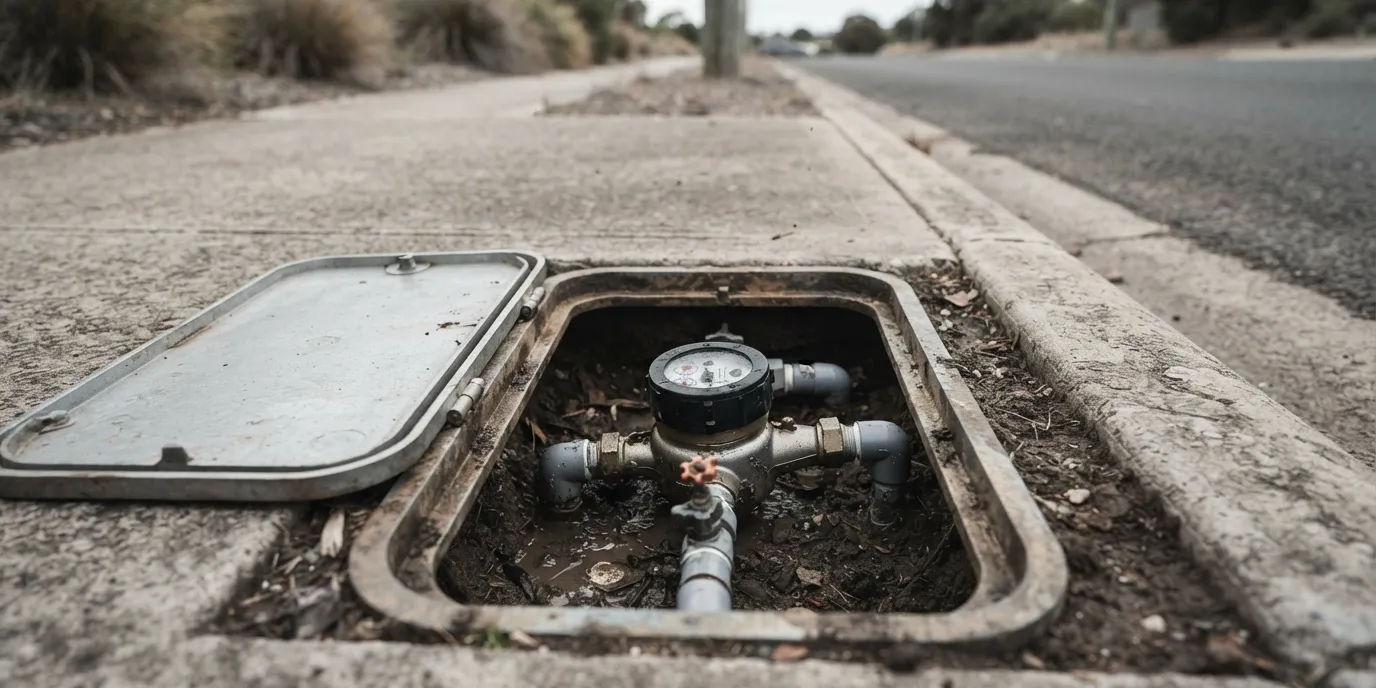
From the meter to the house
The water service line is buried, unmetered attention, and entirely yours from the meter onward. It usually announces itself as a bill you cannot explain.
Sudden total loss of water is urgent. Call and say so, day or night.
Where responsibility sits
On municipal water in Virginia, the utility owns the main under the street and the meter itself. Everything from the meter to your house, commonly called the water service line, is the property owner’s, along with every consequence of it failing. On a well, the equivalent run is from the well head or pressure tank to the house, and it is unambiguously yours.
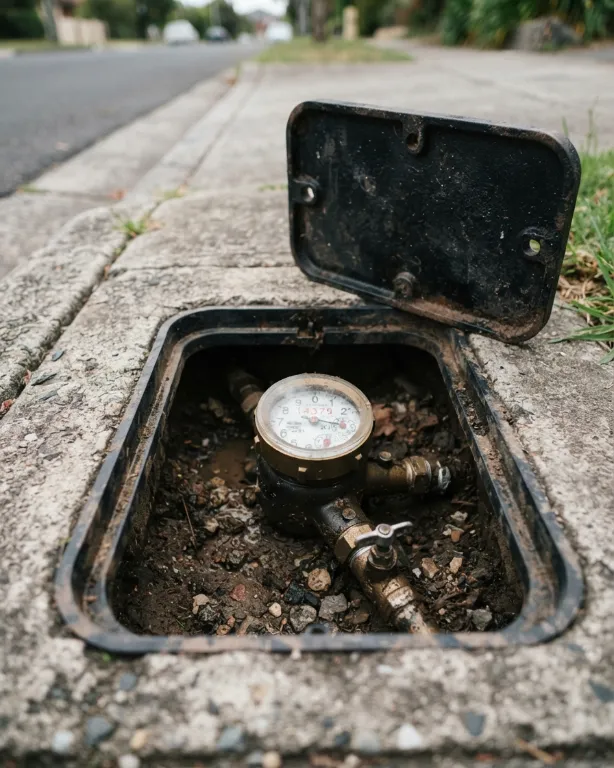
Establishing which side of the meter the loss is on is therefore the first thing that should happen, before any excavation is discussed. It is a straightforward test and it decides who pays. Water pooling in the meter box, or the utility side of the meter running when the house side is closed, points at the utility. A meter that keeps turning with the house isolation valve shut points at your line.
Service lines in Virginia are typically copper in houses from the 1950s through the 1980s, galvanised steel in anything older that has not been replaced, polybutylene in a great many houses built between the late 1970s and the mid 1990s, and PEX or HDPE in modern work. The material largely predicts how it will fail and whether repair or replacement is the sensible answer.
We establish which side of the meter first, then locate the leak before anyone opens ground.
Symptoms
A buried pressurised leak can run for months before anything appears at the surface.
The most common first sign by far. A service line leak runs continuously, so the increase is large, sudden and does not go away.
Whole-house pressure loss with no change indoors points outdoors. If it is only some fixtures, look at the pressure regulator or the pipework instead.
A soft area, standing water in dry weather, or grass growing noticeably faster in a line between the meter and the house.
A faint continuous hiss at the meter or at the point where the line enters the house, audible when the house is quiet.
Sometimes the first evidence, particularly where the line runs under a driveway and the water finds the easiest path out.
A complete failure of the line, or a shutoff that has failed. This is an emergency and gets answered around the clock.
A large unexplained bill plus a soft patch in the lawn is usually enough to diagnose on the phone.
Free, tonight
Before anybody is called out, this tells you whether water is genuinely leaving the system and roughly where, and it costs nothing but twenty minutes.
On a well there is no meter, so the equivalent test is the pump: with everything off, a pump that cycles on periodically is pressurising something that is leaking. See well pump and water system service.
Tell us the result of the shutoff test and we arrive knowing which half of the problem to look at.

Skipping it is the difference between a locate in the yard and a locate in the house. It halves the search area for free.
Before the excavator
A service line can be eighty feet long and six feet down. Locating precisely is what keeps the repair small.
The difference between a located repair and an exploratory one is measured in driveways.
| Method | What it does | Where it struggles |
|---|---|---|
| Acoustic correlation | Listens for the leak signature at two points and calculates the position between them | Very deep lines, plastic pipe, heavy traffic noise |
| Ground microphone | Surface listening directly above the suspected run | Wet ground, wind, and shallow noisy environments |
| Line tracing | Follows the route of the pipe itself so the search runs along it, not across the yard | Non-metallic pipe with no tracer wire |
| Pressure isolation | Sections the line to prove which portion is losing pressure | Needs accessible valves, which older lines often lack |
| Tracer gas | Inert gas introduced into the line and detected at the surface | Time-consuming; usually a last resort on stubborn plastic lines |
| Thermal imaging | Finds the temperature anomaly where water surfaces or saturates | Only useful where the leak has reached near the surface |
Full detail on the equipment and approach is on our leak detection page.
The decision
Once the leak is located, the choice is between a spot repair and replacing the whole run. Material and age decide it more than anything else does.
Repair makes sense when the line is copper or HDPE, in generally good condition, and the failure is a single identifiable event. A rock bearing on the pipe, a nail or a shovel strike, a poorly made joint from an earlier repair. One clean repair on sound pipe is a durable outcome.
Replace makes sense when the line is galvanised steel, which fails by internal corrosion along its whole length; when it is polybutylene, which fails at random and repeatedly; when there have already been two or more leaks; or when the line is deep, long, and the excavation cost dwarfs the pipe cost. Paying twice to open the same trench is the expensive route.
Polybutylene deserves its own note. Grey polybutylene service lines are common in Virginia houses from the late 1970s to the mid 1990s. Repairing one is a stopgap: the rest of the run is the same age and the same material. Where the service line is polybutylene, the interior pipework very often is too. See polybutylene repipe.
We will quote the repair and the replacement so the comparison is yours to make.
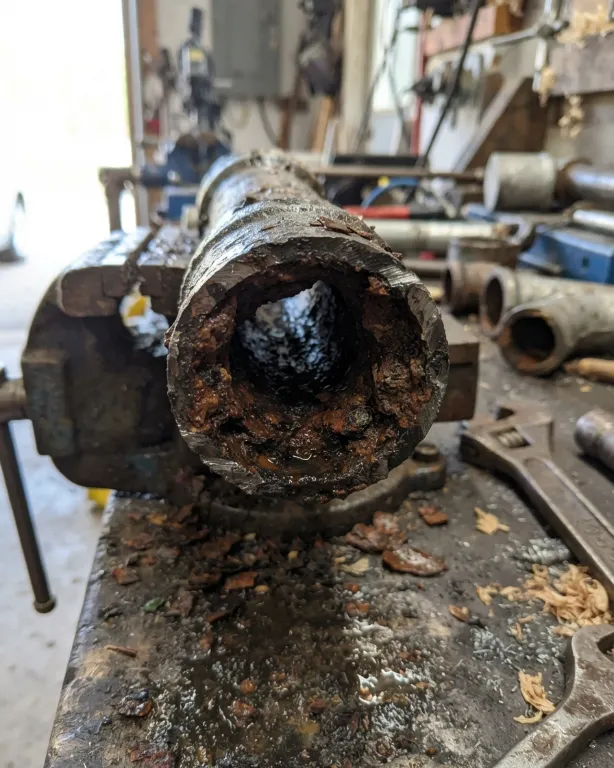
A second leak in the same buried line within a couple of years is the line telling you it is finished. Price the replacement before the third.
How it is done
Replacing a service line no longer means a trench across the whole front garden.
On most Virginia lots the new line can go in without opening the drive.
Common questions
On municipal water in Virginia, the utility owns the main and the meter; everything from the meter to your house is the property owner’s. Details vary slightly between localities, a few take responsibility to the property line, so it is worth confirming with your water authority. Establishing which side of the meter the loss is on should always be the first step.
It is driven by length, depth, what is above the run and the method used. A short, shallow run across a lawn is a modest four-figure job. A long run under a concrete driveway and a public sidewalk, with permits and restoration, is several times that. Directional boring often costs less overall than trenching once surface reinstatement is included.
Close the main shutoff where the line enters the house, then watch the meter. If it is still turning, water is escaping between the meter and that valve. Outside, in the buried line. If it stops, the leak is inside. This one test halves the problem and costs nothing.
Very much so. A pressurised leak six feet down in permeable soil can run for months without ever surfacing, particularly in the sandy soils of parts of Hampton Roads or in well-drained Piedmont ground. The bill is frequently the only evidence until someone looks for it properly.
Usually not. Directional boring runs the new line beneath a driveway, a walkway or a mature tree from small pits at each end. Where the existing line has to be excavated, because it must be located precisely, or because the route is obstructed, we will tell you before work starts, not afterwards.
For a spot repair, typically a few hours. For a full replacement, water is generally off for part of one working day and restored the same evening. On a multi-day job the supply is normally reconnected temporarily so the house is usable overnight, and you will be told the plan in advance.
HDPE or PEX for buried service lines in most Virginia installations. Both are flexible, corrosion-proof, freeze-tolerant and suitable for pulling or boring, which is what makes trenchless replacement practical. Copper is still used where a local code or a specific situation calls for it.
It might be, but check the simpler causes first. A failed pressure reducing valve is a very common cause of whole-house pressure change and is a far smaller job. See water pressure regulator. Partly closed main valves, galvanised interior pipework and a leaking service line are the other usual candidates.
For replacement of a water service line, in effectively every Virginia jurisdiction, yes, and any work in the public right of way or at the meter will be inspected. This is included in the scope of a properly run job, and the signed close-out is paperwork worth keeping for resale.
Then repairing it is a stopgap rather than a fix, because the rest of the run is the same age and the same material and will fail in the same way. It also strongly suggests the interior pipework is polybutylene too. See polybutylene repipe.
Related work
Finding it, what it is made of, and the pressure it delivers.
Acoustic, thermal and pressure equipment that pinpoints a buried leak.
Read moreThe grey pipe that fails at random, indoors and out.
Read moreThe other common cause of a whole-house pressure change.
Read moreUnexplained bill, soft lawn
We establish which side of the meter the loss is on, locate it precisely, and quote the repair and the replacement side by side. Statewide, day or night.
(866) 683-0244No water at all? That is an emergency. Call now.