Polybutylene Repipe
The grey pipe that makes the decision for you.
Read more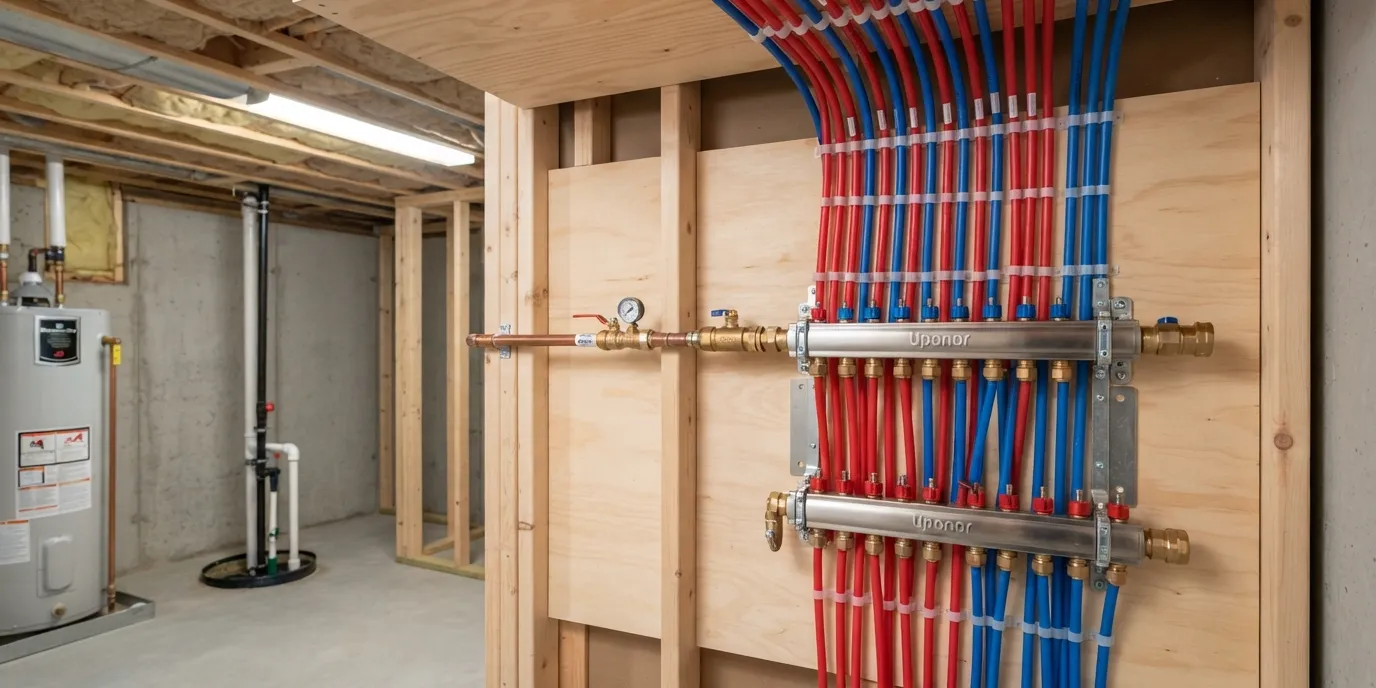
When patching stops adding up
A repipe replaces every supply line in the building. It is disruptive for a few days and then the pinhole leaks, the rust-coloured water and the pressure complaints stop for good.
Free assessment. If patching is still the right answer this year, we will tell you.
The tipping point
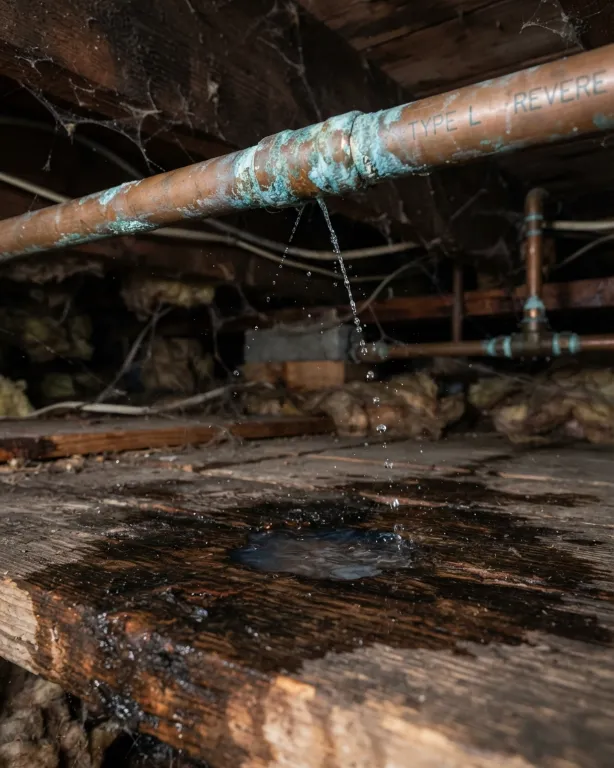
Supply pipe does not fail randomly. It fails when the material reaches the end of its service life, and when it does, every foot of it in the building is the same age and in the same condition. The first pinhole is unlucky. The second, in a different room, is the material announcing itself. By the third, you are no longer buying repairs. You are buying time, at a poor exchange rate.
The arithmetic is usually stark once written down. Three or four emergency call-outs a year, each with its own drywall opening and its own paint touch-up, adds up to a meaningful fraction of a repipe within a couple of years, and at the end of it you still have the same pipe. A repipe ends the sequence.
It is also worth being clear about what it is not. A repipe replaces the supply pipework. The pressurised hot and cold lines feeding every fixture. It does not touch the drains, and it is not a bathroom renovation. Fixtures stay where they are unless you ask otherwise.
We will look at the pipe, the access and the leak history, and tell you whether it is time.
Indicators
One of these on its own is worth a conversation. Three together is usually a decision.
Copper that has begun to pinhole from water chemistry or velocity erosion will keep doing so. Location is effectively random.
Classic galvanised steel corrosion. The bore is scaling closed and the scale is coming out of the taps.
Galvanised pipe narrows internally until flow is a trickle. No amount of pressure at the street compensates for a half-blocked pipe.
Fails at fittings and along the wall without warning. Virginia has a great deal of it. See polybutylene repipe.
If a kitchen or bathroom is coming apart anyway, repiping while the cavities are accessible costs a fraction of doing it later.
Repiping an empty house before moving in removes the disruption entirely and is much easier to finance into the purchase.
Tell us the pipe material and the leak history. That is usually enough for a straight answer.
Identify it
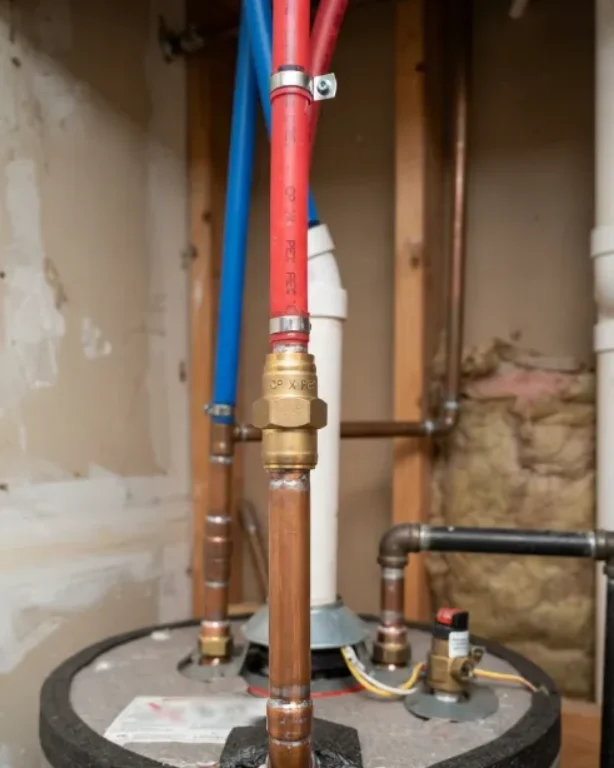
You can usually identify supply pipe material yourself at the water heater, where several feet of it are visible. Virginia’s housing stock breaks down fairly predictably by era.
Mixed materials are extremely common. A 1955 house with galvanised risers, a 1980s copper kitchen extension and a polybutylene run to a later bathroom. Transitions between dissimilar metals are themselves a failure point, and they are one of the reasons a piecemeal history eventually becomes a repipe.
Send a photo of the pipework at the water heater and we will identify it.
If it is grey polybutylene, this is not a maintenance question. Insurers and buyers both treat it as a defect, and it is worth reading the dedicated page.
The material question
Both are good. They are good at different things, and the honest recommendation depends on the house rather than on fashion.
PEX is the default for a reason. Copper is still the right answer in specific situations, and a contractor who offers only one is not advising you.
| PEX | Copper | |
|---|---|---|
| Cost installed | Lower, often substantially | Higher, mostly in labour |
| Install disruption | Less. Flexes through cavities, fewer openings | More. Rigid runs need larger access |
| Freeze behaviour | Expands somewhat before splitting | Splits readily; a real factor in unheated crawl spaces |
| Water chemistry | Unaffected by aggressive or acidic water | Can pinhole where water chemistry is aggressive |
| Service life | Long, though shorter track record than copper | Very long where the water suits it |
| UV and heat | Must not be exposed to sunlight; keep clear of flues | Tolerates both |
| Resale perception | Now entirely standard and well accepted | Still viewed as premium by some buyers |
Water chemistry, crawl space temperatures and access all bear on this. We will explain the reasoning.
The disruption
This is the part people worry about most, and it is generally less bad than expected. A typical three-bathroom Virginia house is three to five working days.
Day one: protection and access. Floors and furniture covered, then access openings cut. A good crew cuts the smallest number of the neatest openings, usually high on walls and in ceilings, planned so that patching is straightforward. You should be shown the plan before anything is cut.
Days two and three: the new system. New lines run to every fixture, often as home runs from a central manifold in a basement or utility space, which means each fixture has its own dedicated line and can be isolated individually. Water is typically off during working hours and back on each evening.
Day three or four: cut over and test. The new system is connected, pressure tested, and the old pipework abandoned in place or removed where accessible. Every fixture is run and checked.
Day four or five: inspection and patching. The jurisdiction inspects while the walls are open, then openings are patched. Confirm in writing whether the quote includes patch only, patch and prime, or patch and paint. This is the single most common source of misunderstanding on a repipe.
Including exactly where the openings will be and who closes them.
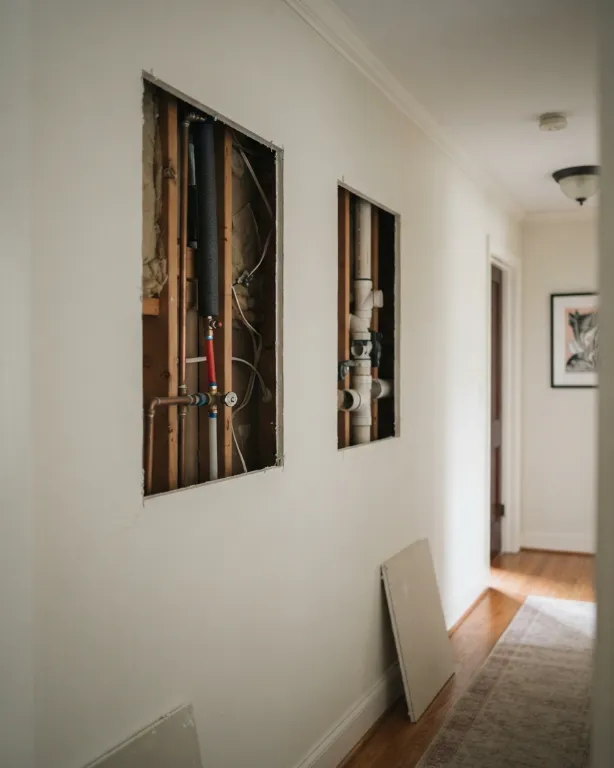
Patch only, patch and prime, or patch and paint to a finish. Three different prices, and the difference is worth clarifying before you sign.
Budgeting
Repipe quotes vary widely between houses for reasons that are entirely legitimate.
Itemised, with restoration scope stated explicitly.
Common questions
It is generally a five-figure job, with the range driven mainly by the number of bathrooms, the number of storeys, foundation type and material choice. A single-storey two-bathroom house over an accessible crawl space, repiped in PEX, sits at the lower end. A three-storey house on a slab with plaster walls, repiped in copper with full paint restoration, sits considerably higher. Any quote should itemise the restoration scope.
Three to five working days for a typical Virginia house, with water off during working hours and restored each evening. Larger or more complex houses take longer. Inspection and patching sit at the end of that window, and paint, if included, may follow separately.
Almost never. Most households stay put. Water is available every evening and overnight, one bathroom is usually kept in service where the layout allows, and the crew works around normal life. An empty house is quicker and cheaper, which is why repiping between purchase and move-in is worth considering if the timing works.
PEX for most Virginia houses: lower cost, less invasive to install, immune to the water chemistry that pinholes copper, and more forgiving in a cold crawl space. Copper remains a reasonable choice where you want the longest possible track record and the water suits it. The genuinely wrong answer is a contractor who offers only one without explaining why.
No. Access openings are cut selectively, usually high on walls and in ceilings, at points chosen to minimise both the number of openings and the difficulty of patching. An experienced crew plans this before cutting anything, and you should be shown that plan.
It depends on the quote, which is exactly why this needs settling in writing. Some include patch only, leaving you to prime and paint. Some include patch and prime. Some finish to paint. All three are legitimate scopes at three different prices. The problem is only ever assuming which one you bought.
If the cause is corroded galvanised pipe closing up internally, yes, dramatically. If the cause is a failed pressure reducing valve, a partly closed main valve or a leaking service line, a repipe will not help and something much cheaper will. That is why the assessment comes first. See water pressure regulator.
Not as part of a supply repipe. Drains are a separate system, usually cast iron or ABS, with their own failure modes and their own costs. If the camera shows the drains are also at end of life, we will say so and price it separately rather than folding it in quietly.
It removes a deduction rather than adding a premium, which in practice is worth a great deal. A disclosed repipe with permit close-out is a straightforward positive in a Virginia listing, particularly where the alternative disclosure would be polybutylene or a history of leaks.
Yes, in effectively every Virginia jurisdiction, and the work is inspected while the walls are open. Keep the signed close-out. A buyer’s agent will ask for it, and it is far easier to file now than to retrieve from a county records office in eight years.
Related work
The specific cases, and the thing to check before you commit to anything.
The grey pipe that makes the decision for you.
Read moreRepiping an old house without destroying the fabric of it.
Read moreCheck this before assuming low pressure means a repipe.
Read morePatching the same house again
A repipe replaces every supply line in the building and ends the cycle. One call reaches an experienced local repipe crew in your part of Virginia, with a fixed price and a stated restoration scope.
(866) 683-0244Free assessment, and an honest answer about timing.