Toilet Repair & Installation
The other fixture in the room, and the one that wastes the most water when it fails.
Read more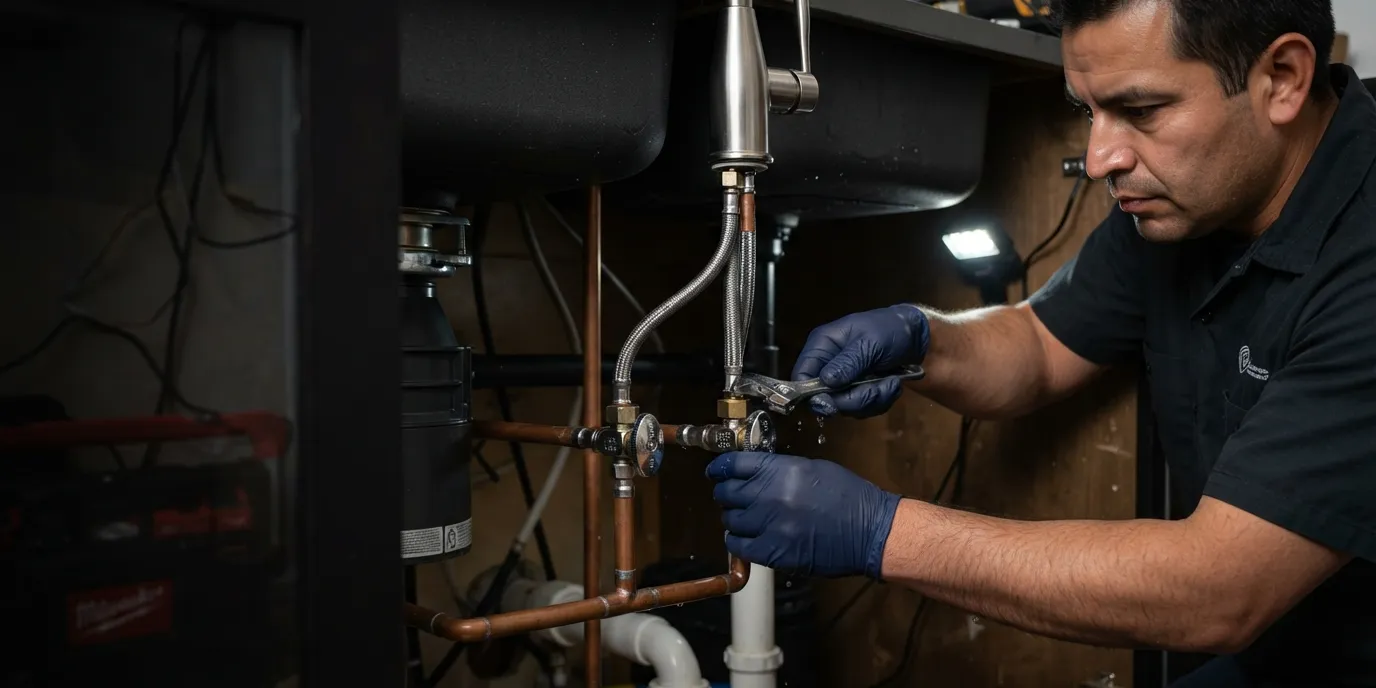
Fixtures · Statewide
A dripping tap is the smallest plumbing problem in a house and one of the most expensive to leave, and the parts that actually decide how bad a fixture failure gets are the shutoffs and supply lines nobody looks at.
Make a list of everything that drips, sticks or wobbles. One visit is far cheaper than four.
Dollar ranges here are typical Virginia costs, given for planning only. They are not a quote. The independent plumber who takes your job sets the price and gives it to you before work begins.
Diagnosis
A faucet has one job and about six ways to stop doing it well. Most are cartridge-level repairs.
| Symptom | Usual cause | Action |
|---|---|---|
| Drips from the spout when off | Worn cartridge or seat | Replace cartridge |
| Leaks around the base of the spout | O-rings under the escutcheon | Rebuild kit |
| Leaks under the sink when running | Supply connection, or the faucet body | Retighten or replace |
| Water under the sink all the time | Supply line or shutoff stop | Replace stop and line |
| Weak flow at one tap only | Clogged aerator or a partly closed stop | Clean or open |
| Weak flow at all taps | Pipe, regulator or supply line | Test pressure first |
| Handle stiff or grinding | Scale in the cartridge | Replace cartridge |
| Handle spins with no effect | Stripped stem or broken handle adaptor | Replace part |
| Cannot balance hot and cold in the shower | Failing pressure-balance or thermostatic valve | Valve cartridge or replacement |
| Loud vibration or hammer when shutting off | Pressure, loose pipe or a worn cartridge | Check pressure and strapping |
The single most useful diagnostic distinction: one fixture or all of them. A weak or dripping single tap is a faucet problem and a small one. Poor flow at every tap in the house is a pressure or pipe problem and belongs on water pressure regulator or, in an older house, historic home plumbing, no amount of new faucets will fix a supply line closed up with rust scale.
One drip per second is roughly 3,000 gallons a year. Two dripping taps and a running toilet show up plainly on a Virginia water bill.
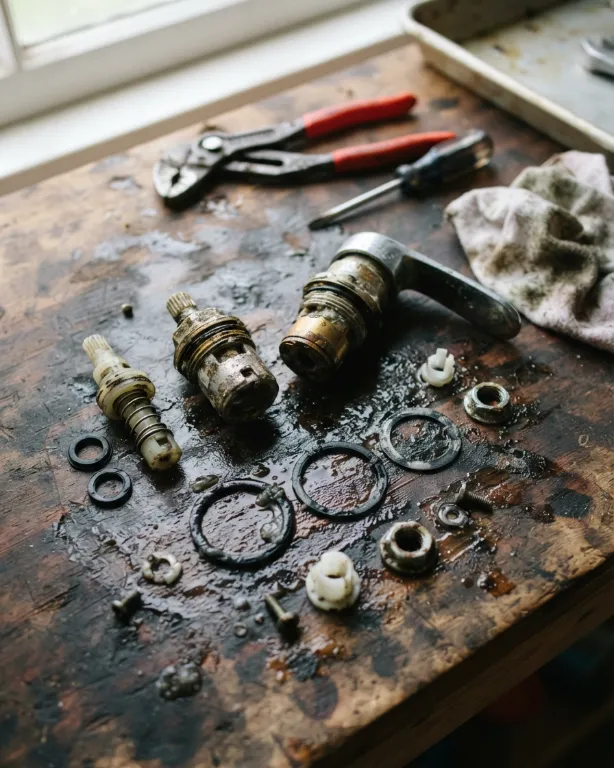
Faucet cartridges are brand and model specific and there are hundreds of them. Photographing the faucet and taking the old part to the counter avoids two extra trips.
Most cartridge and aerator work is a single short visit.
Repairs
Faucets are one of the few fixtures where the quality of the original decides the answer.
The standard fix for a drip or a stiff handle. On a decent-quality faucet, cartridges are available for decades and often carry a lifetime parts warranty from the manufacturer. Worth checking before paying for one.
For leaks around the spout base or under the handle. Inexpensive, and it restores a faucet completely when the cartridge itself is sound.
The first thing to check for weak flow at one tap. Unscrew, soak in vinegar or descaler, rinse the screen and refit. Costs nothing and solves a surprising share of complaints. Especially after any main or repipe work, which flushes debris into every aerator in the house.
Faucets with plastic internals and no available parts are not economically repairable. If the body is plastic and the finish is already failing, put the labour into a better fixture instead.
Where the escutcheon, the mounting nuts or the body have corroded solid, common in hard water and in coastal air, replacement is the practical route.
If the hole configuration is changing, or you are going from a three-hole to a single-hole layout, the faucet changes with it. Plan the hole count and spread before buying.
What actually distinguishes a good faucet: a solid brass body rather than zinc or plastic; a ceramic disc or high-quality cartridge; a physical vapour deposition finish if you want it to still look right in ten years; and a manufacturer with a real parts programme. Pull-down sprayers should have a braided hose and a magnetic dock. Spring docks sag within a couple of years. Beyond that, price is buying you styling.
Whatever you choose, ask for the supply stops to be replaced at the same time. Old multi-turn stops are the reason a small leak becomes a wet floor: the moment you need to close one is the moment it seizes. Quarter-turn ball stops and braided stainless supply lines are a few dollars each and they are the parts that let you handle the next problem yourself.
Tell us the brand and roughly the age. Some faucets have free lifetime parts; some are not worth a cartridge.
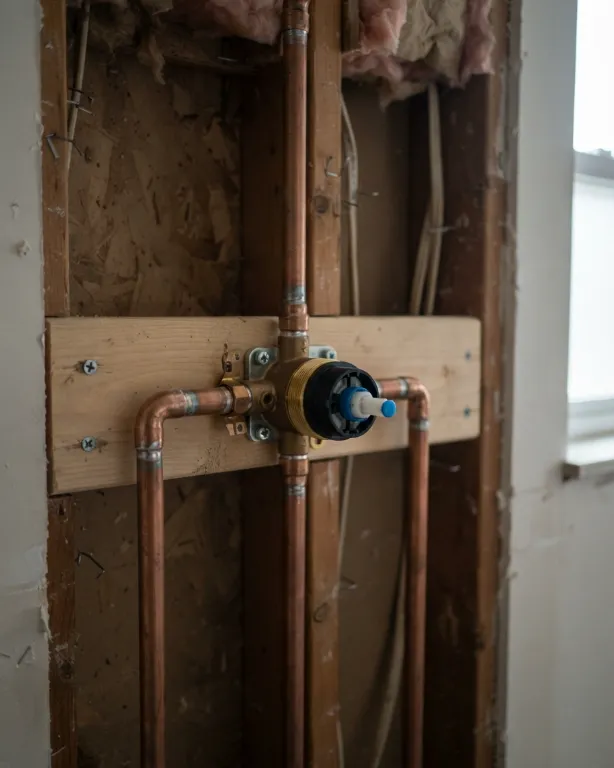
A cartridge is a half-hour job through the trim plate. Replacing the valve body means opening the wall, from the back if there is access, or through tile if there is not. Get an honest answer about which one you need before the work starts.
Showers and tubs
Everything else in this list is accessible. Shower valves are behind tile, which changes the calculus.
Three kinds of valve turn up in Virginia homes. Old two-handle valves with separate hot and cold stems: serviceable, but they offer no scald protection, and a toilet flushing elsewhere will change the shower temperature. Pressure-balancing valves, the current standard: a single handle with an internal spool that holds the hot-cold ratio when pressure changes on one side. Thermostatic valves hold a set temperature rather than a ratio, which is more comfortable and more expensive, and they are the right answer for a large shower with several heads.
Most shower complaints are cartridge-level. A stiff handle, a valve dripping into the tub, a shower that will not get hot enough, or a temperature that swings when a toilet flushes are all cartridge or balancing-spool symptoms, fixed through the trim plate without touching tile. Scale is the usual cause, so in hard-water areas expect a cartridge every eight to twelve years.
The valve body only needs replacing if it is cracked, if the threads or seats are eroded, if you are changing brands, or if you are moving from two handles to one. That is wall-opening work, and where a tiled wall has no rear access it is worth pairing with planned bathroom work rather than doing alone.
Fixtures
Sinks, disposals, laundry, outdoor taps and the small fittings that cause most of the callbacks.
Disposals last eight to fifteen years and fail either at the motor or at the flange seal. A humming unit with no rotation is usually a jam; a unit that trips repeatedly is on its way out. A leak from the body seam is terminal. Disposals also feed grease into the line, if drains are slowing, see drain cleaning.
Rubber washing machine hoses are one of the most common causes of catastrophic domestic water damage. Replace them with braided stainless every five years, and fit a single-lever laundry box so both valves close at once. If the laundry is above finished space, a pan and a leak sensor are cheap insurance.
Virginia winters split hose bibs regularly, usually because a hose was left attached over a freeze. A frost-free sillcock with a vacuum breaker is the correct replacement, and it must be pitched so it drains. See freeze protection.
The unglamorous parts that determine how bad a failure gets. Quarter-turn ball stops and braided stainless lines at every fixture, replaced whenever anything else is being worked on.
Pop-up assemblies corrode and their pivot seals fail, dripping into the cabinet. Old chrome-plated brass P-traps thin out and perforate. Both are inexpensive, and both are usually found while investigating a cabinet that smells damp.
All straightforward additions if there is a supply and, where needed, an outlet nearby. The planning question is always the same: where does the water come from, and where does it go if it leaks?
Two recommendations we make on nearly every fixture visit. First, put braided stainless on everything. Washing machine, dishwasher, ice maker, toilets, faucets. Rubber hoses and plastic ice-maker tubing fail with no warning and they fail at full pressure. Second, know where your main shutoff is and confirm it actually turns. A house where nobody can find the shutoff is a house where a $20 hose becomes a $20,000 claim; if yours is seized, that is a small job worth doing now. See emergency plumbing for what to do in the meantime.
Installation
The fixture is the easy part. The connections, the seals and the shutoffs are where installations succeed or fail.
If several fixtures are being replaced, do them in one visit. Most of the cost is arrival, access and testing, and a plumber already under one sink is much cheaper for the second than a separate call would be. The same logic applies to bundling fixture work with a water heater replacement or a regulator, one visit, one set of shutdowns.
Write down everything that drips, sticks or wobbles. One visit covers it far more cheaply than four.
Cost
Fixture work is predictable, which makes it easy to quote and easy to compare.
| Work | Typical range |
|---|---|
| Aerator clean or replacement | $85. $150 |
| Faucet cartridge replacement | $140. $320 |
| Faucet rebuild with O-ring kit | $150. $300 |
| Kitchen faucet fitted, customer supplied | $220. $450 |
| Bathroom faucet fitted, customer supplied | $180. $380 |
| Supply stop and braided line, each | $95. $190 |
| Shower valve cartridge | $180. $400 |
| Shower valve body replacement, wall access | $600. $1,400 |
| Shower valve body through tile | $900. $2,500 |
| Garbage disposal fitted | $300. $650 |
| Frost-free hose bib replacement | $250. $550 |
| Laundry box with single-lever valve | $350. $750 |
| Sink drain and trap assembly | $150. $350 |
Fixtures supplied by the homeowner are normal and usually cheaper, with one caveat: buy something with available parts. A bargain faucet with plastic internals and no parts programme costs the same to fit and cannot be repaired in five years, so the labour is spent twice.
Roughly 3,000 gallons a year from one tap. A small repair with a measurable return, and it is usually a cartridge.
Washing machine, dishwasher, ice maker, toilets, faucets. Rubber and plastic supply lines fail without warning at full pressure. The cheapest water-damage prevention available.
Then turn it, to confirm it works. Everything else on this page is easier to survive if that one valve does its job.
Questions
A drip a second is roughly 3,000 gallons a year, about 8 gallons a day from a single tap. A faster drip or a small stream can be several times that. It is not the biggest leak in a house, but it is the easiest one to fix, and the repair is usually a cartridge that costs less than a month of the waste.
Repair if it is a decent faucet with a brass body and available parts, many quality brands supply cartridges for decades and some carry lifetime parts warranties, so the repair can be almost free in materials. Replace if the body is plastic or zinc, if the finish is already flaking, or if parts are no longer made. The labour is similar either way, so put it toward something that can be repaired next time.
Start with the aerator: unscrew it from the spout, soak it in vinegar or a descaler and rinse the screen. Scale and debris collect there, and it accounts for most single-tap flow complaints. Particularly after any work on the main or a repipe, which flushes debris into every aerator in the house. If that does not fix it, check that the supply stop under the sink is fully open, then suspect the cartridge.
No. Whole-house low pressure is a pressure or pipe problem. Test static pressure with a gauge at an outside hose bib: below 40 psi points at a failing pressure regulator, a partly closed valve, a restricted service line, or, in houses built before 1960, galvanised supply pipe closed up with internal rust. Replacing faucets will not change any of those.
Yes. Old two-handle valves have no compensation, so any pressure change on one side shifts the mix. A modern pressure-balancing valve holds the ratio, and a thermostatic valve holds an actual temperature. If you already have a single-handle balancing valve and it still swings, the internal spool or cartridge is worn. That is a cartridge replacement through the trim plate, not a wall-opening job.
Not necessarily. Most shower complaints are solved by replacing the cartridge, which is done through the trim plate with no demolition at all. Replacing the whole valve body is what needs access, and that can often come from behind. A closet, an adjoining room, or a basement ceiling. Where a tiled wall has no rear access, ask about fitting a neat access panel while it is open so the next repair is simple.
Eight to fifteen years. A unit that hums without turning is usually jammed and can often be freed. One that trips its reset repeatedly, or that leaks from a body seam rather than a connection, is finished. Bear in mind that disposals send food solids and grease into the drain line, so if drains have been slowing, the disposal may be a contributing cause rather than an innocent bystander.
Almost always a hose left attached through a freeze. Water trapped in the valve body cannot escape, it expands as it freezes, and the body cracks, then leaks inside the wall the next time the tap is opened in spring. The fix is a frost-free sillcock, correctly pitched to drain, with a vacuum breaker, and the habit of disconnecting hoses every autumn.
Yes, and the difference in cost is trivial. Rubber washing machine hoses and plastic ice-maker tubing are among the most common causes of severe domestic water damage, because they fail suddenly at full pressure and often while nobody is home. Braided stainless lines on every appliance and fixture, plus quarter-turn shutoffs, is the cheapest water-damage prevention available.
Yes, and it is often cheaper. Two things to check before you buy: that the hole count and spread match your sink or countertop, and that the manufacturer actually supplies replacement cartridges. A cheap faucet costs the same to install as a good one and cannot be repaired later, so the saving is usually temporary.
Related work
Fixture visits often turn into one of these, or the other way around.
The other fixture in the room, and the one that wastes the most water when it fails.
Read moreWhen the problem is every tap rather than one, start with pressure.
Read moreHose bibs, exposed lines and the winter failures that are entirely preventable.
Read moreMake the list
Most of the cost of fixture work is arriving, getting access and testing. A plumber already under one sink is much cheaper for the second, so write down all of it and do it at once.
(866) 683-0244Statewide, 24 hours. Independent licensed professionals.