Drain Cleaning
Clearing the line, which usually has to happen before the camera goes in.
Read more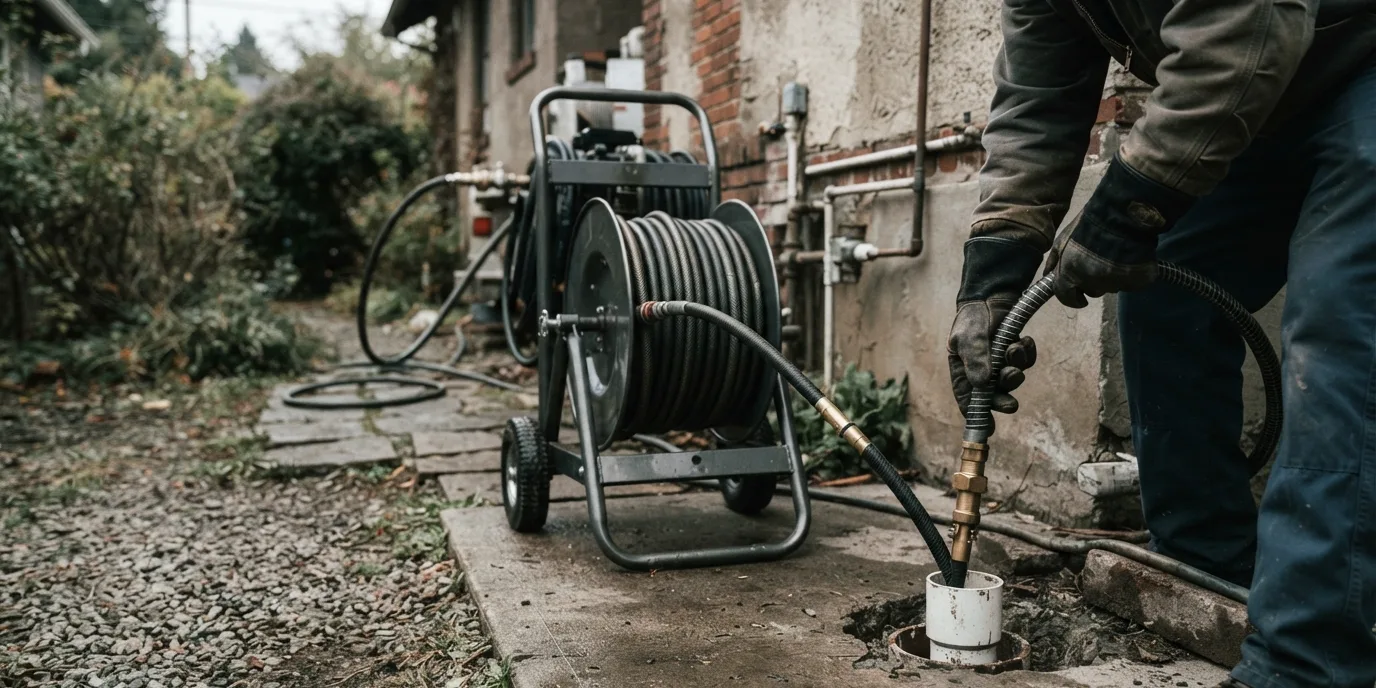
Twenty minutes, one answer
A camera survey turns a four-figure argument into a short conversation over a screen. You get the footage, the distances and a straight explanation of what it shows.
Recording handed over as a file. Bring it to any contractor for a second opinion.
Why it matters
Every expensive sewer decision rests on four pieces of information: what the pipe is made of, what is wrong with it, exactly where along the run the problem sits, and how deep it is at that point. A camera survey establishes all four in about twenty minutes. Without it, every quote is an estimate wrapped around an assumption.
It is also the step that most often saves money rather than costing it. A great many lines that were about to be replaced turn out to have a grease plug, a wipes mass or a single reinstated joint that a jetting visit resolves. The survey that found that is the most profitable hour you will spend on the house.
And the footage is yours. A survey that ends with a plumber saying it looks bad and then putting the equipment away has given you nothing you can act on. You should leave with a file, a set of distance readings, and enough understanding to hold a sensible conversation with a second contractor.
Footage, distances and an explanation. Bookable on its own, without any repair attached.
Good reasons
Not every slow drain needs one. These situations almost always do.
Two clearances is bad luck. Three is a defect. The camera costs less than the fourth clearance and ends the cycle.
Home inspectors do not camera laterals unless asked. On a pre-1975 Virginia house with mature trees this is the highest-value item you can add to an inspection.
No contractor should price a lateral they have not seen, and you should not accept a price from one who has not.
Post-jetting footage proves the wall is bare and reveals defects the build-up was hiding.
A clean recent survey removes a whole category of buyer negotiation. A bad one is far better found by you than by their inspector.
Heavy equipment, new footings and utility trenching all move ground. A survey establishes the line was fine after the work, and by whom it was disturbed if not.
No repair required, no obligation. Just the footage and the facts.
On the screen
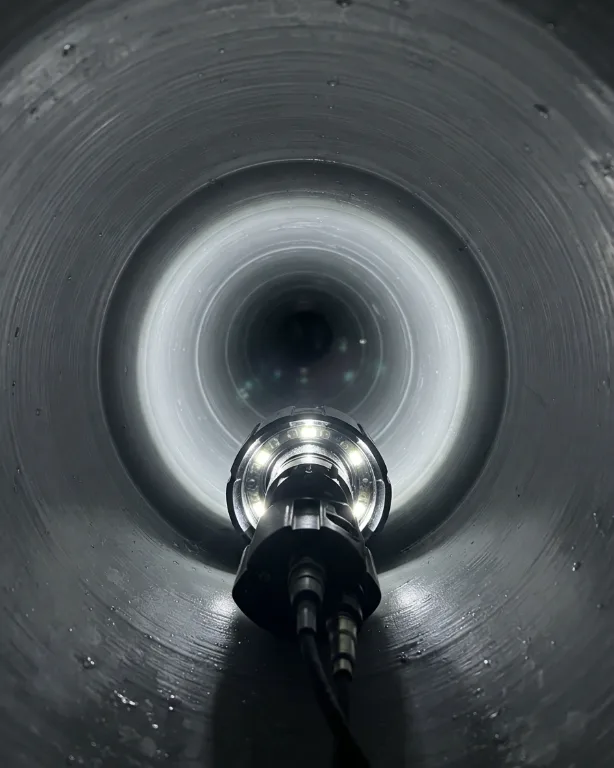
A self-levelling camera head on a push rod goes in at the cleanout and travels the length of the lateral to the connection. What it reports, in order of how often we see it in Virginia:
A sonde in the camera head transmits a signal that is tracked from the surface, so the position of any defect is marked on the ground and its depth estimated. That is the difference between digging where the problem is and digging where someone thought it might be.
Twenty minutes now, instead of a trench in the wrong place later.
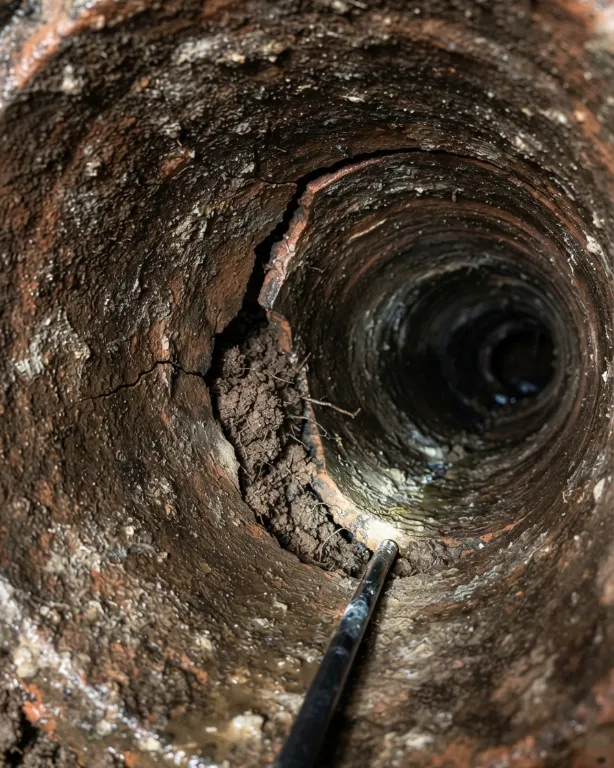
Marking the defect on the surface, with a depth, is what makes the footage actionable. Footage without a located defect is only half a survey.
Reading the report
Terms get used loosely in sewer quotes. Here is what each finding implies about urgency and cost.
Ask one question of every finding: does this need doing now, this year, or at some point? A good surveyor will answer it without hesitating.
| Finding | What it means | Typical response |
|---|---|---|
| Root hair at one joint | Early intrusion, line otherwise sound | Clear and monitor, or line that section |
| Root mass filling the bore | Established intrusion, joint is open | Cut back, then line or replace the section |
| Grease-lined wall | Cleaning problem, not a structural one | Jetting, then habits |
| Offset joint, minor step | Movement has occurred, catching solids | Monitor if flow is fine; repair if it blocks |
| Standing water over several feet | A belly. The line has sagged | Excavate and re-grade; lining will not fix it |
| Soil visible through the wall | The pipe is open to the ground | Repair; this is not something to defer |
| Oval, soft-walled pipe | Deforming Orangeburg | Replacement or bursting; do not jet it |
We will tell you what is urgent and what genuinely is not.
Pre-purchase
A sewer survey is the single best-value addition to a home inspection on any older property, and it is routinely skipped because nobody suggests it.
Which houses. Anything built before about 1975, anything with mature trees between the house and the street, and anything in an established neighbourhood in Richmond, Alexandria, Norfolk, Roanoke, Lynchburg, Fredericksburg or Winchester where clay laterals are the norm.
What it costs relative to the risk. The survey is a small fraction of one percent of the purchase price. The repair it can reveal is frequently a five-figure item, and it is far easier to negotiate before closing than to fund afterwards.
Access. The survey needs a cleanout. On some older houses there is not one, and access has to be taken through a pulled toilet or a roof vent, which is worth knowing before the appointment is booked. Seller cooperation is required, and it is a reasonable thing to ask for.
Timing. Within the inspection contingency period, alongside the general home inspection where possible, so one visit covers both and the findings arrive together.
Scheduled to fit your contingency window, with footage sent the same day.

If the property has no accessible cleanout, establish that early. Installing one is a modest job, but it is not something to discover on inspection day.
Deliverables
If you receive less than this, you have bought a look rather than a survey.
Footage, distances, locations and a written summary as standard.
Common questions
As a standalone visit it is a modest flat fee. Comparable to a routine service call and a very small fraction of any sewer repair. Added to a visit already booked for drain cleaning or jetting, it is cheaper still. Anyone offering it free is generally selling something afterwards, and free surveys have a way of finding expensive problems.
Usually twenty to forty minutes for a typical domestic lateral, plus time to review the footage with you. A long rural run, or a line that has to be cleared before the camera can pass, takes longer. If the pipe is blocked it must be cabled or jetted first, because a camera cannot see through a blockage.
No. The camera goes in through an existing cleanout. Where there is no cleanout, access can sometimes be taken through a pulled toilet or a roof vent, and occasionally the sensible recommendation is to install a cleanout, which is a modest job and makes every future service easier.
Yes, always, as a file you keep. This matters: it is your evidence when comparing quotes, your record at resale, and your baseline if the line is surveyed again in five years. A survey that leaves you with nothing to take away is not worth paying for.
Approximately, yes. The camera head carries a sonde transmitter that is tracked from the surface with a locator, which gives both a position to mark on the ground and a depth estimate. Depth is the largest single factor in excavation cost, so it belongs in the survey rather than in the quote.
On any Virginia house older than about forty years, or with mature trees between the house and the street, yes. Standard home inspections do not include it. It is a small addition to inspection costs and it is the item most likely to uncover a five-figure liability while you can still negotiate on it.
No. Sewer cameras work in drain lines, which are not pressurised. Finding a pressurised water leak is a different discipline using acoustic, thermal and pressure equipment. See leak detection.
That is a good outcome and a common one. It rules out the expensive possibilities, points at something simpler, a venting fault, a fixture problem, a one-off obstruction, and gives you a dated baseline recording of a sound line, which has real value when you come to sell.
The house line and the run out to the tank, yes, and that is often exactly where the problem is. The tank and drain field themselves are the province of a licensed septic contractor. See septic system plumbing.
Related work
A survey is a decision point. These are the three directions it usually points.
Clearing the line, which usually has to happen before the camera goes in.
Read moreWhere the footage shows something structural.
Read moreRebuilding the line without a trench, when the pipe suits it.
Read moreBuying, selling or blocked again
A recorded survey with distances and surface locations, handed to you as a file. One call reaches an experienced local professional with a camera on the van.
(866) 683-0244Standalone surveys welcome, statewide, no repair required.