Slab Leak Repair
Spot repair through the concrete, or a reroute around it.
Read more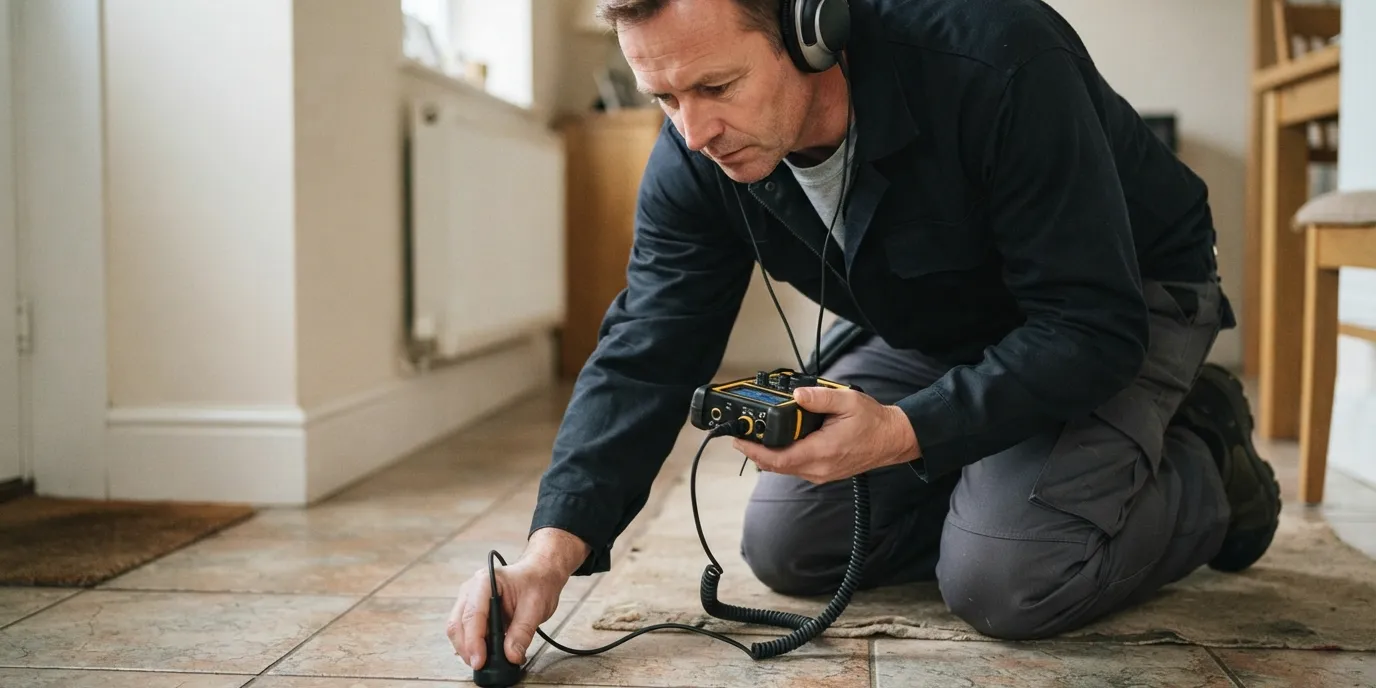
Leak detection · Non-invasive · Statewide
A meter that keeps turning, a stain that comes back, a bill with no explanation. Acoustic, thermal and pressure testing turn a guess into one small hole in exactly the right place.
Detection first, repair second. It is almost always the cheaper order.
The case for looking first
The instinct when water appears is to open the thing nearest the water. It is almost always wrong. Water leaves a pipe under pressure, hits a joist or a stud, runs sideways along it, then travels down inside a cavity until it finds a seam, a light fitting or a drywall joint to come out of. The visible stain is where it finished, not where it started.
Proper detection reverses that. The system is isolated section by section to establish which part is losing water, then acoustic and thermal equipment narrows the location to within inches. Then, and only then, does anything get opened. The result is one neat access instead of an exploratory demolition, and a repair bill that reflects the pipe rather than the drywall.
This matters more in Virginia than in a lot of states because of the housing mix. Slab-built subdivisions hide leaks under concrete. Crawl space homes hide them under a floor nobody visits. Old Richmond, Alexandria, Fredericksburg and Winchester houses hide them inside plaster walls that are genuinely expensive to repair. In all three cases, guessing is costly.
Non-invasive first. You should know where it is before anything is cut.
Symptoms
None of these prove a leak on their own. Two or three together usually do.
A rise of a third or more with no change in habits. Compare to the same month last year rather than to last month, since irrigation and summer use distort the picture. Bills lag, so the leak has probably been running longer than the bill suggests.
A faint hiss or trickle in a wall or under a floor when the house is quiet and every tap is closed. This is the most reliable single indicator there is, and it is why plumbers ask you to listen at night.
Painted over once and back again means active, not historic. Note the shape. A stain with a defined edge that grows slowly is a slow drip; a diffuse one that appeared fast is a bigger escape.
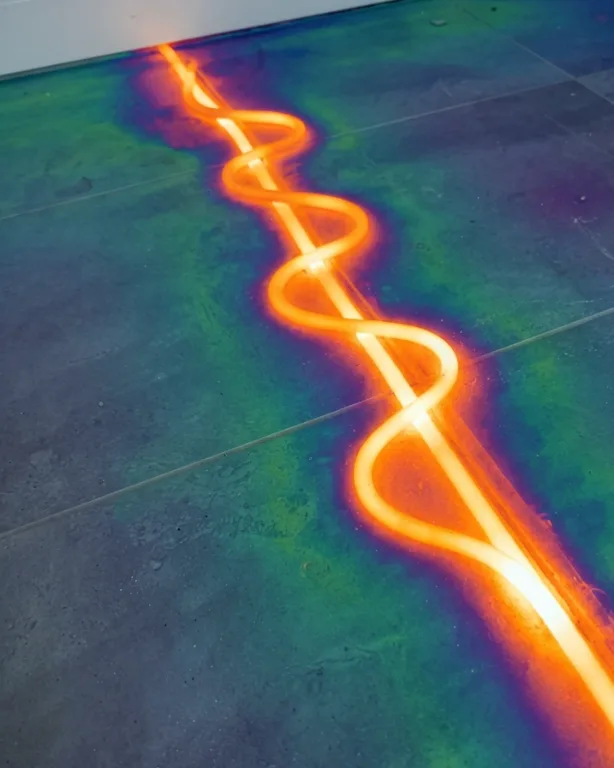
A patch of floor noticeably warmer than the rest, in a slab home, is a hot-water slab leak until proven otherwise. Cool and damp points at a cold line or a drain.
A gradual loss of pressure across the whole house, rather than at one fixture, can mean water is escaping before it reaches the fixtures, often on the main service line.
Grass that stays lush in a dry spell, a soft spot underfoot, or water surfacing along the line from the street. Underground service line leaks announce themselves through the lawn long before anything else.
Two or three of these together usually tells us where to start looking.
Free, and worth doing tonight
This costs nothing and answers the most important question. Is water actually leaving the system, or are you dealing with condensation, a roof issue or something that already stopped?
On a well there is no meter, so the equivalent test is listening for the pump. If it kicks in periodically with no water being used, the system is losing pressure somewhere. See well pump and water system service.
That one test tells us more than a page of description.
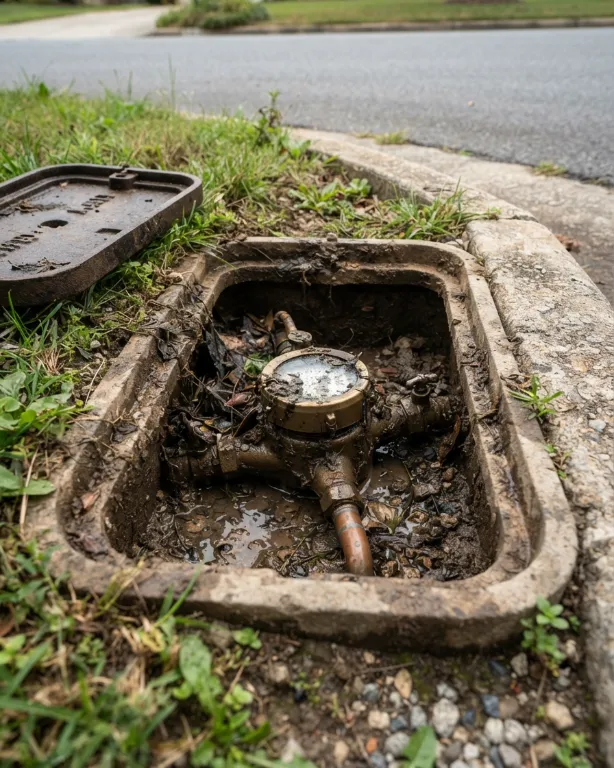
Establishing this before anyone digs is important. Loss on the street side of the meter is generally the utility's responsibility. Loss between meter and house is yours.
The toolkit
No single instrument finds every leak. What makes detection reliable is eliminating possibilities in a sensible order and then confirming the location two different ways before anything is opened.
The goal is not to find water. It is to be confident enough to cut in exactly one place.
| Method | Best for | Limits |
|---|---|---|
| Pressure isolation testing | Establishing which part of the system is losing water. Hot side, cold side, service line, or a fixture | Needs isolating valves, which older Virginia houses often lack in useful places |
| Acoustic listening | Pressurised supply leaks, including under slabs and in walls. The mainstay of the trade | Struggles with drain leaks, which are not under pressure, and with very high background noise |
| Thermal imaging | Hot-water lines under floors, wet material behind finishes, tracing the extent of saturation | Shows temperature, not water. A cold-water leak in a cool wall can be nearly invisible |
| Moisture metering | Confirming how far water has travelled and whether material is still wet | Confirms extent rather than source; used alongside the others |
| Tracer gas | Stubborn cases, small drain leaks and lines that cannot be heard acoustically | Slower and more involved; usually a second-stage method |
Two independent confirmations before anyone opens a wall or a floor.
Local knowledge
The largest category statewide. Nothing to see, nothing to hear from upstairs, and the water simply soaks away. Found by the bill, by a musty smell or by a soft floor. See crawl space plumbing repair.
Warm floor, running sound with everything off, unexplained bill. Located acoustically and thermally from above before any decision about spot repair or reroute. See slab leak repair.
Often the easiest to find and the most damaging while you look, because it is running into a room you use. Common in Northern Virginia and older Piedmont housing stock.
Between the meter and the house. Shows as a green patch, a soft spot, pressure loss, or a meter that keeps moving with the house shutoff closed. See main water line repair.
Historic houses in Richmond, Alexandria, Fredericksburg, Staunton and Winchester. Plaster and lath is expensive to open and expensive to make good, so precise location matters more here than anywhere. See historic home plumbing.
A weeping valve body or a failed shower pan drips into the floor structure and shows up as a stain on the ceiling below, often several feet away. Frequently misdiagnosed as a supply leak.
Photographs, a marked location, and a price for the repair before anything is opened.
Check these first
Before paying anyone to hunt for a hidden leak, rule out the visible ones. A surprising share of "mystery" water bills come from three ordinary things that make no noise and leave no stain.
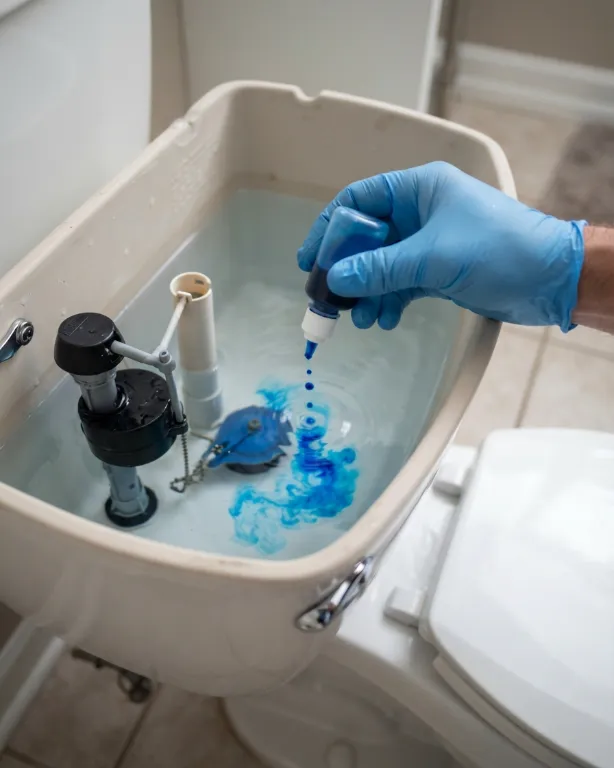
A toilet flapper that seeps. The single biggest silent waster in the average home. Water passes continuously from tank to bowl without any sound or visible movement. Put a few drops of food colouring in the tank, wait twenty minutes without flushing, and if colour appears in the bowl the flapper is passing. A replacement is inexpensive. See toilet repair and installation.
An irrigation system. A stuck valve or a cracked line underground runs for hours on a schedule nobody thinks about. Worth checking the controller and looking for the greenest patch on the property.
A water heater relief valve. A temperature and pressure relief valve discharging into a drain pan or a pipe that runs outside can pass water continuously and completely invisibly. Often a sign of excessive pressure rather than a faulty valve. See water pressure regulators.
If the simple checks come back clean, the leak is hidden and worth finding properly.
Common questions
The meter test settles it on municipal water. Turn off every fixture and appliance that uses water, note the meter reading or watch the small low-flow triangle, and wait two hours. Any movement means water is going somewhere. On a well, the equivalent sign is a pump that cycles on periodically when nobody is using water.
Because water travels. It runs along the top of a joist, down inside a wall cavity, and emerges at the first place gravity and a seam let it out, which is frequently several feet from where it left the pipe. Opening drywall based on a stain is how people end up with three holes and an unfound leak. Detection first, one hole second.
Acoustic listening gear that picks up the sound of pressurised water escaping through a small opening, thermal imaging that shows temperature differences from wet material or a hot line under a floor, moisture meters for confirming extent, tracer gas for stubborn cases, and pressure isolation testing to work out which part of the system is losing water. Most jobs use two or three of these rather than all of them.
Yes, and that is one of the main reasons this service exists. Slab leaks are located acoustically and thermally from above, with the system isolated and pressurised so the escaping water makes a signature that can be traced. Once located, the repair options are a spot repair through the slab or a reroute around it. See slab leak repair.
Usually into the ground, where it leaves no trace you would notice. The service line between the meter and the house is a common culprit, as is a crawl space pinhole dripping onto soil. Indoors, a toilet flapper that seeps continuously into the bowl is the classic silent water waster and can account for a startling volume without ever making a sound.
Not necessarily, which is why bills are a lagging indicator. Depending on the billing cycle you might be two months into a leak before the number looks wrong. If your bill has jumped, the leak has probably been running longer than you think, and that changes what the damage assessment looks like.
Usually there is a diagnostic charge that covers the time and equipment, and it is often credited against the repair if you go ahead the same day. You should be told which arrangement applies before anyone comes out, not after the leak has been found and you are in a weak negotiating position.
Most residential jobs are one to three hours, depending on how large the property is and how many potential sources have to be eliminated. Isolating sections of the system is often the slow part, particularly in a house with no valves in useful places, which is common in older Virginia homes.
Locating it, yes. That is the point of non-invasive detection. Repairing it usually needs access. The value of detection is that it turns "open the ceiling and see" into "open twelve inches of ceiling at this exact spot", which is the difference between a small repair bill and a large one.
On municipal water, the utility is generally responsible up to the meter and the homeowner from the meter to the house, so a leak between the street and the meter is usually the utility’s to fix. Establishing which side of the meter the loss is on is part of the diagnostic, and it is worth knowing before anyone digs up a yard.
Related work
Detection tells you where. These pages cover what happens next.
Spot repair through the concrete, or a reroute around it.
Read moreWhere most hidden Virginia leaks turn out to be.
Read moreWhen the loss is between the meter and the house.
Read moreFor the leaks that do not stay hidden.
Read moreWhen detection keeps finding a new pinhole every few months.
Read moreThe quiet cause behind repeat leaks across a whole house.
Read moreSomething is running and you cannot find it
Acoustic, thermal and pressure testing across all six Virginia regions. You get a marked location, photographs, and a repair price before anything is cut.
(866) 683-0244180 communities, six regions, one number.