Water Filtration & Treatment
Specifying treatment against test results rather than against a sales pitch.
Read more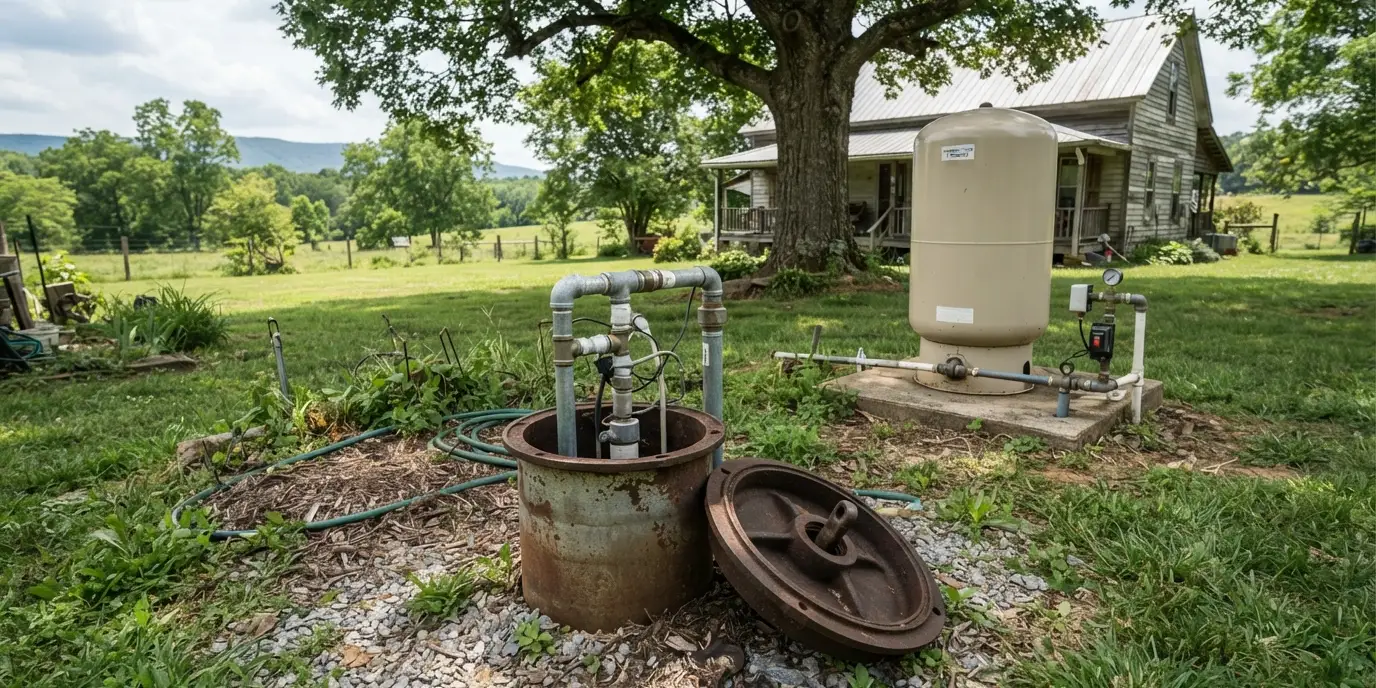
Private wells · Statewide
On a private well there is no utility responsible for your pressure, your quantity or your water quality. It is all mechanical, and it is all yours. The good news is that most well faults are cheap, and the expensive one is usually caused by ignoring a cheap one.
Tell us what the pressure gauge does and how the pump behaves. Those two facts identify most faults before a visit.
Dollar ranges here are typical Virginia costs, given for planning only. They are not a quote. The independent plumber who takes your job sets the price and gives it to you before work begins.
The system
Six components, and knowing which one is misbehaving is most of the diagnosis.
Around a fifth of Virginia households draw water from a private well, and in the rural Piedmont, Shenandoah Valley and southwest the proportion is far higher. Unlike a municipal connection, there is no utility responsible for pressure, quantity or quality past the property line, all of it is yours, and all of it is mechanical.
| Component | What it does | Typical life |
|---|---|---|
| Submersible pump | Sits in the well, pushes water up | 8. 15 years |
| Jet pump (shallow wells) | Sits above ground, draws water up | 6. 12 years |
| Pressure tank | Holds a cushion of pressurised water so the pump is not always running | 8. 15 years |
| Pressure switch | Starts and stops the pump at set points | 3. 10 years |
| Check valve | Stops water draining back down the well | 10+ years |
| Well cap and casing | Keeps surface contamination out | Decades, if intact |
| Control box (3-wire pumps) | Starting components for the motor | 5. 15 years |
The pressure tank is the part homeowners understand least and the part that causes the most trouble. It contains a rubber bladder with an air charge behind it. Water entering compresses the air; the air pushes water back out on demand. That cushion is why your pump does not start every time someone runs a tap. When the bladder fails or the air charge is lost, the tank fills with water, the cushion disappears, and the pump starts and stops rapidly every time water is used. short cycling, which destroys pumps and switches faster than anything else in the system.
The rest is straightforward. The switch tells the pump when to run, usually on a 40/60 or 30/50 psi setting. The check valve stops the column of water in the pipe falling back down the well when the pump stops. The cap and casing keep surface water, insects and debris out of the well itself. The single most important component for water safety, and the one most often found cracked or unsealed.
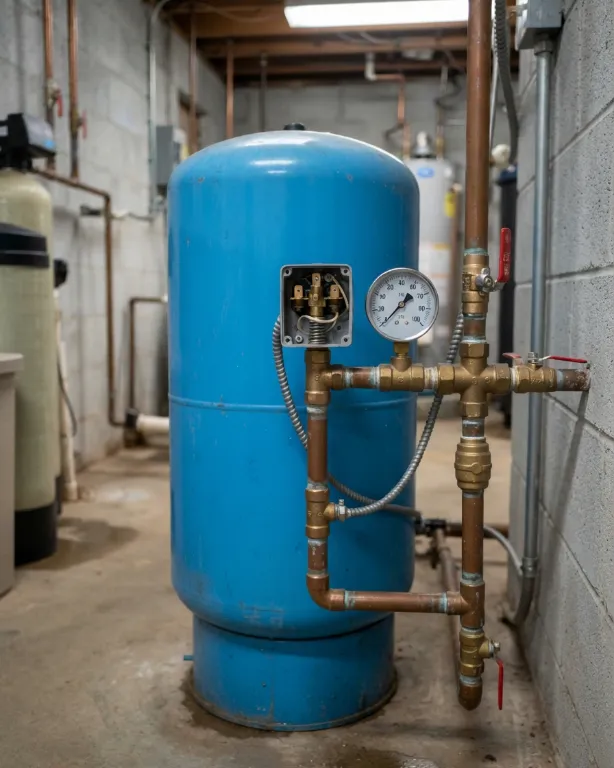
Note the pressure gauge readings when the pump starts and stops, and roughly how long it runs. Once you know normal, every future fault is obvious in thirty seconds.
A pump clicking on and off every few seconds while a tap runs is destroying itself. Turn the pump off at the breaker and call. Running it that way turns a $300 tank job into a $2,500 pump job.
Describe what the gauge does and how the pump behaves. That usually identifies the fault before a visit.
Diagnosis
Well systems fail in patterns, and the pressure gauge is the instrument that reads them.
| Symptom | Likely cause | Urgency |
|---|---|---|
| No water at all, pump silent | Tripped breaker, failed switch, failed pump or control box | Same day |
| No water, pump running constantly | Dropped water level, broken drop pipe, failed check valve, worn pump | Turn the pump off. It can burn out |
| Pump cycles rapidly while water runs | Waterlogged pressure tank (failed bladder or lost air charge) | Turn off; fix promptly |
| Pressure fluctuates while showering | Tank charge low, or switch drifting | Soon |
| Pressure fine then fades after a minute | Well recovery rate lower than demand | Investigate. May need storage |
| Sputtering, air in the lines | Water level near the pump intake, or a leak in the drop pipe | Soon |
| Sand or grit at fixtures | Failing well screen or pump set too low | Investigate |
| Sudden cloudiness after heavy rain | Surface water entering. A casing or cap breach | Stop drinking it; test now |
| Rotten egg smell | Sulphur bacteria or a reaction in the water heater | Test; see treatment |
| Rust stains, metallic taste | Iron and manganese | Treatable |
Two of those are genuinely urgent for different reasons. A pump running constantly without delivering water is running dry, and a submersible pump relies on the water around it for cooling. It will destroy itself in hours. Switch it off at the breaker first, then diagnose. And sudden cloudiness after heavy rain means surface water is reaching the well, which is a contamination event: stop drinking it, switch to bottled water, and get the casing and cap inspected and the water tested before anything else.
The cheapest and most common finding, though, is the pressure tank. A tank that has become waterlogged makes the pump behave alarmingly, and homeowners routinely arrive at the conclusion that the pump has failed, when a $300 to $600 tank replacement fixes it, and would have prevented the pump failure that was about to follow.
Where the needle sits, when the pump kicks in, how fast it cycles. Those three facts narrow it fast.
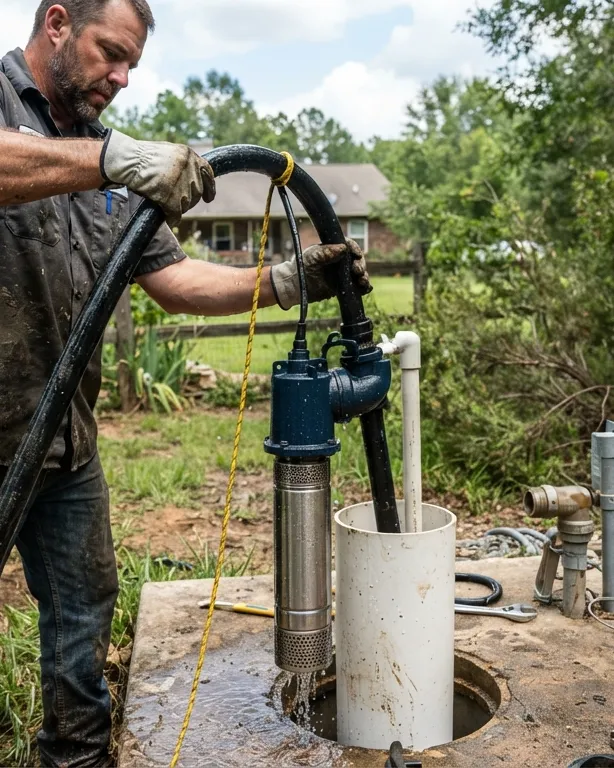
If a pump is running and no water is arriving, switch it off at the breaker immediately. Submersible pumps are cooled by the water they sit in, and running dry destroys a motor in hours. Turning a switch or tank repair into a full pump replacement.
Pumps
A submersible pump lives 8 to 15 years, and its replacement is dominated by depth and access.
Diagnosis follows a sequence: confirm power at the breaker and the switch, test the switch itself, check the tank pressure and air charge, measure amperage draw at the control box, and only then consider pulling the pump. Skipping to the pump is how homeowners end up paying for one they did not need, and a good technician works through the cheap possibilities first.
When the pump does need replacing, the practical variables are these:
Ask for the drawdown and recovery figures when a pump is replaced. Knowing your well’s static level, drawdown under pumping and recovery rate tells you whether future problems are mechanical or hydrological, and it is measured for free while the pump is out.
Water quality
No utility is testing your water. Nobody is, unless you arrange it.
Virginia recommends annual testing of private wells for bacteria and nitrates at minimum, and a broader panel every few years or after any change in taste, smell, colour or nearby land use. Many local health departments and the Virginia Household Water Quality Program run periodic low-cost testing clinics, which are the cheapest route to a proper laboratory panel.
| Test | Why | If found |
|---|---|---|
| Total coliform and E. coli | Indicates surface contamination reaching the well | Shock chlorinate; inspect cap and casing; retest |
| Nitrate and nitrite | Agricultural and septic influence; serious for infants | Treatment or an alternative source |
| pH | Low pH corrodes copper and leaches metals | Neutralising filter |
| Iron and manganese | Rust staining, metallic taste, black specks | Oxidising filter or softener |
| Hardness | Scale in heaters and fixtures | Softener. See treatment |
| Hydrogen sulphide | Rotten egg smell | Aeration or oxidising filter |
| Arsenic and radon | Naturally occurring in parts of Virginia geology | Specific treatment; test to know |
| Lead | Older plumbing rather than the well itself | See historic home plumbing |
Two practical points. First, the well cap is the front line. A cracked, missing or unsealed cap lets insects, surface runoff and debris directly into your drinking water, and it is a cheap thing to put right. The casing should also stand proud of grade and the ground should slope away from it. A well head sitting in a puddle is a contamination path.
Second, treat the actual problem. Well water treatment is frequently oversold: a whole-house softener does nothing for bacteria, a UV lamp does nothing for iron, and a carbon filter does nothing for hardness. Get the laboratory panel first and specify equipment against the results. Detail on water filtration and treatment.
Maintenance
Well systems reward small amounts of attention and punish neglect expensively.
One item that catches households out: a power cut means no water at all. Well pumps are electric, and unlike a municipal supply there is no pressure in the system beyond what the tank holds, which is a few gallons, not a day. If outages are common where you live, a generator circuit that includes the well pump is worth planning, and stored drinking water is worth keeping regardless.
Freeze protection matters too. Above-ground jet pumps, pressure tanks in unheated spaces, and the line from the well head into the house are all vulnerable. See pipe insulation and freeze protection.
Tank charge, switch, gauge behaviour, cap and casing. One short visit that prevents the expensive failures.
Cost
Well work spans small switch repairs to full pump replacement, and depth is the main variable.
| Work | Typical range |
|---|---|
| Diagnostic visit | $120. $280 |
| Pressure switch replacement | $180. $400 |
| Recharge pressure tank air | $110. $220 |
| Pressure tank replacement | $500. $1,400 |
| Check valve replacement | $250. $600 |
| Control box replacement (3-wire) | $300. $700 |
| Submersible pump replacement, under 200 ft | $1,400. $3,000 |
| Submersible pump replacement, 200. 400 ft | $2,200. $4,500 |
| Jet pump replacement (shallow well) | $800. $2,000 |
| Drop pipe and wire replacement with pump | $400. $1,200 extra |
| Shock chlorination of a well | $250. $600 |
| Well cap replacement and seal | $150. $400 |
| Water testing, full laboratory panel | $150. $450 |
Well drilling itself, a new well, or deepening an existing one, is a separate trade with its own equipment and permitting, and typically runs $8,000 to $25,000 in Virginia depending on depth and geology. That is a driller’s job rather than a plumber’s, though the pump, tank and house connection afterwards are plumbing work.
A pump clicking on and off rapidly is destroying itself, and the cause is usually a $500 tank rather than a $2,500 pump. Turning the breaker off protects the expensive part.
If the pump runs and no water arrives, kill the power. Submersible pumps are cooled by the water they sit in.
Bacteria and nitrate are invisible and tasteless. Nobody is testing your well but you, and local health departments often run low-cost clinics.
Depth, pump model, wire size, install date, static level, recovery rate. It saves money on every future visit.
Questions
That is short cycling, and it is nearly always a waterlogged pressure tank. The internal bladder has failed or the air charge behind it has been lost, so there is no cushion of compressed air to hold pressure between pump cycles. Switch the pump off at the breaker, because cycling that fast destroys pumps and pressure switches quickly. The repair is usually a tank recharge or replacement, which is far cheaper than the pump it is about to ruin.
Check the breaker for the pump, then listen at the pressure tank and switch. If the pump is silent, suspect the breaker, the pressure switch or the pump itself. If the pump is running but no water arrives, switch it off immediately. It is running dry and will burn out in hours. That points at a dropped water level, a broken drop pipe, a failed check valve, or a worn pump.
Eight to fifteen years for a submersible pump, six to twelve for an above-ground jet pump. Pressure tanks last about the same, and pressure switches are the shortest-lived part at three to ten years. Short cycling shortens all of it dramatically, which is why a failing tank so often takes the pump with it.
Surface water is reaching the well, which means the casing or the cap has been breached. Treat it as a contamination event: stop drinking it, switch to bottled water, and have the cap and casing inspected and the water tested for coliform bacteria straight away. It is often a cheap physical fix, a proper sealed cap and grading the ground away from the well head, but the testing comes first.
Annually for total coliform bacteria and nitrates, and a fuller laboratory panel every three to five years or after any flooding, nearby construction or change in taste, smell or colour. Nobody else is testing it. There is no utility monitoring a private well. Local health departments and the Virginia Household Water Quality Program often run low-cost testing clinics, which are the cheapest route to proper lab results.
It stores a volume of water under pressure behind an air cushion, so that small draws, a hand wash, a toilet refill, are served by the tank rather than by starting the pump. Without it, or with a failed bladder, the pump starts and stops constantly. It is the component that protects the expensive component, and it is the one most often found faulty.
Most are set to 40/60 or 30/50 psi, meaning the pump starts at the lower figure and stops at the upper. The tank’s air pre-charge should sit about 2 psi below the cut-in point. What matters more than the exact numbers is that they are consistent: if the cut-in or cut-out has drifted, the switch is failing or the tank has lost its charge.
Yes, almost immediately. The pump is electric and there is no municipal pressure backing up the system. You have whatever the pressure tank holds, which is a few gallons rather than a day’s supply. If outages are common where you live, consider including the well pump on a generator circuit, and keep stored drinking water regardless.
No, and it usually makes things worse. A larger pump simply draws the well down faster. If the well’s recovery rate is lower than household demand, the answer is storage: a holding tank with a flow control, so the well refills at its natural rate while the house draws from stored water. Ask for drawdown and recovery figures to be measured, which is free while a pump is out.
Only what the test results justify. Well water treatment is frequently oversold: a softener does nothing for bacteria, a UV lamp does nothing for iron, and a carbon filter does nothing for hardness. Get a full laboratory panel, then specify equipment against the actual findings. Hardness, iron, pH, sulphur, nitrate and bacteria all need different treatment.
Related work
Well systems touch pressure, treatment and freeze protection.
Specifying treatment against test results rather than against a sales pitch.
Read morePressure behaviour, gauges and what normal looks like.
Read morePressure tanks and well lines in unheated spaces.
Read moreCheap first, expensive last
A pump that behaves alarmingly is usually reporting a $500 problem, not a $2,500 one, but running it that way converts the first into the second. Switch it off at the breaker and let us look.
(866) 683-0244Statewide, 24 hours. Independent licensed professionals.