Leak Detection
The acoustic and thermal work that locates a slab leak before anything is opened.
Read more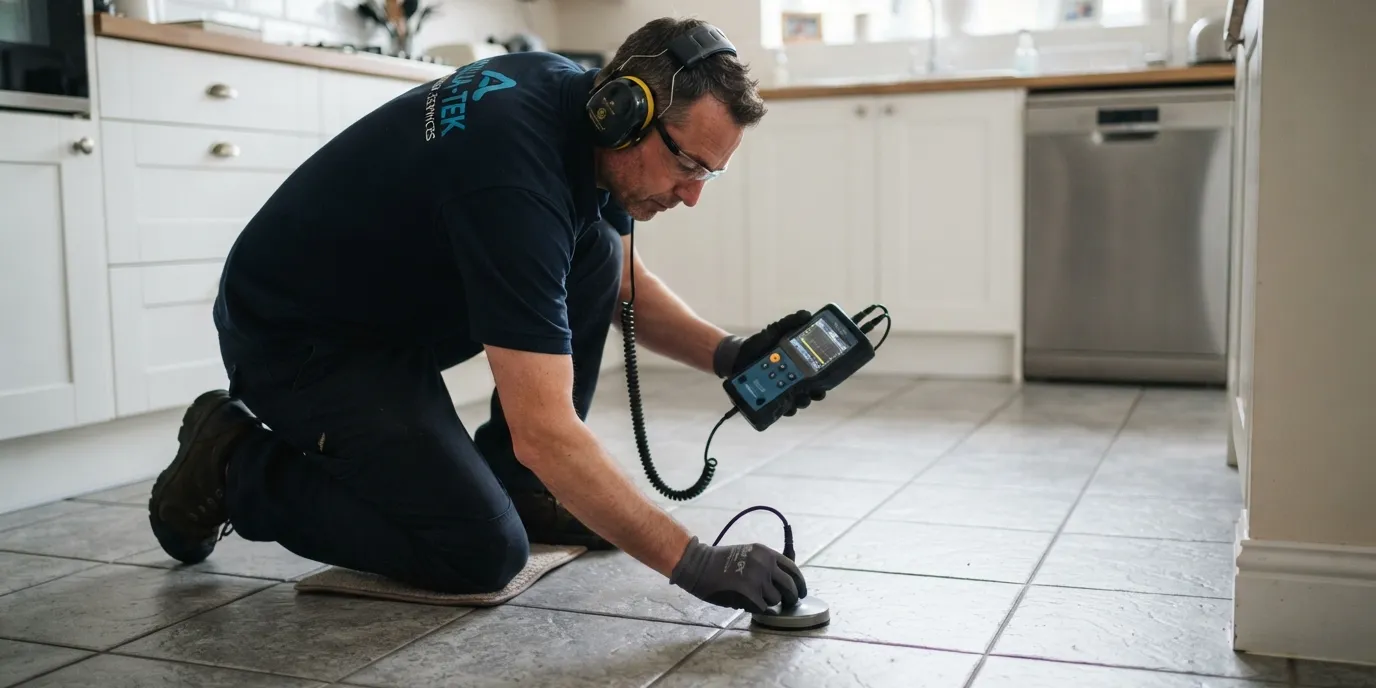
Slab leak repair · Located before anything is opened
A warm patch of floor, a sound of running water with every tap closed, a bill with no explanation. Located acoustically first, then repaired or rerouted. Whichever costs you less overall.
Locating precisely is what keeps this from becoming a demolition job.
Why this one is different
A leaking supply line is a trivial repair when you can see it. Cut out the bad section, put in a new one, pressure-test, done. What makes a slab leak expensive is that the pipe is under four inches of concrete and a floor you chose, and every additional square foot of that you open is real money.
So the entire discipline of slab leak work is about reducing uncertainty before anything is broken. Isolate the system, establish whether it is the hot or cold side, pressurise it, listen through the slab for the signature of escaping water, confirm with thermal imaging where it is a hot line, and mark a location you are genuinely confident in. Only then does anyone decide between cutting through the floor and going around it.
The second thing that makes slab leaks different is what the water does. It has nowhere to go but into the soil the foundation bears on. That is not urgent in the way a burst pipe is urgent, but it is not indefinitely postponable either. Saturated subgrade under a slab is how a plumbing problem becomes a structural one.
Days are fine. Months of water under a foundation are not.
Symptoms
Slab leaks are diagnosed largely from symptoms, because there is nothing to look at. Which symptom you have narrows down which line has failed.
| What you notice | What it usually means |
|---|---|
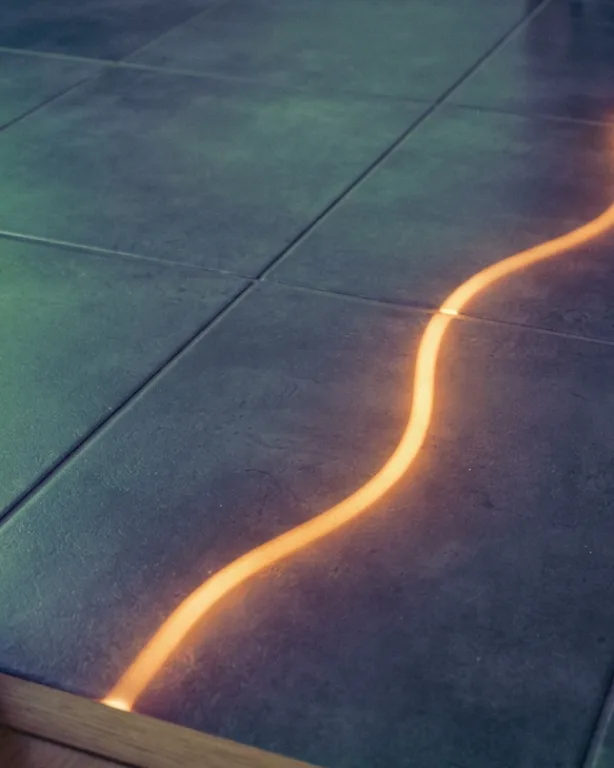
| A warm patch of floor | Almost diagnostic of a hot-water slab leak. The location of the warm spot is close to, though not always exactly on, the failure. |
| Running water with everything off | An active pressurised leak somewhere. Combined with a moving meter and no visible water, the slab is the prime suspect. |
| Water bill up sharply | Confirms water is leaving the system. Tells you nothing about location on its own, but rules out condensation and historic damage. |
| Damp at the base of a wall | Water travelling along the top of the slab and emerging at the perimeter. Often several feet from the actual failure. |
| Reduced pressure throughout | A significant escape. Also consistent with a service line leak, which is why the meter test matters. |
| Flooring lifting or a new slab crack | A leak that has been running for a long time. At this stage the conversation includes the foundation, not just the pipe. |
Shut every fixture, watch the meter's low-flow indicator, then close the house main and watch again. If it moves with everything off but stops when the house is isolated, the leak is inside, under the slab is likely. If it keeps moving with the house shut off, the problem is out in the yard instead, which is a completely different job.
Warm floor, running sound or a jumped bill. Each sends us looking in a different place.
Root cause
Copper poured directly against concrete, or bedded in soil with aggressive chemistry, corrodes from the outside in. The sleeve that should have protected it was often omitted or damaged during the pour.
Hot lines expand and contract every time water is drawn, thousands of times a year, working the pipe against whatever it touches. This is the main reason hot-side slab leaks substantially outnumber cold-side ones.
Soil movement, foundation settlement and vibration grind pipe against concrete. Virginia's clay soils shrink and swell seasonally, which keeps the process going year after year.
A failed pressure regulator lets municipal main pressure into the house unchecked, accelerating every failure mode in the building including under the slab. Worth testing whenever a slab leak is found. See water pressure regulators.
Kinked pipe, over-tight bends, unsupported spans and joints placed under the slab where they should never have been. These fail early and they fail at predictable points.
Velocity, pH and mineral content all affect how quickly copper thins from the inside. This varies by water source across Virginia, which is part of why some neighbourhoods produce far more slab leaks than others.
The cause decides whether a spot repair is sensible or a false economy.
Before the concrete saw
Every inch of accuracy in the location is an inch of floor that stays intact. This is the part of the job worth paying for properly.
Opening concrete in roughly the right place is not a repair strategy. It is an excavation with optimism attached.
Meter test to confirm active loss, then isolate the hot and cold sides separately to establish which system is losing water. On a house with no useful isolating valves, this step takes longer and sometimes means fitting one.
The suspect line is brought to a controlled pressure so the escape produces a steady acoustic signature. Ground microphones work across the floor in a grid until the sound peaks, which narrows the location to a small area.
On a hot-water leak, thermal imaging shows the warm plume through the floor covering and confirms the acoustic finding independently. Two agreeing methods is the standard to insist on before anything is cut.
Marked, photographed and confirmed twice before a saw comes out of the van.
The real decision
Three legitimate answers, and the right one depends on the age and condition of the pipe rather than on which sounds cheapest today.
| Approach | What it involves | Makes sense when | Watch out for |
|---|---|---|---|
| Spot repair | Cut through the floor covering and slab at the located point, expose the pipe, replace the failed section, backfill and patch the concrete | First failure, pipe otherwise sound, accessible location, floor covering that can be matched or is not precious | Patching concrete and matching flooring is often the larger part of the bill |
| Reroute | Abandon the under-slab section entirely and run a new line overhead through attic or walls to the same fixtures | Leak is in an awkward location, the floor is tile or hardwood you cannot match, or you want the pipe out of the slab permanently | Needs drywall access at each end and insulation on attic runs to prevent freezing |
| Full repipe | Replace the house supply system, taking every line out of the slab and running new pipe overhead | Second or third slab leak, aged copper throughout, or a material with a known failure history | Largest up-front cost, but the only one that ends the cycle. Often the cheapest over five years. |
One slab leak can be bad luck. A second one in the same house is a pattern, and at that point paying to open the floor again is usually the worse financial decision. Ask your plumber directly: "if this were your house, would you repair this one or take the system out of the slab?" You will get a straight answer.
Both prices, side by side, before you commit to either.
The part people forget to budget
Homeowners compare plumbing quotes and then discover the flooring is the bigger number. It is worth thinking about at the start rather than at the end.
Carpet lifts and relays easily, and a spot repair beneath it is barely noticeable afterward. Vinyl plank can usually be taken up and refitted if there are spare boards. Ceramic or porcelain tile is the difficult one. Tile is rarely matched years later, and a patch of visibly different tile in the middle of a floor is permanent. Hardwood can be patched by a good floor fitter, but the repair will show until the whole floor is refinished. Polished or stained concrete as a finished floor cannot be patched invisibly at all.
This is why reroutes are often the right answer in houses with expensive floors, even when the raw plumbing cost is higher. Running a new line through the attic and dropping down inside a wall means two neat drywall patches and a floor nobody has touched. Drywall is cheap to repair and easy to paint. Tile is not.
If your floor is tile, stone or hardwood, this conversation usually saves money.
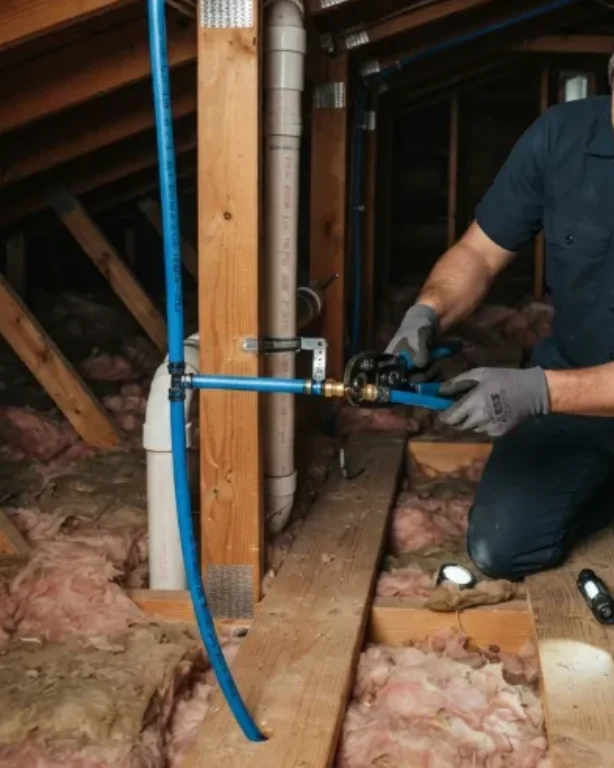
An attic run in Virginia is exposed to genuine freezing temperatures. Any reroute through an attic should be insulated properly as part of the job, not as an afterthought.
Common questions
A leak in a water line that runs beneath or within the concrete foundation slab your house sits on. Because the pipe is encased in or buried under concrete, the water has nowhere obvious to go. It saturates the ground beneath the slab, wicks up through the concrete, or travels along the outside of the pipe until it emerges at an edge. That is why the symptoms are strange and indirect.
The classic sign is a patch of floor that is warm underfoot with no reason to be. That is a hot-water line. Others include the sound of running water when every fixture is closed, a water bill that has climbed, unexplained damp at the base of a wall or along the edge of a floor, a drop in water pressure, and in bad cases a hairline crack appearing in the slab or a floor covering lifting.
Not usually in the burst-pipe sense, because the water is not filling your living room. But it is not something to sit on either. Water under a slab softens the soil the foundation bears on, and sustained saturation can eventually cause settlement, which is a structural problem rather than a plumbing one, and vastly more expensive. Days are fine. Months are not.
Frequently, yes, and it is often the better option. Rerouting abandons the failed under-slab section and runs a new line overhead through the attic or around through a wall, so nothing gets jackhammered. Spot repair through the slab makes sense when the leak is in an accessible location, the rest of the pipe is in good condition, and the floor covering above is not precious.
The system is isolated and pressurised so the escaping water makes a consistent sound, which acoustic equipment picks up through the slab. Thermal imaging confirms hot-water leaks by showing the warm plume. Between the two, the location is usually narrowed to within a foot or so before anything is opened, which matters enormously when opening means concrete. See leak detection.
It depends on the pipe, not the preference. If the line is copper of a certain age and this is the first failure, a spot repair is reasonable. If it is the second or third leak under the same slab, the pipe is telling you it will keep failing, and rerouting or repiping is the honest answer. Paying to jackhammer the same floor three times is the outcome to avoid.
Several reasons. Copper in direct contact with concrete or soil corrodes over time, particularly where the concrete was poured against it. Abrasion where a pipe rubs against the slab as the house moves. Water chemistry. Excess pressure. Poor installation with too-tight bends. And on the hot side, thermal expansion cycling the pipe against its surroundings thousands of times a year, which is why hot lines fail more often than cold.
Common in newer subdivisions across the state and particularly prevalent in parts of Hampton Roads, where the water table and flat terrain make slab construction the practical choice. Much of the older housing stock statewide is crawl space or basement built, so slab leaks are concentrated in postwar and newer developments.
A reroute leaves it untouched, which is often the deciding factor for houses with tile, hardwood or polished concrete. A spot repair means cutting through whatever is on top, and matching a discontinued tile or refinishing a hardwood patch is sometimes more expensive than the plumbing. That cost belongs in the comparison.
Policies vary considerably and it usually turns on whether the escape was sudden, and whether the policy covers the cost of accessing the pipe as distinct from repairing it. Many policies pay for breaking and restoring the slab but not for the pipe itself. Get the plumber’s findings in writing with photographs and take that to your insurer before committing to an approach.
Related work
Related pages homeowners read alongside this one.
The acoustic and thermal work that locates a slab leak before anything is opened.
Read moreTaking the supply system out of the slab permanently.
Read moreWhen the loss turns out to be in the yard rather than under the house.
Read moreExcess pressure accelerates every failure mode, including under a slab.
Read moreIf the leak has escalated to water in the living space.
Read moreFor failures above the floor rather than beneath it.
Read moreWarm floor, running water, no explanation
Acoustic and thermal location across Virginia, then an honest comparison of spot repair against a reroute, including what each does to your flooring.
(866) 683-0244Covering 180 Virginia cities and towns.