Frozen Pipe Repair
The most common trigger in Virginia, and how to thaw a line without causing the split.
Read more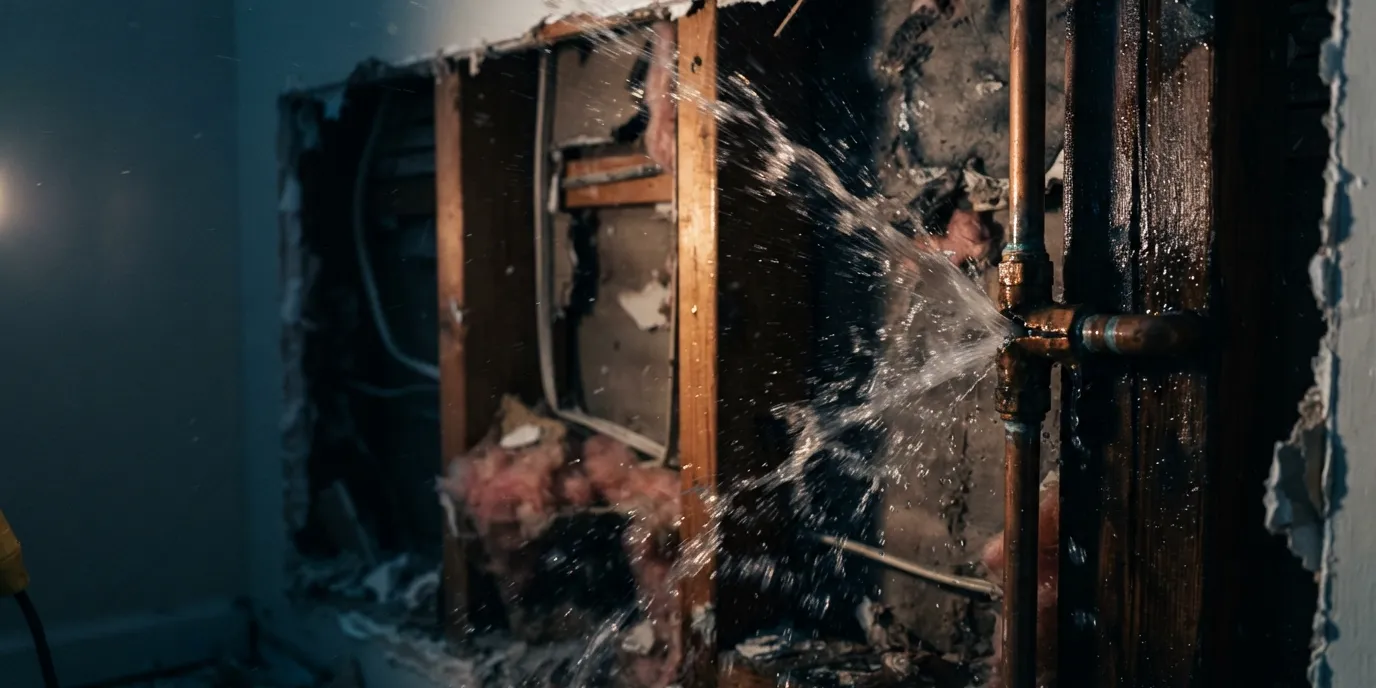
Burst pipe repair · Statewide · 24/7
The pipe is cheap. The ceiling, the flooring and the insulation are not. Shut the main, then call. We will get a local pro to you and check the rest of the run while they are there.
If you cannot find your shutoff, say that first when you call.
Right now
If you are still hunting for the shutoff when you ring, we will help you find it.
Causes
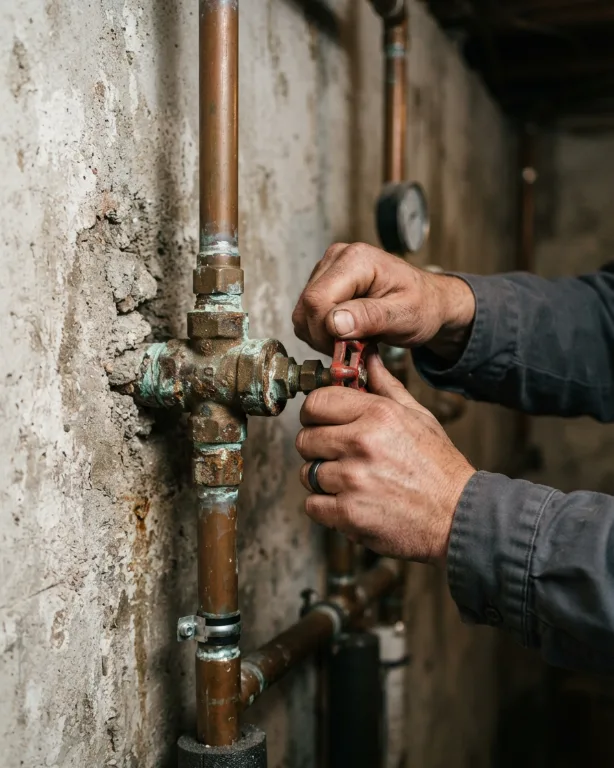
Freeze gets the blame because it provides the dramatic final straw. In most Virginia houses the pipe was already close to failing, and understanding why matters, because it decides whether you are buying one repair or planning a bigger one.
The ice plug pressurises the trapped water behind it until the weakest point gives, usually a fitting several feet from the ice. Concentrated in crawl spaces, garage walls, attics and exterior-wall runs. See frozen pipe repair.
Galvanised steel in pre-1960 houses rusts from the inside until the wall is paper. Copper develops pinholes where water chemistry, velocity or stray current has worked at it. The first pinhole is rarely the last.
A failed pressure regulator lets main pressure into the house unchecked. It shortens the life of every fill valve, supply hose and joint in the building, and it is a frequent hidden cause behind repeated failures. See water pressure regulators.
Polybutylene and its early fittings are the classic Virginia example, common in houses built from the late 1970s to the mid 1990s. Failures are sudden, often at a fitting, and frequently repeat elsewhere in the same house. See polybutylene repipe.
Pipe that was never properly strapped rubs against a joist or a nail plate for twenty years. Water hammer accelerates it. The failure looks sudden but the wear mark tells the real story.
A screw through a wall during a remodel, a nail into a line behind trim, a shovel through a service line in the yard. These show up days or weeks later, once the small wound has worked itself open.
The cause decides whether this is one repair or the first of several. Worth knowing now.
Know what is in your walls
Virginia housing stock spans a century of plumbing practice, and what your supply lines are made of largely determines whether a burst is bad luck or a warning.
| Material | Typical era | How it fails | What a burst usually means |
|---|---|---|---|
| Galvanised steel | Pre-1960 | Internal rust, progressive narrowing, then a rupture at a thin spot or a threaded joint | The rest of the system is the same age and condition. Repiping is the honest conversation. |
| Copper | 1950s to today | Pinholes, freeze splits, failed solder joints, erosion at tight bends | One isolated failure can genuinely be one repair. Several pinholes in a year is a system telling you something. |
| Polybutylene | Late 1970s. Mid 1990s | Fitting failures and pipe embrittlement, often sudden and without warning | Repair to restore water, then plan a repipe. Insurers and buyers both take a view on this material. |
| CPVC | 1980s to today | Cracking from thermal shock, UV exposure during construction, or over-tightened fittings | Usually localised, but brittleness tends to be house-wide if the material was poorly handled at install. |
| PEX | 2000s to today | Rarely the pipe itself. It expands. Failures are at fittings, or from rodent damage in a crawl space | Almost always a genuinely isolated repair. Worth checking neighbouring fittings from the same batch. |
Look at the pipes at the water heater, where several materials are usually visible. Grey plastic with crimped bands is polybutylene. Cream or tan rigid plastic is CPVC. Flexible red, blue or white tubing is PEX. Dull silver metal with threaded joints is galvanised. Reddish-brown metal is copper.
Describe the colour and the fittings and we can usually name the material on the phone.
The work itself
The physical repair is often the shortest part of the visit. Locating it, reaching it and verifying that the rest of the run is sound is where the time goes, and where the value is.
Replacing the section that failed and leaving the identical section next to it is not a repair. It is a deposit on the next call.
Water off at the main or, better, at the nearest isolating valve so the rest of the house keeps working. System drained down, and any water held in a ceiling relieved deliberately rather than left to find its own way out.
Open the smallest access that does the job. The damaged section is cut back to sound pipe on both sides, not to the visible crack, which is usually shorter than the damage.
New section joined in matching material with appropriate transitions, properly supported, and clear of the nail plates and joists that caused the problem if abrasion was the cause.
System brought back up and held, with the repair and the adjacent joints watched under pressure. Air purged through the fixtures, and the water heater refilled fully before power or gas goes back on.
The rest of the accessible run gets looked at. Green staining, weeping joints, wall thinning and identical fittings elsewhere are all noted, so you know whether you have one problem or six.
If the trigger was a freeze, the fix is insulation and air sealing. If it was pressure, the regulator gets tested. If it was the material, you get a straight answer about what a repipe would involve.
Cut out, replaced, pressure-tested, and the rest of the run inspected before anyone leaves.
Being straight with you
A plumber stops the water, repairs the pipe and verifies the system. What a plumber does not do is dry out a house, replace drywall, or handle a contaminated carpet. Those are remediation and building trades, and someone who offers to do all of it in one visit is usually doing at least one of those jobs badly.
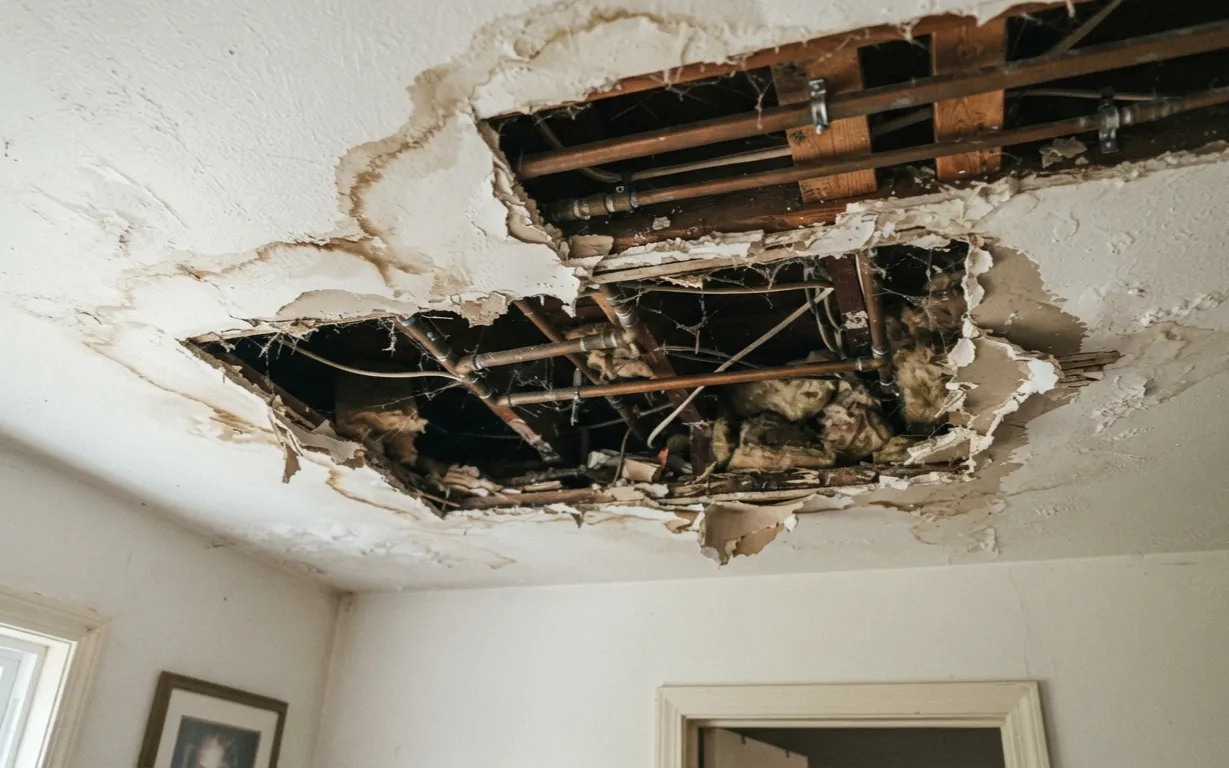
What you should expect is a clear handover: which materials are wet and need to come out, where the water travelled, and what to tell a restoration company or an insurer. Water moves along joists and down inside wall cavities, so the wet patch you can see is frequently not the extent of it.
The practical order is almost always the same. Stop the water. Repair the pipe. Get the wet material out fast, because mould in a humid Virginia summer is a matter of days rather than weeks. Then repair the finishes last, once everything behind them is genuinely dry.
We will tell you plainly which parts of this are ours and which are not.
Money, plainly
We do not quote burst pipe repairs sight unseen, because the pipe is rarely the variable. Access, location and the condition of the surrounding system are.
Pricing basis before dispatch, and an agreed price on site before any work starts.
Common questions
More than most people picture. A half-inch supply line at typical household pressure can move in the region of several hundred gallons an hour, and a failed washing machine hose is worse because the bore is larger. That is why the shutoff matters more than the repair. The pipe costs very little, and the drywall, flooring, cabinetry and insulation cost a great deal.
It depends on your foundation. In a basement home, look on the wall where the service line enters, usually toward the front of the house. In a crawl space home, it is often just inside the access hatch or in a utility closet. On a slab, check the garage or an exterior wall. On municipal water there is also a curb stop at the street, though that usually needs a key. On a well, the shutoff is at the pressure tank.
A clean single failure in otherwise sound pipe is cut out and replaced with a new section. That is a proper permanent repair, not a patch. What changes the answer is the condition of everything around it. If the plumber finds thinning copper, green corrosion at multiple joints, or polybutylene, then repairing one spot is buying a few months. You should be told which of those two situations you are in.
Usually a combination rather than a single cause. Age and wall thinning, water chemistry, high static pressure from a failed regulator, mechanical stress from poorly supported pipe, and then one cold night that provides the trigger. The freeze gets the blame, but the pipe was often already close to the end of its service life.
If you are shutting the main off for more than a few minutes and the heater is electric, yes. Switch the breaker off so an element cannot run dry. On a gas unit, set the control to pilot. Once water is restored, refill fully before restoring power or the burner.
That is between you and your insurer, and it usually turns on whether the escape of water was sudden and accidental rather than gradual. What helps your case is photographs taken before you clean anything up, a plumber’s written description of the failure, and prompt action to stop further damage. What hurts it is a leak that has clearly been running for months.
Wet insulation does not dry in place and should come out. Drywall that has been soaked at the bottom of a wall will wick moisture upward and needs cutting back. That is remediation work rather than plumbing, and a straight-talking plumber will tell you where their job stops so you are not paying a trade to do work outside its lane.
Not at all. Freeze is the biggest single trigger, but we see bursts year-round from failed washing machine hoses, corroded galvanised steel giving way, polybutylene fittings letting go, water hammer from a failed pressure regulator, and pipes damaged by someone driving a screw through a wall.
A visible burst on accessible copper or PEX is often an hour or two on site. A burst inside a wall or under a slab is a different job, because locating and accessing it is most of the work. What extends any of them is discovering the surrounding pipe is no better than the section that failed.
Water off, lowest tap in the house opened to drain the system, power off to anything wet, photographs taken, and standing water moved away from anything absorbent. If water has collected in a ceiling and it is bulging, do not stand under it. That weight will come down.
Related work
The pages that come either side of this one.
The most common trigger in Virginia, and how to thaw a line without causing the split.
Read moreWater you cannot stop, at any hour, anywhere in the state.
Read moreWhen one repair a month has stopped being a strategy.
Read moreThe grey pipe behind a great many sudden Virginia failures.
Read moreThe quiet cause behind repeated, unrelated-looking failures.
Read moreFor the leaks that never announce themselves this dramatically.
Read moreWater where it should not be
Statewide, around the clock. A local pro who repairs the failure, checks the rest of the run, and tells you honestly whether the pipe around it is any better.
(866) 683-0244Covering 180 Virginia cities and towns.