Water Heater Repair
Whether the current unit is worth saving, and what each symptom means.
Read more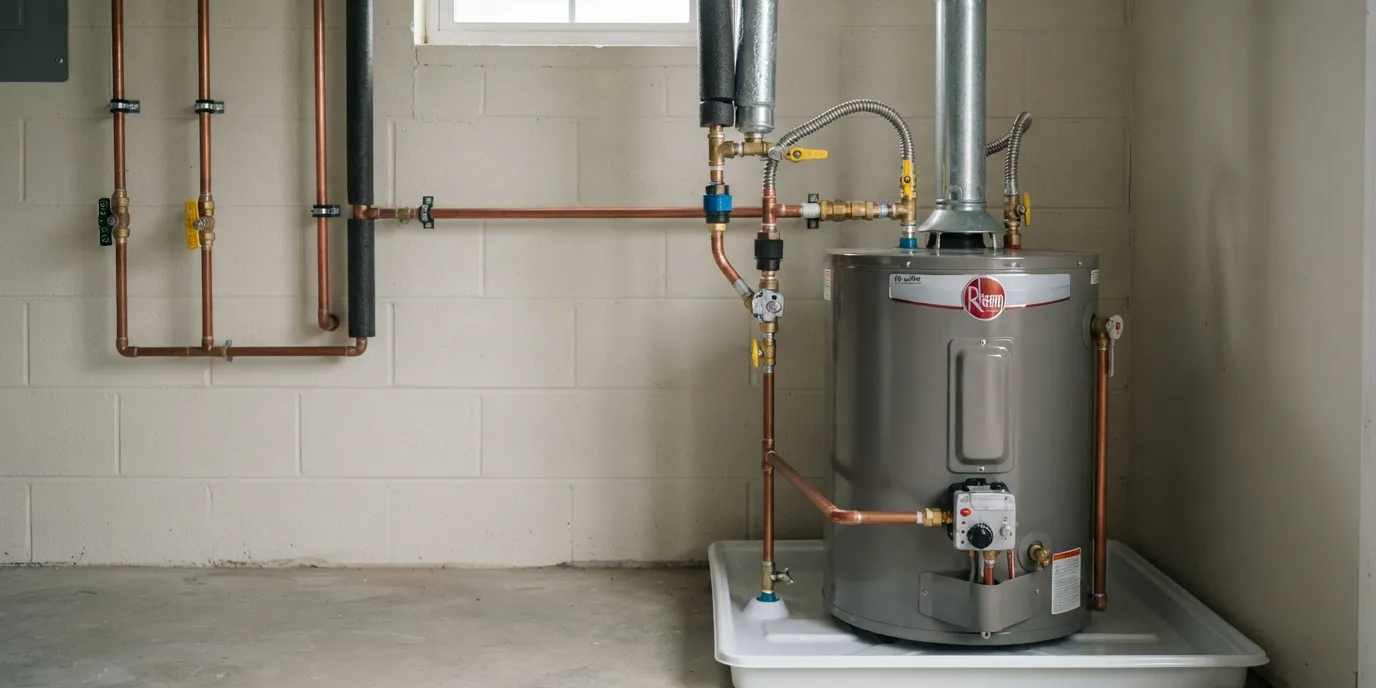
Water heaters · Statewide
A replacement is not automatically a like-for-like swap. Fuel type, capacity, recovery rate, venting and location all get a vote, and the difference between a good installation and a cheap one shows up in year eight, not week one.
Tell us the fuel, the current capacity and how many people are in the house. That is enough to size a replacement over the phone.
Dollar ranges here are typical Virginia costs, given for planning only. They are not a quote. The independent plumber who takes your job sets the price and gives it to you before work begins.
The choice
Four realistic options in a Virginia house. The right one depends on fuel availability, location and how long you plan to stay.
| Type | Installed cost | Life | Best when |
|---|---|---|---|
| Gas storage tank | $1,600. $3,200 | 8. 12 yrs | Gas is already there, venting exists, budget matters |
| Electric storage tank | $1,400. $2,800 | 8. 12 yrs | No gas service, simple swap, low upfront |
| Heat pump (hybrid) tank | $2,800. $5,500 | 12. 15 yrs | Unconditioned basement or garage, electric house, long stay |
| Gas tankless | $3,500. $7,000 | 20+ yrs | High demand, space is tight, gas line can support it |
| Electric tankless (point of use) | $600. $1,800 | 15+ yrs | One remote fixture, not whole-house |
| Indirect (boiler-fed) | $2,500. $5,000 | 20+ yrs | House already has a hydronic boiler |
Storage tanks remain the default for good reasons: cheapest to install, simplest to service, and they deliver a large volume quickly. Their weakness is standby loss and a hard capacity limit, when the tank is empty you wait.
Heat pump tanks are the quiet winner in a lot of Virginia houses. They move heat rather than generating it, running at roughly a third of the electricity of a resistance tank, and they dehumidify the space they sit in. Genuinely useful in a Virginia basement. They need about 700 cubic feet of air, they make some noise, and they cool the room, which makes an unconditioned basement or garage ideal and a hallway closet unsuitable.
Tankless gives endless hot water and a twenty-year life in a fraction of the footprint. The catch is nearly always the gas supply and the venting: most existing half-inch gas branches cannot feed a 199,000 BTU unit, and the unit needs its own sealed vent. Details on tankless water heater installation.
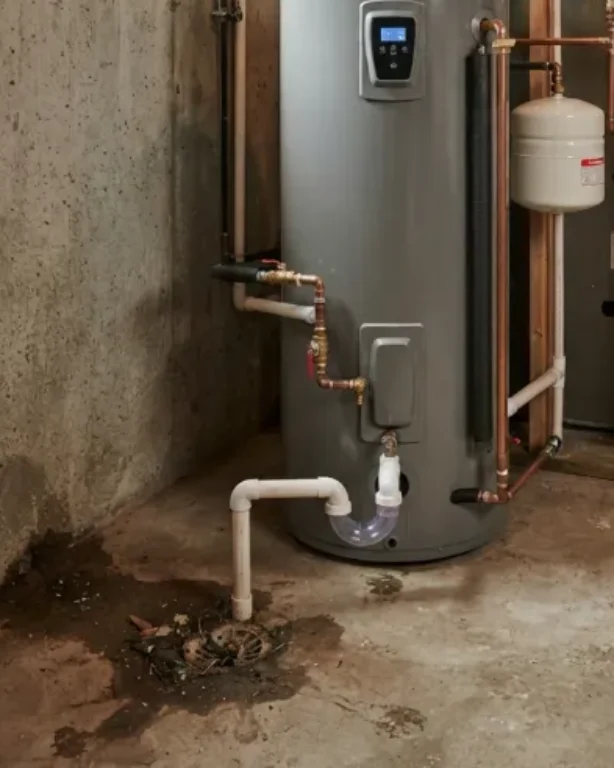
Tankless upgrades are frequently quoted without checking the gas supply. If the meter or the branch cannot deliver the volume, the real price includes new gas pipe and possibly a meter upgrade.
Large-capacity electric resistance tanks have largely given way to heat-pump models. If you are replacing a 55-gallon-plus electric tank, expect the like-for-like option to be a hybrid.
Fuel, location, household size. Three answers narrow it to one or two sensible choices.
Sizing
Undersizing produces cold showers. Oversizing produces standby losses and a needlessly large purchase. Both are avoidable.
For a storage tank, two numbers matter: capacity and first-hour rating. Capacity is what the tank holds. First-hour rating is what it can actually deliver in an hour from a full start, combining stored volume with recovery. First-hour rating is the more useful figure and it is printed on the yellow EnergyGuide label.
| Household | Peak-hour demand | Gas tank | Electric tank |
|---|---|---|---|
| 1. 2 people, 1 bath | 25. 35 gal | 30. 40 gal | 30. 40 gal |
| 2. 3 people, 1.5. 2 baths | 35. 45 gal | 40 gal | 40. 50 gal |
| 3. 4 people, 2 baths | 45. 60 gal | 40. 50 gal | 50. 65 gal |
| 4. 5 people, 2.5. 3 baths | 60. 75 gal | 50 gal | 65. 80 gal |
| 5+ people, 3+ baths | 75. 100 gal | 75 gal or two units | 80 gal or hybrid |
| Any household with a large soaking tub | Tub volume + 20% | Size to the tub | Size to the tub, or tankless |
Electric tanks need more capacity than gas ones for the same household, because their recovery rate is much slower. Roughly 20 gallons per hour against 40 or more for gas. That is why the electric column above runs larger.
Two situations break the table. A large soaking tub sets the requirement on its own: a 90-gallon tub needs about 60 gallons of hot water in one draw, which a 40-gallon tank cannot supply regardless of recovery. And simultaneous demand, two showers plus a dishwasher, routine in a family house on a weekday morning, is what most undersized installations fail at. Size for the peak hour you actually have, not the average day.
If the household has grown since the last heater went in, this is the moment to correct it. Fitting the same 40-gallon tank into a house that now has four teenagers repeats a problem you have been living with for a decade.
Tell us the household, the bathroom count and whether there is a big tub. We will name a capacity and a first-hour rating.
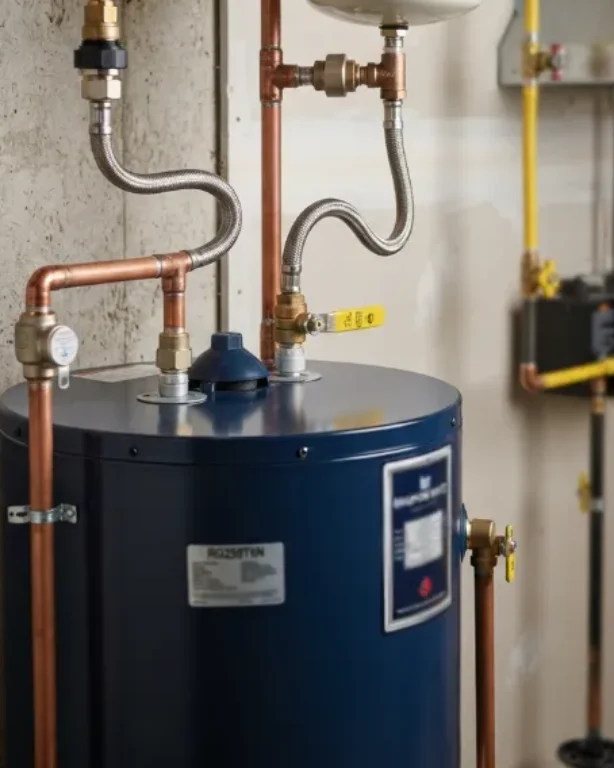
Ask explicitly whether the price includes a new shutoff valve, new flexible connectors, an expansion tank, a drain pan, code strapping, permit fees, and haul-away of the old unit. Those omissions are how two quotes on the same unit differ by $600.
Scope
The unit is maybe half the cost. The other half is what surrounds it, and that is where quality differs.
Two extras worth their small cost. A recirculation provision, a dedicated return or a comfort valve at the far fixture, kills the long wait for hot water at a distant bathroom, and the pipe work is far cheaper while the heater is already disconnected. And pipe insulation on the first six feet of hot and cold lines reduces standby loss for a few dollars; see pipe insulation.
Technical
The three utility questions that decide whether the heater you want can actually go where you want it.
An atmospherically vented tank relies on natural draft up a flue, and it shares that flue with other appliances in many older houses. Remove a furnace from a shared flue and the water heater can be left orphaned in an oversized chimney that will not draft. Direct-vent and power-vent units solve this by using their own sealed pipe, and they open up locations a natural-draft unit cannot use.
A gas line has to deliver enough cubic feet per hour at adequate pressure for every appliance running at once. A 40,000 BTU tank and a 199,000 BTU tankless are not remotely the same demand. Sizing is calculated from meter capacity, pipe diameter and total run length, not assumed.
Gas appliances in small closets need combustion air openings sized to the input. Tightly sealed newer houses and retrofitted closets are where this gets missed, and the symptom is backdrafting and a carbon monoxide risk.
A standard electric tank needs a dedicated 240V circuit, typically 30A on 10 AWG. Larger units and some hybrids need more. Converting from gas to electric frequently means new circuit work and sometimes panel capacity. Get that priced before committing.
A hybrid needs roughly 700 cubic feet of surrounding air or ducting, plus a condensate drain or pump. It cools and dries the room, which is a bonus in a basement and a nuisance in a conditioned closet.
A heater in an attic or over finished space needs a pan, a piped drain and ideally a sensor with an automatic shutoff. Where there is a choice, moving a heater to a garage or basement during replacement is money well spent.
One Virginia-specific note: houses with older masonry chimneys serving both a furnace and a water heater are extremely common, and heating replacements have often left the water heater alone on a flue never intended for it. If your furnace has been changed to a high-efficiency sidewall-vented unit and the water heater still uses the chimney, have the draft checked. It is a five-minute test with real consequences.
Compliance
The paperwork is what protects the warranty, the insurance position and the resale conversation.
It is a small cost and it is what your warranty, your insurer and your eventual buyer will all want to see.
Cost
Installed prices for Virginia, plus what each type costs to run once it is in.
| Type | Installed | Est. annual energy | Notes |
|---|---|---|---|
| Electric storage, 50 gal | $1,400. $2,800 | $450. $600 | Simplest swap; slowest recovery |
| Gas storage, 40. 50 gal | $1,600. $3,200 | $220. $350 | Needs venting; fast recovery |
| Power-vent gas, 50 gal | $2,200. $4,000 | $230. $360 | Frees location; needs power |
| Heat pump, 50. 65 gal | $2,800. $5,500 | $130. $220 | Best electric running cost; needs air volume |
| Gas tankless | $3,500. $7,000 | $180. $300 | Endless hot water; gas and vent work |
| Indirect off a boiler | $2,500. $5,000 | Varies with boiler | Only where a hydronic boiler exists |
Add-ons commonly needed: expansion tank $250, $550, new gas line or upsize $400, $1,500, new 240V circuit $350, $900, pan and piped drain $150, $400, relocation $600, $2,000, permit $50, $200 depending on locality.
Federal and utility incentives for heat-pump water heaters have been meaningful and they change frequently. Check the current federal tax credit and your electric co-op or utility rebate before choosing, because on a hybrid they can close most of the gap to a resistance tank.
A planned replacement is a scheduled half-day at a normal rate with the unit you chose. An emergency replacement is whatever is on the truck, at whatever hour, plus water damage. If the tank is past eleven, plan it.
The regulator, the expansion tank, the shutoffs and any recirculation line all live in the same few feet of pipe. Bundling them is one visit instead of three.
A full 50-gallon tank weighs over 500 pounds. Confirm haul-away is in the price and that the route out. Stairs, doorway widths, a tight crawl space hatch. Has been looked at.
Questions
A like-for-like tank swap in an accessible location is typically three to five hours, including draining the old unit, removing it, fitting and connecting the new one, filling, purging air and commissioning. Add time for venting changes, gas or electrical work, relocation, or a difficult route in and out. A tankless conversion is usually a full day and sometimes two.
It depends on three things: whether your gas supply can feed it, whether a vent path exists, and how long you plan to stay. Tankless gives endless hot water, a twenty-year life and a much smaller footprint, but the installed cost is roughly double and the gas and venting work is where the surprises live. In a house you will own for fifteen years with adequate gas, it is a strong choice. For a two-year hold, it is not.
Match the first-hour rating to your peak-hour demand rather than choosing by tank size alone. As a rough guide: 40 gallons of gas or 50 electric for a family of three with two baths; 50 gas or 65 to 80 electric for four or five people with three baths. A large soaking tub overrides all of that. Size to the tub. And electric always needs more capacity than gas for the same household because it recovers roughly half as fast.
In an unconditioned basement or garage, often yes. It runs at about a third of the energy of an electric resistance tank, lasts longer, and dehumidifies the space. Genuinely valuable in a Virginia summer. It costs more upfront, makes some noise, needs around 700 cubic feet of air, and needs a condensate drain. Federal and utility incentives frequently close much of the price gap, so check what is current before deciding.
Yes, in Virginia localities this is permitted work, and it is worth having. The inspection checks venting, relief valve discharge and gas connections. The items that cause injuries rather than inconvenience. Unpermitted installations can also void the manufacturer warranty and complicate insurance and resale.
It is a small tank with an internal bladder that absorbs the volume increase of water as it heats. You need one if your house has a pressure reducing valve, because that makes the plumbing a closed system with nowhere for expansion to go. Without it, pressure spikes on every heating cycle, the relief valve drips, and the tank is stressed continuously. Most Virginia houses need one.
It is legal for a homeowner to work on their own residence in most Virginia localities, and permits are available to homeowners. But gas connections, venting and relief valve piping are the three areas where errors cause carbon monoxide exposure or a pressure vessel failure, and they are not intuitive. If any part of the job involves gas or a vent change, this is not the right project to learn on.
120 degrees suits most households: hot enough to inhibit bacterial growth in the tank, cool enough to reduce scald risk, and it slows scale formation. Some households run 140 for specific health reasons, which requires thermostatic mixing valves at fixtures to prevent scalding. Do not run the tank hotter simply to stretch capacity. That is a burn risk substituting for correct sizing.
It changes what a failure costs, so it should change the installation. A pan with a properly piped drain to the exterior is essential, a leak sensor with an automatic shutoff valve is strongly worth the money, and a smaller-diameter unit may be needed for the access hatch. If there is any option to relocate to a garage or basement during replacement, take it.
Often, yes, for common tank sizes and fuel types. Where a like-for-like replacement is available, an emergency swap is usually same-day. Non-standard capacities, tankless conversions, and jobs needing gas or electrical work generally need at least a day of lead time, and a conversion needs a survey first.
Related work
The pages homeowners read alongside a replacement decision.
Whether the current unit is worth saving, and what each symptom means.
Read moreThe conversion in detail: gas sizing, venting, condensate and running costs.
Read moreExpansion tanks, relief valve dripping, and the pressure that decides tank life.
Read morePlan it, do not react to it
A planned half-day at a normal rate with the unit you actually chose, versus whatever is on the truck at 11pm plus a wet floor. If the tank is past eleven years, let us price the replacement now.
(866) 683-0244Statewide, 24 hours. Independent licensed professionals.