Drain Cleaning
When one fixture is slow, it is a local clog, not the septic system.
Read more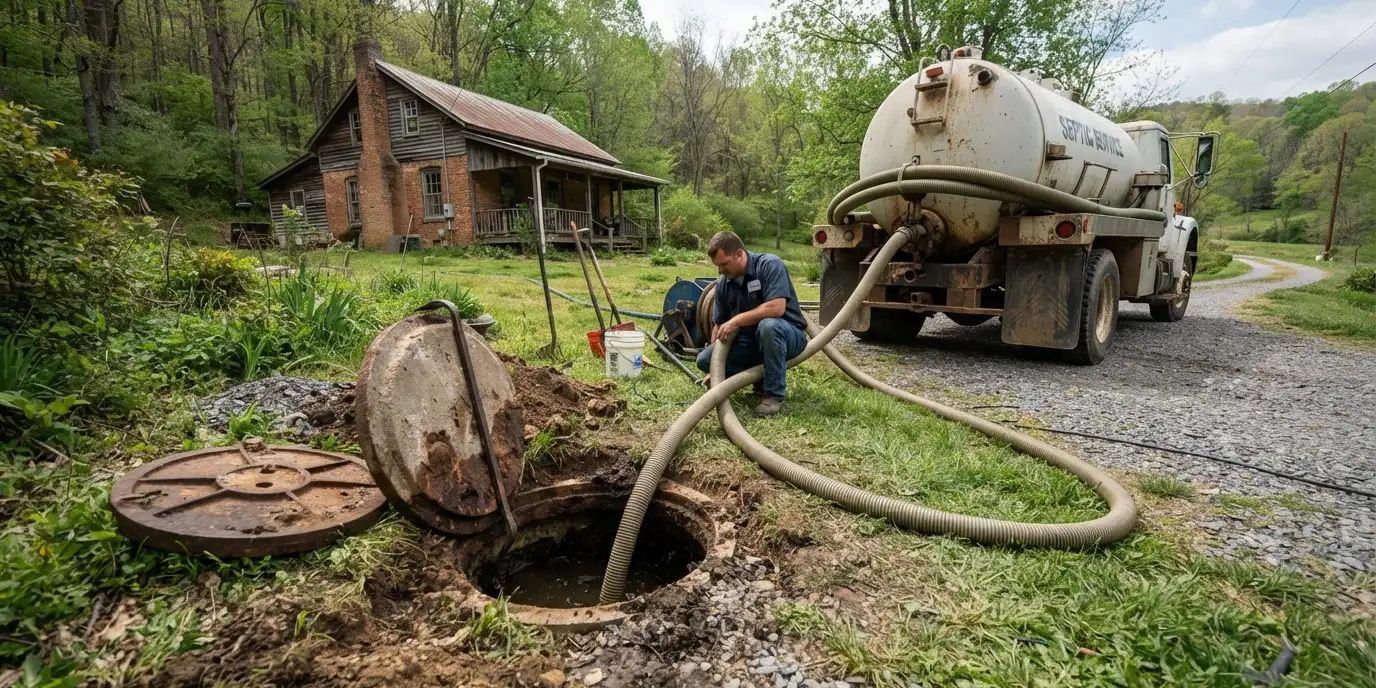
Septic · Statewide
A septic system has one cheap component and one very expensive one. The tank can be pumped for a few hundred dollars; a failed drain field is a five-figure project. Everything worth knowing about septic care follows from protecting the second with the first.
Tell us when it was last pumped and what the symptoms are. If sewage is backing up, stop using water and call.
Dollar ranges here are typical Virginia costs, given for planning only. They are not a quote. The independent plumber who takes your job sets the price and gives it to you before work begins.
The system
Two stages, one of which is repairable and one of which is very expensive to replace. Everything about septic care follows from that.
Waste leaves the house through the building drain and enters a buried tank, typically 1,000 to 1,500 gallons. Inside, solids settle to the bottom as sludge, grease and light solids float to the top as scum, and relatively clear liquid, effluent, occupies the middle. Baffles at the inlet and outlet keep the layers from short-circuiting, and the outlet draws from the middle layer only.
Effluent then flows to the drain field (or leach field): a network of perforated pipe in gravel trenches, where the liquid percolates into the soil and soil bacteria complete the treatment. In some Virginia installations there is also a pump chamber, a distribution box, or, on difficult soils, an alternative or engineered system with a pump, a filter and sometimes a control panel with an alarm.
The distinction that matters: the tank is serviceable, the drain field is not. Pumping a tank costs a few hundred dollars. Replacing a failed drain field costs many thousands, requires soil evaluation and permitting, and needs suitable land available. Essentially all septic maintenance is about protecting the drain field from solids and from hydraulic overload.
Which is why the single most important habit is pumping the tank on schedule. Sludge and scum accumulate; once the layers grow deep enough that solids reach the outlet baffle, they travel into the drain field and clog the soil pores. That damage is cumulative, invisible, and not reversible by pumping afterwards.
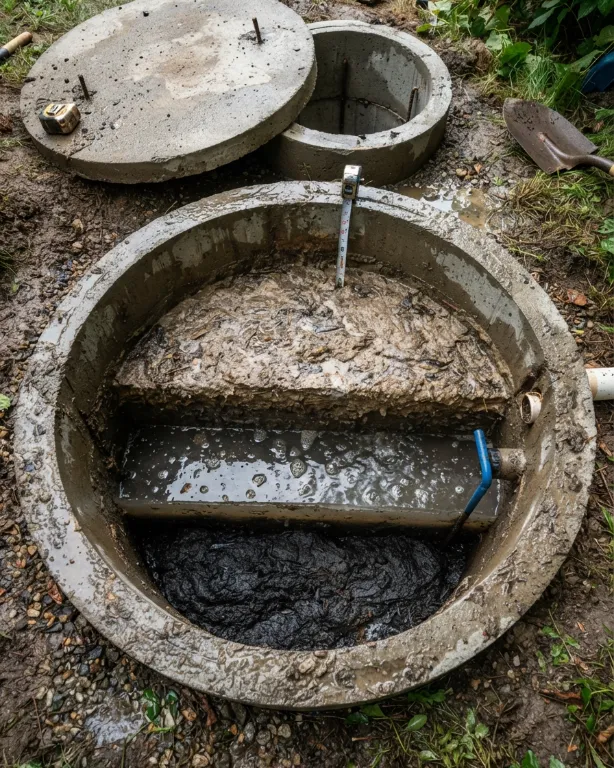
Sooner for a large household, a smaller tank, or a house with a garbage disposal. It is the cheapest insurance in the property.
Tank gases are lethal and oxygen-depleted, and people die attempting this every year. Inspection is done from outside, with the right equipment.
Tank levels, baffles, and drain field condition. Knowing where you stand is inexpensive.
Diagnosis
Septic systems give warnings. They are just easy to attribute to something else.
| Symptom | Likely cause | Urgency |
|---|---|---|
| Slow drains throughout the house | Tank full, outlet blocked, or drain field saturated | Investigate now |
| Gurgling in drains and toilets | Restricted flow out of the house | Soon |
| Sewage backing up into the lowest fixture | Tank or line blockage | Stop using water. Urgent |
| Standing water or soggy ground over the field | Drain field failing or saturated | Serious |
| Unusually green, lush grass over the field | Effluent surfacing and fertilising | Serious |
| Sewage smell outdoors near the tank or field | Surfacing effluent or a broken lid | Investigate |
| Sewage smell indoors | Dry trap, failed wax ring, or a venting fault, not usually the tank | See toilet work |
| Alarm sounding on an engineered system | Pump or float failure, high water level | Same day |
| One fixture only is slow | A local clog, not the septic system | See drain cleaning |
| Well water tests positive for bacteria | Possible septic influence on the well | Test and investigate together |
The most useful diagnostic distinction is the same as with any drain problem: one fixture or all of them. A single slow sink is a local clog and has nothing to do with the septic system. Everything in the house slowing together, or the lowest fixture backing up, means flow out of the building is restricted, which could be the line, the tank, or the field, and a camera inspection plus a look in the tank distinguishes them.
Two symptoms are worse than they look. Lush green grass over the drain field means effluent is surfacing and fertilising the lawn. The field is failing hydraulically. And soggy ground over the field in dry weather is the same message. Both mean the soil is no longer accepting the liquid load, and both are the point at which to get a professional evaluation rather than to wait.
If sewage is actually backing up into the house, stop using water entirely, every flush and every load of laundry adds to what has nowhere to go, and treat it as emergency plumbing.
Every gallon you send adds to the problem. Call and we will connect you with someone nearby.
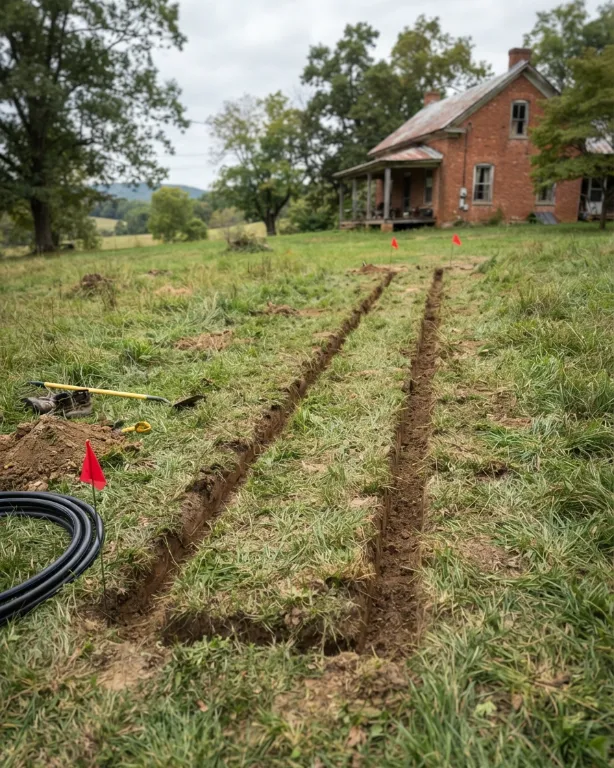
Mark it. No parking, no vehicles, no sheds, no raised beds, no trees. Compaction and roots both end drain fields.
Care
A septic system is a biological process in a box. It is not fussy, but it has clear limits.
Pump on schedule. Every three to five years for a typical household, more often for a large family, a small tank, or a house with a garbage disposal. Ask the pumper for the sludge and scum measurements and keep them. That record is what sets your correct interval, rather than a generic guess.
Manage water volume, not just content. Hydraulic overload is as damaging as solids. Spread laundry through the week rather than doing eight loads on a Saturday, fix running toilets promptly, and keep roof and surface drainage away from the drain field. A single running toilet can add hundreds of gallons a day to a system sized for a household.
One structural point specific to Virginia: many older rural properties have systems installed long before current standards, sometimes with undersized tanks, no distribution box, or fields in marginal soil. If you have bought such a property, an inspection that locates the components and measures the levels is the sensible first step. It establishes what you actually own.
Repairs
A useful hierarchy, from routine to expensive.
Every three to five years. A vacuum truck empties the tank through the access lid. Ask for sludge measurements and for the baffles to be inspected while it is empty.
If the access lid is buried, fitting a riser to grade makes every future pumping cheaper and means the lid gets checked rather than guessed at. Inexpensive and worth doing at the next pumping.
Inlet and outlet baffles fail, especially in older concrete tanks. A failed outlet baffle lets scum straight into the drain field, so this is a repair that protects the expensive component.
Many newer systems have a filter in the outlet tee. It needs cleaning periodically, and a blocked one produces exactly the slow-drain symptoms of a full tank. A cheap fix mistaken for a serious fault.
On engineered and pump-assisted systems these are ordinary electromechanical parts with ordinary lifespans. An alarm sounding is usually one of them.
The line from house to tank can crack, root-invade or belly like any other sewer line. A collapsed or unlevel distribution box overloads one trench while others sit unused. A repair with a large effect.
What cannot be cheaply fixed is a failed drain field. Once the soil pores are clogged with solids, or the field has been compacted, or it has simply reached the end of its service life, the options are limited: rest and partial recovery in some cases, a replacement field if suitable land and soil exist, or an engineered alternative system where they do not. All of it requires soil evaluation and local health department permitting, and all of it is a five-figure conversation.
Which is the entire argument for the routine column. Pumping, baffles, filters and keeping vehicles off the field are inexpensive things that protect the one component you cannot afford to lose.
Property
Septic is one of the few plumbing subjects that regularly changes the price of a house.
Repairs, replacements and alterations to septic systems are permitted through the local health department in Virginia, and alternative or engineered systems typically carry an ongoing operation and maintenance requirement with a licensed operator. If you are buying a property with an engineered system, ask what that obligation costs annually. It is a real recurring expense that rarely appears in listing details.
A septic inspection before closing is a fraction of the cost of a drain field. Get it done separately from the home inspection.
Cost
Routine septic care is inexpensive. Drain field replacement is not, and the gap between them is the whole point.
| Work | Typical range |
|---|---|
| Tank pumping, 1,000. 1,500 gal | $350. $700 |
| Locating a buried tank | $150. $400 |
| Riser and secure lid fitted to grade | $300. $800 |
| Full septic inspection with measurements | $300. $700 |
| Effluent filter clean | $150. $350 |
| Inlet or outlet baffle replacement | $400. $1,200 |
| Distribution box replacement or levelling | $600. $2,000 |
| House-to-tank line repair | $800. $3,500 |
| Effluent pump or float replacement | $600. $1,800 |
| Drain field replacement | $8,000. $25,000+ |
| Engineered alternative system | $15,000. $45,000+ |
| Annual O&M contract, engineered system | $200. $600 per year |
Set the top of that list against the bottom. Pumping every four years for twenty years costs less than a tenth of a single drain field replacement, and the pumping is what prevents it. There is no plumbing category where routine maintenance has a clearer return.
Every three to five years, and ask for the sludge and scum depths each time. Those measurements set your true interval better than any rule of thumb.
Enzymes and septic "starters" are unnecessary in a working system, and some break down the sludge layer so solids reach the field. Save the money.
No cars, no sheds, no patios, no trees. Compaction and roots are the two things that kill fields other than solids.
Spread laundry across the week and fix running toilets fast. Hydraulic overload damages a field as surely as solids do.
Questions
Every three to five years for a typical household, and more often for a large family, a smaller tank, or a house with a garbage disposal. Rather than guessing, ask the pumper to measure the sludge and scum depths each visit and keep the record. A few years of measurements establishes your actual interval precisely, and pumping is the single thing that protects the drain field.
Slow drains throughout the house at the same time, gurgling from drains and toilets, sewage backing up into the lowest fixture, standing water or soggy ground over the drain field, unusually lush green grass over the field, and sewage smells outdoors near the tank or field. A single slow fixture is a local clog and unrelated. If sewage is backing up indoors, stop using water entirely and call.
Rarely and only partially. Once the soil pores are clogged with solids or the ground has been compacted, the realistic options are resting the field in the hope of partial recovery, installing a replacement field where suitable land and soil exist, or fitting an engineered alternative system where they do not. All require soil evaluation and health department permitting, and all are five-figure projects, which is precisely why routine pumping matters so much.
No. In a normally functioning system the bacteria needed for treatment arrive with the waste and additives contribute nothing. Some are actively harmful, breaking down the sludge layer so that solids travel out to the drain field, which is the exact damage you are trying to prevent. Put the money toward pumping on schedule instead.
You can, but be careful. A disposal roughly doubles the solids load reaching the tank, shortening your pumping interval and increasing the risk of solids carrying over into the drain field. If you have one, use it sparingly and pump more frequently. Many septic households do without it entirely, and some localities discourage or restrict them.
Wipes of any kind (including "flushable" ones), paper towel, sanitary products, cat litter, cotton buds, dental floss and medication. Down drains: paint, solvents, fuel, motor oil, pesticides, and large volumes of bleach or antibacterial cleaner, which kill the bacteria doing the treatment. Grease, coffee grounds and heavy disposal use should be minimised rather than banned.
Because effluent is surfacing and fertilising it. That is a sign the field is no longer accepting the liquid load properly, not a sign of a healthy system. Combined with soggy ground in dry weather, it means the field is failing hydraulically and needs professional evaluation rather than time.
No. Vehicle weight compacts the soil and crushes the distribution pipe, and structures prevent the evaporation and oxygen exchange the field depends on. That includes sheds, patios, pools, raised beds and driveways. Trees and shrubs are also out, because their roots will find the pipe. Grass is the correct planting over a drain field, and nothing else.
Yes, and separately from the standard home inspection, which does not evaluate septic systems. A proper inspection locates the tank and field, measures sludge and scum, checks the baffles and filter, and assesses whether the field is accepting flow. Also pull the health department permit records to confirm the tank size, the bedroom rating and whether a reserve area for a replacement field still exists and has not been built over.
More than on a municipal connection. Hydraulic overload damages a drain field just as surely as solids do, and a running toilet can add several hundred gallons a day to a system sized for normal household use. The same applies to doing all the week’s laundry in one day. Spreading it out genuinely helps.
Related work
Septic problems and drain problems present identically until someone looks.
When one fixture is slow, it is a local clog, not the septic system.
Read moreDistinguishing a blocked house-to-tank line from a full tank or a failing field.
Read moreOn properties with both, well contamination and septic condition are looked at together.
Read moreThe cheapest insurance on the property
Twenty years of pumping on schedule costs less than a tenth of one drain field replacement, and it is what prevents it. If you cannot remember the last pumping, that is the answer.
(866) 683-0244Statewide, 24 hours. Independent licensed professionals.