Well Pump & Water System Service
Testing, bacteria, pressure and the mechanical side of a private well.
Read more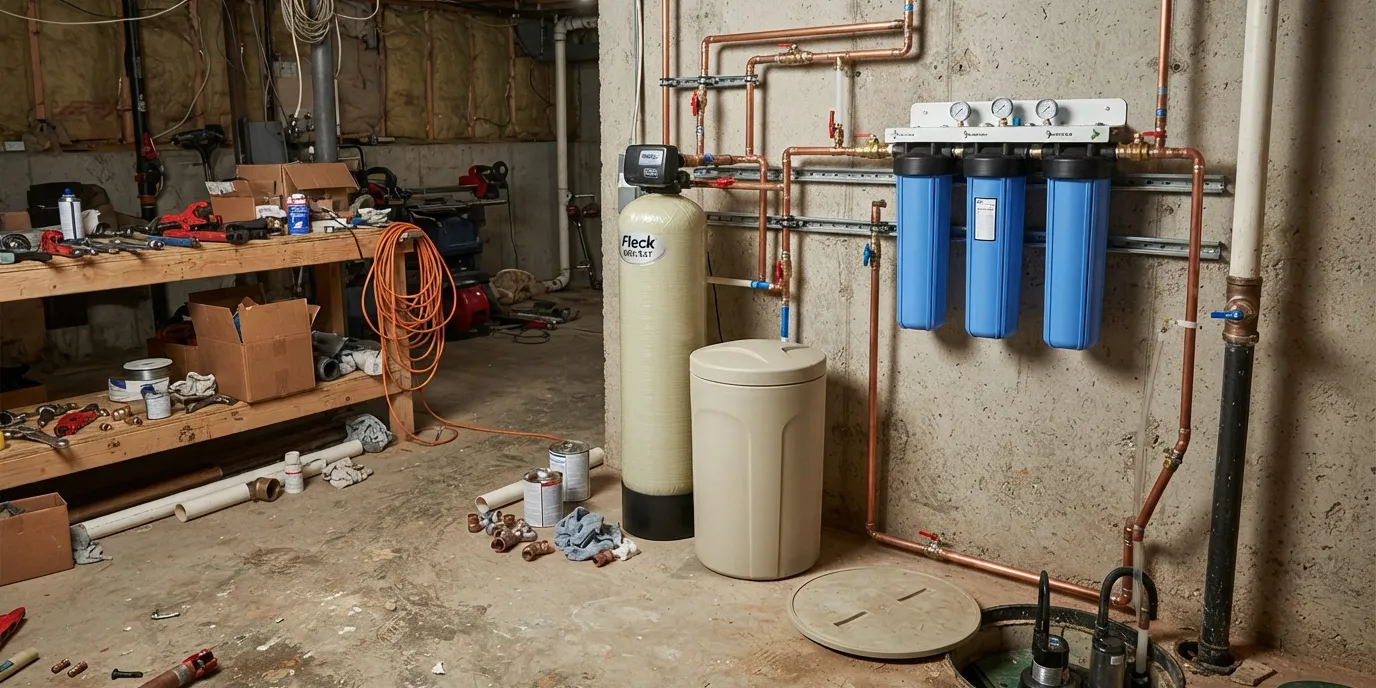
Water quality · Statewide
This is the most oversold category in plumbing. Almost every genuine water problem has one specific, well-understood treatment, and the way to find out which one you need is a laboratory test, not a demonstration in your kitchen.
Tell us whether you are on a well or a municipal supply, and what you are noticing. Staining, smell, scale, taste.
Dollar ranges here are typical Virginia costs, given for planning only. They are not a quote. The independent plumber who takes your job sets the price and gives it to you before work begins.
First
Water treatment is the most oversold category in plumbing. A laboratory panel costs a fraction of the equipment and it is the only thing that tells you what you actually need.
The pattern is familiar: someone knocks, runs a demonstration that turns a glass of your water cloudy, and quotes several thousand dollars for a whole-house system. The demonstration proves almost nothing. Most of those tests react to harmless dissolved minerals, and some are simple electrolysis, which will discolour any water on earth.
What actually identifies a water problem is a laboratory panel from a certified lab. On municipal water, start with your utility’s annual Consumer Confidence Report, which is published free and tells you what is in the supply before it reaches your house, then test at the tap for what the house itself contributes, primarily lead from older plumbing. On a private well, nobody is testing anything, so a full panel is the only information available; see well pump and water system service.
| Test | Why it matters | Typical cost |
|---|---|---|
| Total coliform and E. coli | Bacterial contamination. Wells only | $30. $70 |
| Nitrate and nitrite | Agricultural and septic influence | $25. $60 |
| Hardness | Scale in heaters, fixtures and appliances | $15. $40 |
| pH | Low pH corrodes copper and leaches metals | $15. $30 |
| Iron and manganese | Rust staining, black specks, metallic taste | $30. $70 |
| Lead and copper | Comes from your plumbing, not the source | $30. $80 |
| Hydrogen sulphide | The rotten egg smell | $30. $60 |
| Arsenic, radon, uranium | Naturally present in some Virginia geology | $60. $180 |
| Full residential panel | All of the above together | $150. $450 |
Local health departments and the Virginia Household Water Quality Program periodically run low-cost testing clinics, which are by far the cheapest route to a proper panel. Whatever route you take, get the results in writing and keep them. They are the specification document for any equipment you subsequently buy.
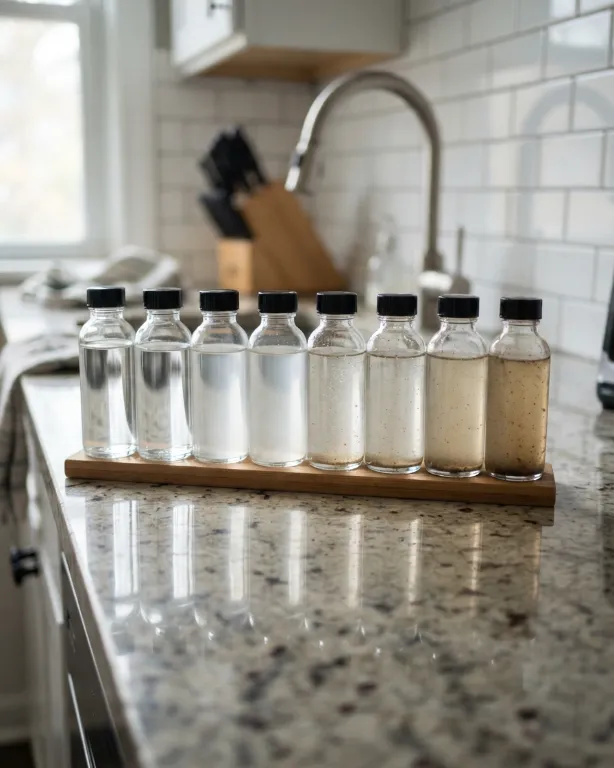
Precipitation tests and electrolysis demonstrations discolour ordinary safe water. If someone is showing you a reaction in a glass rather than a laboratory report, that is a sales technique, not a diagnosis.
Your utility publishes an annual water quality report. Read that before spending anything, then test at your own tap only for what the house adds. Mainly lead in pre-1986 plumbing.
Tell us whether you are on a well or a municipal supply and what you are noticing. We will name the panel.
Problems
Each water problem has a specific solution. Nothing treats everything, whatever the brochure says.
| Problem | You notice | Correct treatment |
|---|---|---|
| Hardness (calcium, magnesium) | Scale, spotting, soap that will not lather | Ion-exchange softener |
| Iron | Orange-brown staining, metallic taste | Oxidising filter, or softener at low levels |
| Manganese | Black specks and staining | Oxidising filter |
| Hydrogen sulphide | Rotten egg smell | Aeration or oxidising filter |
| Chlorine and chloramine taste | Municipal taste and smell | Carbon filter |
| Sediment and turbidity | Grit, cloudiness | Sediment prefilter |
| Bacteria | Positive coliform test | UV, or shock chlorination plus repair |
| Nitrate | Lab result only | Reverse osmosis or anion exchange |
| Lead | Lab result only | Point-of-use RO or filter; replace source plumbing |
| Low pH | Copper pipe pinholes, blue-green staining | Neutralising filter |
| Tannins | Yellow-brown tint, well water | Tannin-specific resin |
| Arsenic | Lab result only | Specific adsorptive media or RO |
Three mismatches worth naming because they are sold constantly. A softener does nothing for bacteria. It exchanges hardness minerals for sodium and has no disinfection function whatever. A UV lamp does nothing for iron, hardness or taste. It inactivates microorganisms and nothing else, and it needs clear water to work at all. And a carbon filter does nothing for hardness, though it does improve municipal taste considerably and cheaply.
Order matters too. Treatment stages have to be sequenced correctly: sediment first, then iron or oxidation, then softening, then carbon, then UV last where fitted. Get the order wrong and one stage destroys the next. Iron will foul a softener resin, and turbidity will render a UV lamp ineffective. This is a large part of what you are paying a competent installer for.
Panel results in, equipment matched to findings, stages in the right order. That is what a real quote looks like.
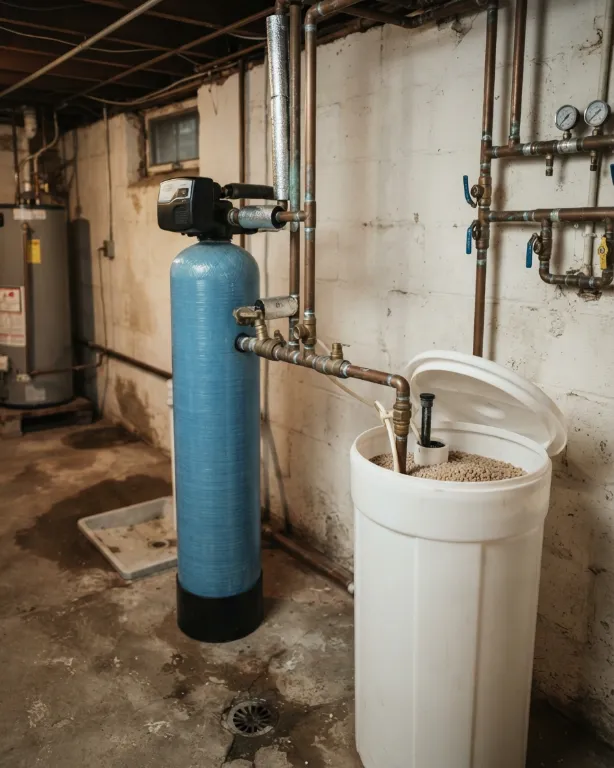
Hardness is not a health issue. It is an equipment issue. Scale in the water heater, scale in a tankless exchanger, spotting on glass, and more soap and detergent for the same result.
Softeners
Much of Virginia has moderately hard water, and well water in the Valley and Piedmont can be very hard indeed.
Scale is what hardness costs you. It coats the inside of a water heater and insulates the burner or element from the water, so the unit works harder and lasts less long. It narrows the passages in a tankless heat exchanger, which is why descaling is mandatory on those. It furs up shower heads and aerators, spots glassware, and stiffens laundry. And it makes soap and detergent less effective, so households on hard water use measurably more of both.
A conventional softener passes water through a resin bed that exchanges calcium and magnesium for sodium, then periodically regenerates by flushing the resin with brine from a salt tank. Things worth knowing before buying one:
If your house has copper pipe with a history of pinhole leaks, test the pH before assuming hardness is the problem. Low-pH water is aggressive to copper, and the correct treatment is a neutralising filter. A softener will not help and may not be relevant at all. See whole-home repiping if the pipe is already failing.
Scope
Two different jobs, two different budgets, and confusing them is the most common overspend.
Problems that affect the plumbing and the appliances: hardness, iron, sediment, sulphur, low pH, and bacteria on a well. These have to be treated where the water enters the house, because the damage happens throughout the system.
Problems that only matter in what you drink and cook with: lead, nitrate, arsenic, taste, and general polish. A reverse osmosis unit under the kitchen sink treats a few gallons a day at a fraction of whole-house cost.
A common and sensible combination. A softener and iron filter at the point of entry for the equipment’s sake, plus an under-sink RO for drinking water. Considerably cheaper than trying to make one whole-house system do everything.
Worth connecting to the treated line if you fit RO. Scale and taste both show up in ice more than people expect.
Genuinely effective for taste and, with the right certified cartridge, for lead. For a rental or an interim measure they are a legitimate answer rather than a compromise.
Look for NSF/ANSI certification for the specific contaminant you are treating. 42 for taste and aesthetics, 53 for health contaminants including lead, 58 for reverse osmosis, 55 for UV. A device with no certification for your contaminant is decorative.
The honest summary for most Virginia households on municipal water: read the utility report, test your own tap for lead if the house predates 1986, fit a carbon filter or an under-sink RO for drinking water if you dislike the taste, and add a softener only if a measured hardness result justifies it. That is a few hundred dollars, not several thousand, and it addresses what the tests actually found.
For well households the calculus is different, because there is no treatment upstream at all, and there a properly specified point-of-entry system is often genuinely necessary. Even then, it should be specified against a panel.
Ownership
Treatment equipment is not an appliance you install and forget. Neglected, it goes from useful to harmful.
| Equipment | Task | Frequency |
|---|---|---|
| Sediment prefilter | Replace cartridge | 3. 6 months |
| Carbon filter | Replace cartridge or media | 6, 12 months / 3, 5 years |
| Softener | Check salt level | Monthly |
| Softener | Clean brine tank, check resin | Annually |
| Iron / oxidising filter | Backwash check, media replacement | Annually / 5. 8 years |
| UV system | Replace lamp | Annually, regardless of appearance |
| UV system | Clean quartz sleeve | Every 6 months |
| Reverse osmosis | Replace prefilters | 6. 12 months |
| Reverse osmosis | Replace membrane | 2. 5 years |
| Neutralising filter | Top up media | Annually |
| Any system | Retest the water | Annually |
Two failure modes to understand. A spent carbon filter becomes a bacterial habitat. Carbon removes chlorine, which means the media itself is unprotected, and a cartridge left in for years is worse than no filter at all. And a UV lamp keeps glowing long after it stops working: output degrades over roughly a year while the lamp still looks lit, so it is replaced on schedule rather than on appearance. On a well being disinfected by UV, that annual lamp is not optional.
Retest annually. It is the only way to know the equipment is still doing what it was bought for, and on a well it is the only way to know the water has not changed.
Filters, lamps and media on a written schedule. Neglected treatment equipment is worse than none.
Cost
Installed prices for Virginia, and the running cost that comes with each.
| Equipment | Installed | Annual upkeep |
|---|---|---|
| Whole-house sediment prefilter | $250. $600 | $30. $80 |
| Whole-house carbon filter | $600. $1,800 | $60. $250 |
| Ion-exchange softener, metered | $1,200. $3,000 | $80. $250 salt |
| Salt-free scale conditioner | $800. $2,200 | $50. $150 |
| Iron / manganese oxidising filter | $1,500. $3,500 | $80. $200 |
| Sulphur aeration system | $1,800. $4,000 | $100. $250 |
| pH neutralising filter | $1,000. $2,500 | $80. $200 media |
| UV disinfection | $700. $1,800 | $90. $200 lamp |
| Under-sink reverse osmosis | $400. $1,200 | $60. $180 |
| Full well treatment train | $4,000. $10,000 | $250. $600 |
| Laboratory panel | $150. $450 | . |
Compare that with what an unsolicited in-home demonstration typically quotes. Frequently $5,000 to $9,000 for a whole-house system on municipal water that a $400 under-sink unit and a $12 test would have addressed. There are legitimate cases for a full treatment train, and they are nearly all on private wells with a laboratory panel to justify them.
A $200 laboratory test is the cheapest thing you will buy in this category, and it turns a sales pitch into a specification.
Softeners do not disinfect. UV does not remove iron. Carbon does not soften. Any single device sold as a complete answer is being oversold.
Sediment, then iron, then softening, then carbon, then UV. Wrong order and one stage destroys the next.
It keeps glowing long after its output has dropped below effective. On a well, that lamp is the disinfection.
Questions
Only if a test says so. On municipal water, read your utility’s annual water quality report first. It is free and it tells you what is in the supply. Then test your own tap for lead if the plumbing predates 1986. Many municipal households need nothing more than a carbon filter for taste. On a private well, nobody is treating or testing anything upstream, so a laboratory panel is essential and treatment often genuinely is too.
That demonstration proves very little. Precipitation tests react to ordinary dissolved minerals that are harmless, and electrolysis demonstrations will discolour any water including bottled. Neither identifies a contaminant or a concentration. Ask for a certified laboratory report instead, if the seller cannot provide one, the diagnosis does not exist.
A softener removes hardness minerals, calcium and magnesium, by ion exchange, and does nothing else. A filter removes or reduces specific substances depending on its media: carbon for chlorine, taste and some organics; oxidising media for iron and manganese; sediment cartridges for grit. They solve different problems, and a softener sold as a general-purpose water improver is being misrepresented.
No. Hardness is not a health concern. It is an equipment and convenience issue. It scales water heaters and tankless heat exchangers, furs up shower heads and aerators, spots glassware, stiffens laundry and makes soap less effective. Those are real costs worth addressing, but they are not health risks.
They do something, but not what softeners do. Template-assisted crystallisation devices alter how scale forms so it is less likely to adhere to pipe and heater surfaces. That can genuinely reduce scale deposition. But they do not remove hardness minerals, so the water will still spot glassware and still resist soap. If your goal is scale protection they may suit; if your goal is soft water they will disappoint.
Hydrogen sulphide, usually from sulphur bacteria or naturally occurring conditions in the aquifer. The treatments are aeration or an oxidising filter, depending on concentration. Before installing anything, check whether the smell is only on the hot side, if so, the reaction is happening in the water heater with its anode rod, and swapping the rod is a much cheaper fix.
A properly certified one will, but the type matters. Look for NSF/ANSI 53 certification for lead specifically, or NSF/ANSI 58 for reverse osmosis. Point-of-use is the right approach, since lead only matters in what you drink and cook with. Bear in mind that lead comes from your own plumbing rather than the source, lead-tin solder on pre-1986 copper, brass fixtures, or an old lead service line, so replacing the source is the permanent fix.
It inactivates bacteria, viruses and protozoa by exposing them to ultraviolet light. Nothing else. It does not remove iron, hardness, sediment, taste or chemicals, and it needs clear water to work at all, so it goes last in a treatment train after filtration. The lamp must be replaced annually because its output degrades long before it stops glowing.
A laboratory panel is $150 to $450. An under-sink reverse osmosis unit is $400 to $1,200 installed. A metered softener is $1,200 to $3,000. A full well treatment train with several stages runs $4,000 to $10,000. If you are on municipal water and being quoted $5,000 or more for a whole-house system, ask which laboratory result justifies each stage, often the honest answer is a $400 under-sink unit.
More than people expect, and it is not optional. Sediment cartridges every three to six months, carbon every six to twelve, softener salt monthly with an annual brine tank clean, UV lamps annually, RO prefilters every six to twelve months and membranes every two to five years. A spent carbon cartridge becomes a bacterial habitat, so neglected equipment is genuinely worse than none. Retest the water annually to confirm it is all still working.
Related work
Water quality decisions overlap with wells, heaters and pipe condition.
Testing, bacteria, pressure and the mechanical side of a private well.
Read moreHard water is the main enemy of a tankless heat exchanger.
Read moreWhen low pH has been attacking copper, or lead solder is the real problem.
Read moreTwo hundred dollars, then decide
It is the cheapest purchase in this category and it converts a sales pitch into a specification. Tell us whether you are on a well or city water and we will name the panel worth running.
(866) 683-0244Statewide, 24 hours. Independent licensed professionals.