Water Heater Installation
Tank, heat pump and tankless compared, with sizing and installed costs for each.
Read more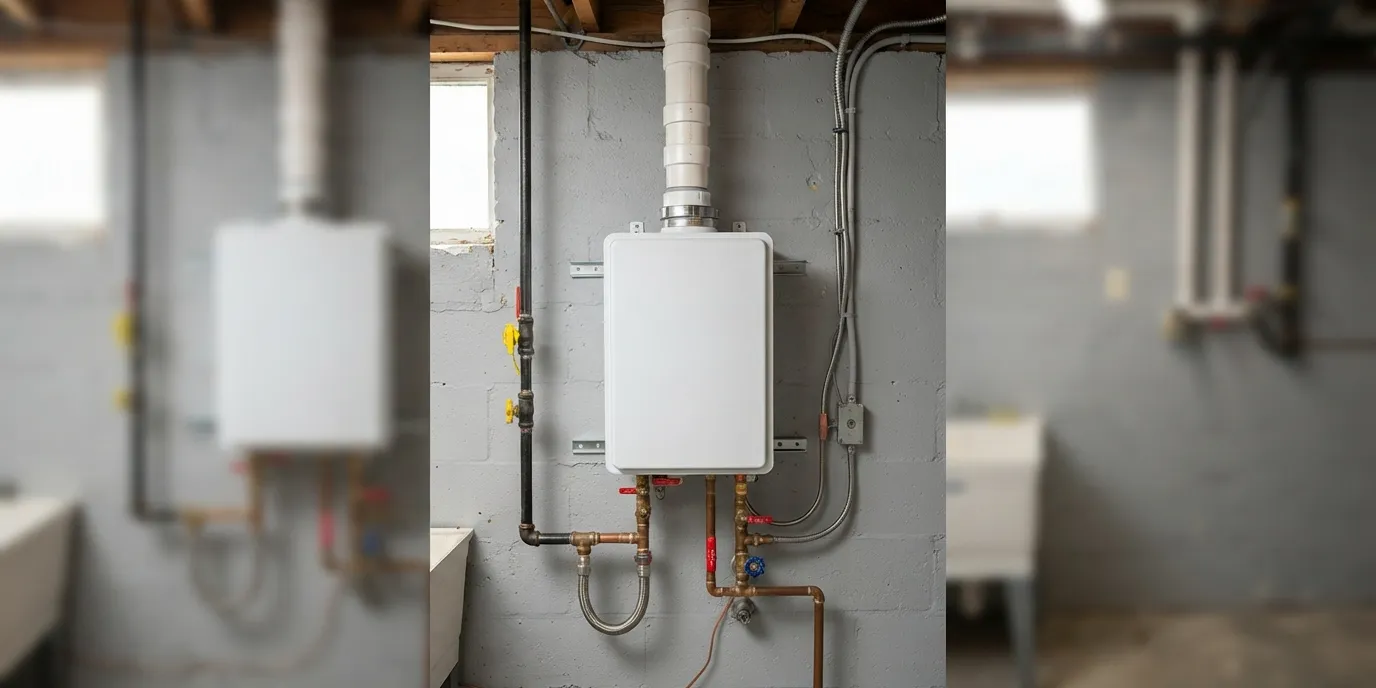
Tankless · Statewide
Endless hot water, twenty-plus years of life, and a unit the size of a carry-on suitcase. The reason tankless is not universal is not the heater. It is the gas line, the vent, and the flow rate arithmetic that most quotes skip.
The first question we will ask is your gas meter size and the diameter of the branch feeding the current heater. That determines everything else.
Dollar ranges here are typical Virginia costs, given for planning only. They are not a quote. The independent plumber who takes your job sets the price and gives it to you before work begins.
The case
Real advantages, real limitations, and the situations where a storage tank is simply the better buy.
What tankless genuinely delivers. Hot water that does not run out, however many consecutive showers. A twenty to twenty-five year service life against eight to twelve for a tank. Roughly a quarter to a third less gas use, because there is no standby loss keeping fifty gallons hot around the clock. A footprint that frees a whole closet or a corner of a garage. And no fifty-gallon vessel of water waiting to fail onto your floor, which, if the current heater sits above finished space, is an argument on its own.
What it does not deliver. Instant hot water at the tap. The wait is set by the length of pipe between the heater and the fixture, exactly as with a tank. Unlimited simultaneous flow: a tankless unit has a hard gallons-per-minute ceiling and beyond it the temperature drops. Freedom from maintenance: in hard water it needs descaling roughly annually, and a neglected unit scales up and loses output. Or a simple installation: the gas and vent work is the majority of the cost and complexity.
When a tank is the better answer. If you are moving within a few years, the payback will not arrive. If the house is all-electric with no gas service, whole-house electric tankless demands a service upgrade that rarely makes sense. A heat-pump tank is the better electric option, covered on water heater installation. If the existing gas meter and branch cannot be upgraded at reasonable cost, the arithmetic breaks. And if demand is modest, one or two people, one bathroom, the standby loss you are eliminating is small.
Where it shines. Families of four or more with two or three bathrooms and simultaneous morning demand. Houses where the heater sits in an attic or above a finished ceiling. Small houses and condos where the closet is worth more than the tank. And long-hold owners who will actually see the second decade of a twenty-year unit.
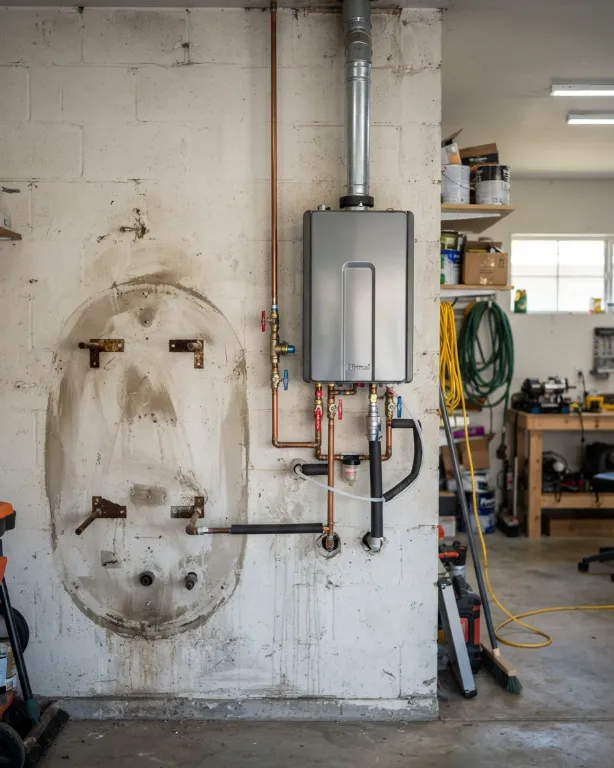
A typical 40,000 BTU tank sits on a half-inch branch. A whole-house tankless wants 150,000 to 199,000 BTU, which usually needs three-quarter-inch or larger pipe and sometimes a larger meter. Any quote that has not looked at this is not a real quote.
Meter size, branch diameter, household demand. Three answers tell us whether this is straightforward or a bigger project.
Capacity
Tankless is sized in gallons per minute at a given temperature rise, and a Virginia February makes that rise much larger than the brochure assumes.
A tankless heater does not store hot water; it raises the temperature of water passing through it. Its capacity is therefore expressed as flow at a temperature rise. The same unit that delivers 9.8 gpm at a 35-degree rise delivers only about 5 gpm at a 70-degree rise. Incoming groundwater in Virginia runs roughly 65 to 70 degrees in late summer and 45 to 50 in February. Heating to 120 means a 50-degree rise in August and a 75-degree rise in winter, so a unit sized on summer conditions underperforms exactly when you notice most.
| Fixture | Flow | Notes |
|---|---|---|
| Low-flow shower head | 1.5. 2.0 gpm | The dominant demand in most houses |
| Standard shower head | 2.0. 2.5 gpm | Older heads can exceed this |
| Bathroom faucet | 0.5. 1.5 gpm | Small but additive |
| Kitchen faucet | 1.5. 2.2 gpm | Often runs alongside a shower |
| Dishwasher | 1.0. 2.0 gpm | Many heat internally, reducing demand |
| Washing machine | 1.5. 3.0 gpm | Warm cycles only |
| Soaking tub fill | 4.0. 6.0 gpm | The single biggest draw in most homes |
| Simultaneous use | Needed flow | Unit class |
|---|---|---|
| 1 shower | 2.0 gpm | 120,000. 140,000 BTU |
| 1 shower + 1 faucet | 2.5. 3.0 gpm | 150,000 BTU |
| 2 showers | 4.0 gpm | 180,000. 199,000 BTU |
| 2 showers + kitchen | 5.5 gpm | 199,000 BTU, or two units |
| Tub fill + shower | 7.0. 8.0 gpm | Two units in cascade |
| 3 showers, large family | 6.0 gpm and up | Two units in cascade |
Two practical consequences. First, insist on being quoted at a winter temperature rise, not a nominal maximum flow rate. A 9.8 gpm unit is a 5 gpm unit in February. Second, if your peak demand genuinely exceeds what a single 199,000 BTU unit can do at a 75-degree rise, the answer is two units in cascade, not one unit and disappointment. That changes the gas sizing again, which is why the gas conversation comes first.
There is also a small-flow floor: tankless units need a minimum flow, typically around 0.4 to 0.5 gpm, to fire at all. A trickling bathroom tap may run cold. Modern units handle this far better than early models did, but it is worth knowing.
Sizing at a 75-degree rise is the number that matters in Virginia. Ask any installer for it.
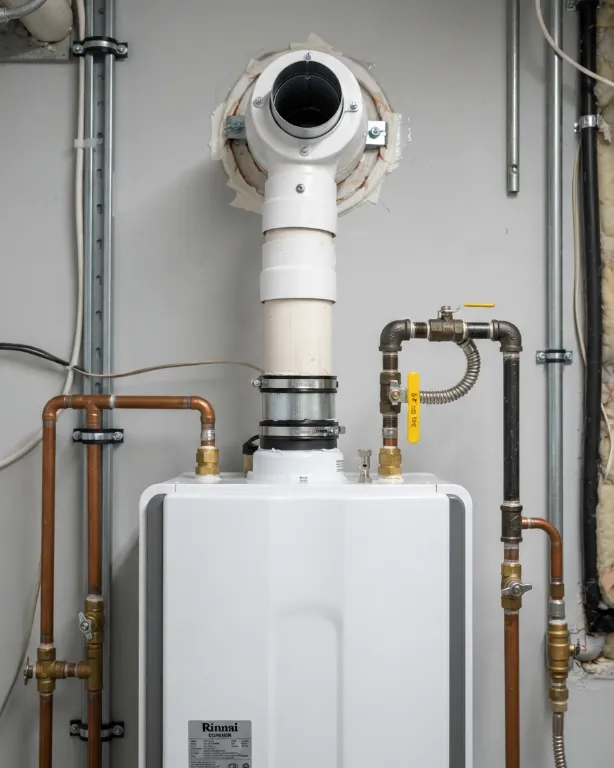
A tankless unit cannot vent into an existing chimney or a B-vent flue meant for a tank. Condensing units need sealed PVC or polypropylene venting rated for the appliance, correctly pitched with condensate provision. Reusing an old flue is a carbon monoxide risk, not a shortcut.
Utilities
Six technical requirements that determine feasibility and cost.
The work
A first-time tankless conversion is a full day, occasionally two. Here is the sequence.
Gas meter capacity, existing pipe sizing, appliance inventory, vent route options, condensate route, electrical availability, and a peak-demand calculation at winter temperature rise. This produces the unit size and the real price.
Plumbing, gas and often mechanical permits, inspected at rough and final. Tankless conversions get looked at carefully, which is a good thing.
Drained, disconnected and hauled out. If the tank was in a closet, expect to gain that space back.
The bulk of the labour: upsized gas pipe with a sediment trap and appliance shutoff, then the vent run cut, sealed, pitched and terminated with correct clearances.
Unit mounted to structure, water connected through isolation valves so future descaling needs no cutting, condensate routed, electrical connected.
Gas pressure verified under load, combustion checked, temperature set, flow tested at several fixtures simultaneously, and the owner shown how to descale and what the error codes mean.
Ask for two things specifically. Isolation valve kits, a pair of service valves with hose ports, are inexpensive at install and make annual descaling a forty-minute job instead of a cutting exercise; a unit installed without them will cost you more over its life than the valves cost now. And a recirculation provision if any fixture is a long run from the unit: tankless does nothing about the cold water already sitting in the pipe, and a dedicated return or a comfort-valve arrangement is much cheaper to install now than later.
If the conversion is happening alongside a repipe or a polybutylene replacement, do them together. The heater connections, the recirculation line and the pressure work all overlap.
Ownership
The one place tankless asks more of the owner than a tank does.
A tankless heat exchanger has narrow passages and a high surface temperature, which is exactly the condition in which calcium scale forms. Scale reduces flow, reduces heat transfer, triggers error codes and eventually kills the exchanger. The most expensive part in the unit. Descaling is a flush of the exchanger with a circulating pump and a mild acid solution through the isolation valves.
| Task | Frequency | Who |
|---|---|---|
| Descale the heat exchanger | Annually in hard water; every 2 years in soft | Plumber, or owner with a kit |
| Clean the inlet water filter screen | Every 6. 12 months | Owner |
| Clean the air intake filter | Annually | Owner |
| Replace condensate neutraliser media | Annually | Plumber |
| Check vent terminal for obstruction | Annually, and after storms | Owner |
| Combustion and gas pressure check | Every 2. 3 years | Plumber |
| Flush isolation valve ports | With each descale | Plumber |
Much of Virginia has moderately hard water, and well water in the Shenandoah Valley and parts of the Piedmont can be very hard. If yours is, treat a softener or a scale-inhibiting cartridge as part of the tankless decision rather than an optional extra. It protects the most expensive component in the system and it also extends fixture and appliance life throughout the house.
Manufacturer warranties on heat exchangers are long, commonly twelve to fifteen years, but frequently conditional on documented maintenance. Keep the descale invoices.
Annual descaling is what makes a twenty-year unit reach twenty years. It is a short visit and it protects the warranty.
Cost
Installed ranges for Virginia, and an honest look at the return.
| Scenario | Typical range |
|---|---|
| Straight swap where gas and vent already suit | $3,000. $4,500 |
| Typical conversion with gas upsize and new sidewall vent | $4,000. $6,500 |
| Conversion with long gas run or difficult vent route | $5,500. $8,500 |
| Two units in cascade for high demand | $8,000. $14,000 |
| Add-on: recirculation line and pump | $600. $2,000 |
| Add-on: water softener | $1,200. $3,000 |
| Annual descaling service | $150. $350 |
Energy saving against a conventional gas tank is real but modest in absolute terms. Commonly $80 to $180 a year for a typical Virginia household. On energy alone, payback against an $1,800 tank installation runs well past a decade. The honest case for tankless is not the gas bill. It is the twenty-year life against eight to twelve, so you buy one unit instead of two; the endless hot water; the recovered floor space; and the absence of a fifty-gallon tank waiting to leak.
Where tankless is genuinely the wrong purchase: a short ownership horizon, low demand, no gas service, or a gas supply that cannot be economically upgraded. In those cases a heat-pump tank or a good conventional tank is the better use of the money, and we will say so.
A service valve kit costs little at installation and makes every future descale straightforward. Without them, maintenance means cutting pipe, and maintenance that is awkward does not happen.
Ask for the flow rating at a 75-degree temperature rise, not the headline maximum. That is the number your February shower will experience.
A tankless unit needs electricity. In an outage there is no hot water and no stored reserve. If that matters to your household, know it before you buy.
Questions
It will not run out from a duration standpoint. You can shower for an hour. But it has a hard flow limit: beyond its gallons-per-minute capacity at the current temperature rise, the outlet temperature drops. So it never runs out, but it can be overwhelmed by too many fixtures at once. That is why correct sizing at a winter temperature rise matters so much.
No. The delay at a fixture is the time it takes to push the cooled water already sitting in the pipe out of the way, and that is identical whether the heat source is a tank or a tankless unit. Some units add a second or two of ignition delay. If a slow tap is the complaint, the answer is a recirculation line or a point-of-use unit, not tankless in general.
Typically $4,000 to $6,500 for a conversion that includes upsizing the gas line and running a new sealed sidewall vent. A rare straight swap where gas and venting already suit can be $3,000 to $4,500; a difficult vent route or a long gas run pushes toward $8,500; two cascaded units for a high-demand house run $8,000 to $14,000. The unit itself is a minority of that. The gas and vent work is the bulk.
Because volume, not just presence, is what matters. A conventional 40-gallon tank draws around 40,000 BTU and lives happily on a half-inch branch. A whole-house tankless draws 150,000 to 199,000 BTU. Delivering that at proper pressure, alongside a furnace and a range, usually needs three-quarter-inch or one-inch pipe and occasionally a larger meter. Any quote that has not addressed this is incomplete.
Usually yes, and you gain the floor space, but the vent has to go somewhere. Condensing units vent through a sidewall in sealed plastic pipe, so the practical question is whether there is a suitable exterior wall within reach with correct clearances from windows, doors, soffits and the gas meter. An old chimney or B-vent flue cannot be reused.
Annually in hard water, every two years in soft water. Much of Virginia is moderately hard, and well water in the Valley and Piedmont can be very hard. Descaling is a circulating acid flush through the isolation valves and takes under an hour. Skipping it is the main reason tankless units fail early, and manufacturers often require documented maintenance to honour the heat exchanger warranty.
Yes, but their capacity drops as the incoming water gets colder, because the unit has to achieve a bigger temperature rise. A unit rated 9.8 gpm at a 35-degree rise delivers around 5 gpm at the 75-degree rise a Virginia February demands. Units on exterior walls or in unconditioned garages also rely on powered freeze protection, which makes a winter power cut a genuine risk.
You get no hot water. Gas tankless units need electricity for the fan, ignition and controls. A conventional standing-pilot gas tank keeps whatever is already hot in the tank and can even continue heating. If outages are common where you live and hot water during them matters, that is a real point against tankless, or an argument for a small generator circuit.
For a whole house, rarely. Whole-house electric tankless units draw enormous current, often 100 to 150 amps, which typically means a service upgrade costing more than the heater. They make good sense as point-of-use units for a single remote sink or a workshop. For an all-electric house wanting efficiency, a heat-pump tank is the far better answer.
Twenty to twenty-five years is the normal expectation with annual descaling, against eight to twelve for a storage tank. Heat exchangers are commonly warranted twelve to fifteen years. That longevity is the strongest part of the financial case: you buy one tankless unit where you would have bought two tanks, and it is a much smaller thing to fail when it eventually does.
Related work
Tankless decisions rarely stand alone. These are the adjacent pages.
Tank, heat pump and tankless compared, with sizing and installed costs for each.
Read moreWhether the current unit is worth saving before you commit to a conversion.
Read moreIf pipe work is coming anyway, the heater and recirculation work belongs in the same visit.
Read moreStart with the gas line
Meter capacity, branch diameter and a peak-demand calculation at winter temperature rise. That survey turns a vague idea into a real price, and sometimes into an honest "a tank suits you better".
(866) 683-0244Statewide, 24 hours. Independent licensed professionals.