Drain Cleaning
When the disposal works but the sink does not, the line is the problem.
Read more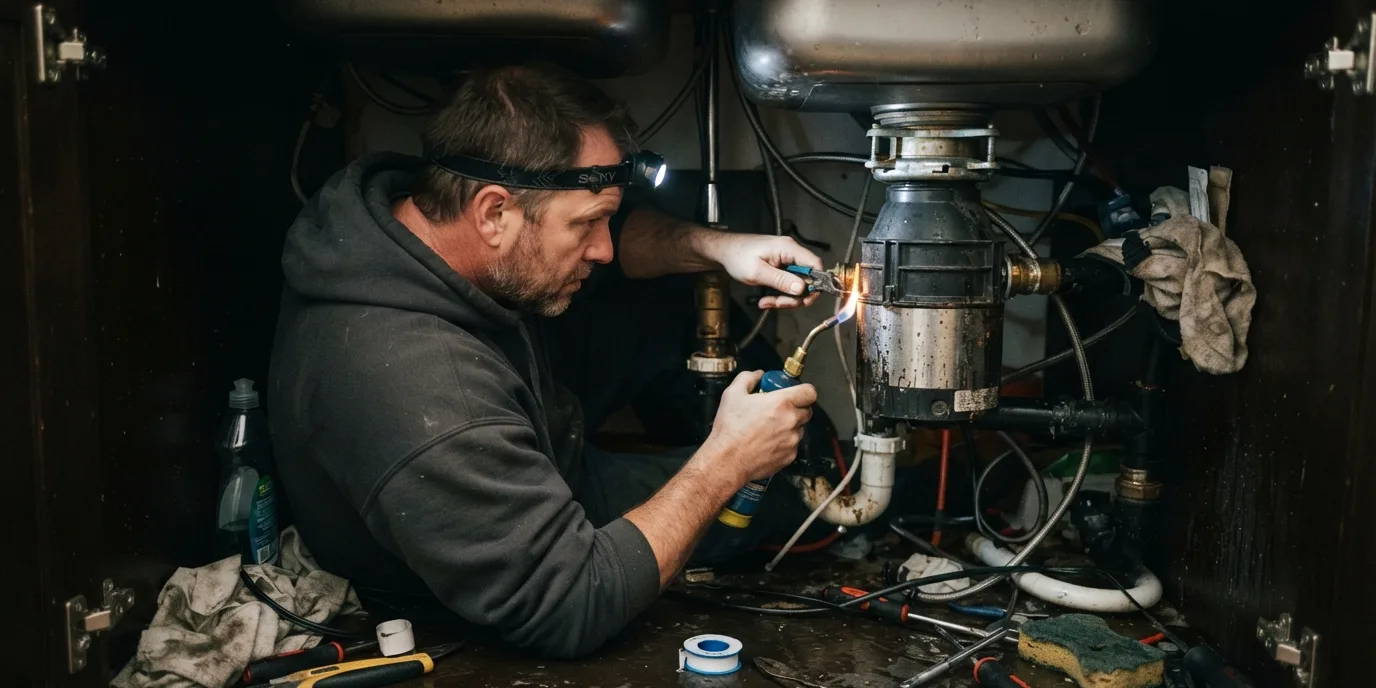
Kitchen · Statewide
A disposal that hums is jammed and fixable. A disposal that leaks from the bottom is finished. And a sink that stands full of water after the disposal has run properly is not a disposal problem at all. It is the drain line.
Tell us whether it hums, does nothing, rattles, or leaks, and if it leaks, whether the water appears at the rim, the side or the bottom.
Dollar ranges here are typical Virginia costs, given for planning only. They are not a quote. The independent plumber who takes your job sets the price and gives it to you before work begins.
Diagnosis
A disposal gives you four distinct symptoms, and each one points at a different part.
| Symptom | Cause | Outcome |
|---|---|---|
| Hums but does not turn | Jammed impeller plate | Free it. Repairable |
| Nothing at all, no hum | Tripped reset, breaker, or dead motor | Reset first, then diagnose |
| Loud metallic rattle | Foreign object. A bone, a spoon, a bottle cap | Remove it |
| Grinds slowly, smells sour | Dull or corroded impellers, food packed in the chamber | Clean; often near end of life |
| Leaks at the top rim | Failed sink flange seal or loose mounting | Reseal. Repairable |
| Leaks at the side hose | Dishwasher inlet or discharge gasket | Replace gasket |
| Leaks from the bottom of the body | Internal seal and shell corrosion | Terminal. Replace |
| Trips the reset repeatedly | Failing motor windings or a chronic jam | Replace |
| Drains slowly after grinding | Line problem, not a disposal problem | See drain cleaning |
| Standing water in both bowls | Blockage downstream of the tee | Line problem |
The most important line in that table is the last two. A disposal that grinds normally but leaves water standing in the sink has done its job. The food has been reduced and then met a restriction further down. Replacing the disposal changes nothing. That is a drain call, and in a kitchen it is usually grease, which is what hydro jetting is for.
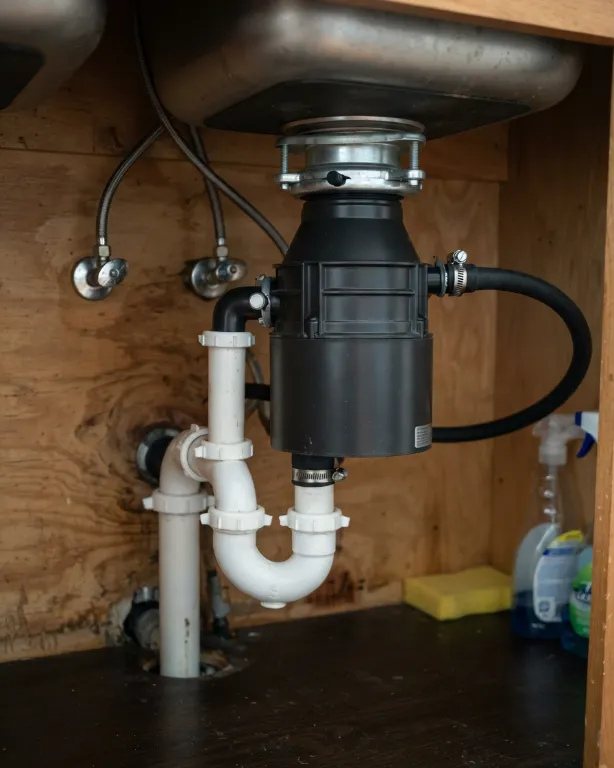
A red or black button on the underside of the unit. A disposal that seems completely dead is very often just tripped, and pressing it costs nothing.
Even switched off. Use tongs, pliers, or a torch and a wooden spoon handle. To free a jam, switch the unit off at the breaker first, not just at the wall switch.
Jams, reseals and gasket work are short visits. Tell us which of the four symptoms you have.
Repairs
Three of the four common faults are genuinely homeowner-fixable.
What is not a repair: a leak from the bottom of the housing. That is the internal shell seal and the motor housing, and it means water is getting to the motor. There is no gasket to change and no economic repair. The unit is finished, and every day it runs after that is a risk to the cabinet floor.
Describe where the water appears. Rim, side, or bottom. That single detail decides repair or replace.
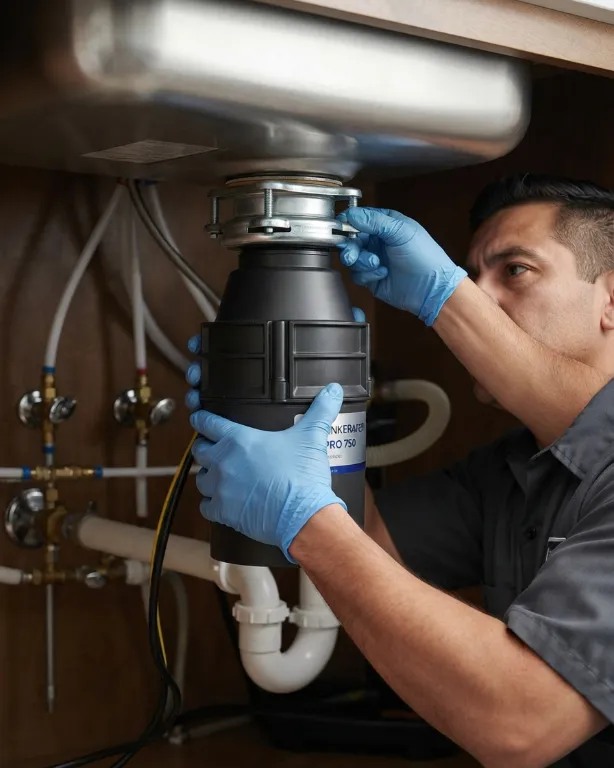
The difference between a builder-grade unit and a well-insulated one is dramatic in an open-plan kitchen. It is the upgrade people notice daily.
Replacement
Disposals last eight to fifteen years. Past ten, the arithmetic tips quickly.
Replace rather than repair when the housing leaks from the bottom, when the reset trips repeatedly, when the motor has seized entirely, or when the unit is over ten years old and needs anything more than a jam cleared. A new mid-range disposal fitted costs less than two service visits and comes with a warranty.
Choosing one. Four things actually matter, and horsepower is not the first:
Septic systems deserve a warning. A disposal roughly doubles the solids load reaching the tank, shortening the pumping interval and raising the risk of solids carrying into the drain field. The expensive part to replace. On septic, either skip the disposal, fit the smallest unit and use it sparingly, or budget for more frequent pumping. See septic system plumbing.
Installation
An hour in an accessible cabinet, and there are four things that separate a good fit from a callback.
The sink flange must be bedded in fresh putty or a new gasket, cleaned of all old material, and the mounting ring tightened evenly. Almost every rim leak we see is a reused, hardened bed.
New units ship with the dishwasher inlet plugged. If a dishwasher connects and the plug is left in, the dishwasher will not drain; if it is knocked out and no dishwasher connects, the port must be capped. Both errors are common.
The dishwasher drain hose needs a high loop secured under the counter, or an air gap at the sink deck, to stop disposal waste siphoning back into the dishwasher. This is a code item and a hygiene one.
The discharge elbow into the trap arm has to have proper fall, and the trap must be a P-trap, not an S-trap or a flexible accordion. Bad geometry here causes the slow-draining, gurgling sink people blame on the disposal.
A dedicated switch, a properly wired cord or hard connection, and, under a sink, GFCI protection. Do not leave the old cord dangling into standing water territory.
The unit hangs off the sink; it should not be resting on the cabinet floor or pulling the trap sideways. Misalignment strains every joint in the assembly.
If the sink or faucet is being changed at the same time, do the whole under-sink assembly together. Trap, tailpieces, supply stops and braided lines. It is the same access and the same testing, and the small parts are what fail. See faucet and fixture installation.
Care
A disposal is a food shredder, not a bin. Most failures are diet.
| Item | Verdict | Why |
|---|---|---|
| Soft food scraps, small amounts | Fine | What it is designed for |
| Citrus peel, small pieces | Fine | Cleans and deodorises |
| Grease, oil, butter | Never | Cools and coats the drain line downstream |
| Coffee grounds | No | Pack into a sludge in the trap |
| Eggshells | No | Membrane wraps the impellers; grit settles |
| Pasta, rice, oats | No | Swell and form a paste |
| Potato peel | No | Turns to starch glue |
| Celery, onion skin, corn husk | No | Fibres wrap the impellers |
| Bones, fruit pits | No | Jam or damage the grind ring |
| Flour, batter | No | Sets in the line |
| Any non-food item | Never | Metal ruins the grind ring |
The operating routine matters as much as the diet. Run cold water, never hot, which liquefies fat so it can travel down the line and re-solidify. Start the water before the food and keep it running for twenty to thirty seconds after the grinding noise stops, so waste is carried well past the trap rather than left sitting in it. Feed small amounts rather than pushing a full plate in at once.
Grease is the one that costs real money. Kitchen lines that carry fat build a hard deposit along the pipe wall over years, which is why kitchen branches are the most commonly blocked drains in a house and why hydro jetting rather than cabling is the correct clearance for them. A disposal does not make grease disappear; it just moves the problem twenty feet downstream.
If the disposal grinds fine but the sink is slow, the line is the problem. That is a different visit and a different tool.
Cost
Disposal work is at the inexpensive end, and replacement is often cheaper than a second repair visit.
| Work | Typical range |
|---|---|
| Diagnostic and jam clearing | $110. $220 |
| Reset and electrical fault trace | $110. $250 |
| Sink flange reseal and remount | $180. $350 |
| Dishwasher inlet or discharge gasket | $120. $240 |
| New disposal fitted, unit supplied | $300. $650 |
| Premium insulated unit fitted | $450. $850 |
| Disposal plus new trap and tailpieces | $400. $800 |
| Add a dishwasher air gap or high loop | $95. $220 |
| Removal, no replacement, with new basket strainer | $220. $420 |
Removal without replacement is a legitimate choice, and one we fit more often than people expect, in septic houses, in kitchens where composting has replaced it, and in houses where a quiet sink is worth more than a shredder. It costs less than a new unit and simplifies the whole assembly.
Two free checks before a paid visit. A dead disposal is very often a tripped overload or a tripped GFCI under the sink.
Water from the base of the housing has reached the motor. There is no seal to renew, and every run after that risks the cabinet floor.
Twenty to thirty seconds past the last grinding noise. It is the single habit that most extends both the disposal and the drain line.
Questions
It is jammed. The motor is energised but the impeller plate cannot turn. Switch it off at the breaker, then use the hex wrench that came with the unit in the socket on the underside and rock it back and forth until it moves freely. If there is no socket, lever the plate round with a wooden broom handle from above. Remove whatever caused it, restore power, press the reset button, and test with cold water running. Never put your hand into the chamber.
Usually not. Check three things in order: the reset button on the underside of the unit, the breaker, and any GFCI outlet inside the cabinet. A tripped GFCI under the sink is one of the most common causes of a disposal with no signs of life. If it resets and then trips again within seconds, the motor is failing and replacement is the answer.
Look at where the water starts, not where it pools. A drip at the top rim is the sink flange seal, which is resealable. A drip at the side is the dishwasher inlet or discharge gasket, which is a cheap part. Water coming from the bottom of the housing is the internal shell seal, and that is not repairable. The unit needs replacing before water reaches the motor and the cabinet floor.
Eight to fifteen years, with usage and diet making most of the difference. Past ten years, replacement is generally the better value than any repair beyond clearing a jam, because a new mid-range unit fitted costs about the same as two service visits and comes with a warranty.
No to both, despite the folklore. Coffee grounds pack into a dense sludge in the trap. Eggshell membranes wrap around the impellers and the shell grit settles in the line. The genuinely bad ones are grease, oil, pasta, rice, potato peel, fibrous vegetables and anything with bones or pits. Small quantities of soft food scraps and a little citrus peel are what it is designed for.
Cold, always. Hot water melts fats so they flow down the line and then re-solidify further along, which is exactly how kitchen drains block. Start the cold water before you feed anything in and let it run for twenty to thirty seconds after the grinding stops, so waste is carried well past the trap.
Because the problem is downstream. The disposal has done its job and the reduced waste has met a restriction in the trap, the branch line or further along. Kitchen lines block with grease more than any other drain in a house. Replacing the disposal will not change it. The line needs clearing, and for grease that means jetting rather than cabling.
Be cautious. A disposal roughly doubles the solids load going into the tank, which shortens the pumping interval and raises the risk of solids carrying into the drain field. The most expensive part of a septic system to replace. Either do without, or fit a small unit, use it sparingly, and pump the tank more often. Some localities restrict disposals on septic outright, so check.
Half a horsepower for one or two people, three-quarters for a typical family, one for heavy cooking. But horsepower matters less than grind design and build: stainless impellers, a multi-stage grind chamber and good sound insulation make more practical difference than the motor rating. Insulation in particular is the feature people appreciate every day in an open kitchen.
Yes, and it is a perfectly reasonable choice. We do it fairly often. A standard basket strainer and a new tailpiece and trap replace the unit, the assembly gets simpler, and the kitchen gets quieter. It costs less than a new disposal and it suits septic houses and households that compost.
Related work
Kitchen plumbing problems tend to travel together.
When the disposal works but the sink does not, the line is the problem.
Read moreThe correct clearance for grease-coated kitchen branch lines.
Read moreThe rest of the under-sink assembly: traps, stops, supply lines and faucets.
Read moreTwo free checks first
A disposal with no signs of life is very often a tripped overload or a tripped outlet inside the cabinet. Try both before booking anything, and if it hums, that is a jam and it usually clears.
(866) 683-0244Statewide, 24 hours. Independent licensed professionals.