Tankless Water Heater
The appliance that most often triggers a gas line upgrade, and why.
Read more
Gas · Statewide
Gas work has two failure modes: the one everybody fears, and the one nobody notices. A leak announces itself. An undersized line quietly starves appliances into incomplete combustion, and that is what carbon monoxide alarms are for.
If you smell gas right now, leave the building and call your gas utility from outside. Then call us for the repair.
Dollar ranges here are typical Virginia costs, given for planning only. They are not a quote. The independent plumber who takes your job sets the price and gives it to you before work begins.
First
Everything else on this page can wait. This cannot.
Natural gas is odourised with mercaptan specifically so that a leak smells like rotten eggs or sulphur at concentrations far below anything dangerous. If you can smell it, act. The smell is doing exactly what it was designed to do. Propane is heavier than air and settles in basements and low spots, so a propane smell low in a building deserves the same response.
Other signals that are easy to miss: a hissing or whistling near a pipe or appliance; dead or yellowing vegetation in a line over a buried service; bubbling in standing water or wet ground near the meter; soot or scorch marks around an appliance; a persistently yellow rather than crisp blue burner flame; and repeated headaches, nausea or drowsiness that improve when you leave the house, which points at combustion products rather than raw gas.
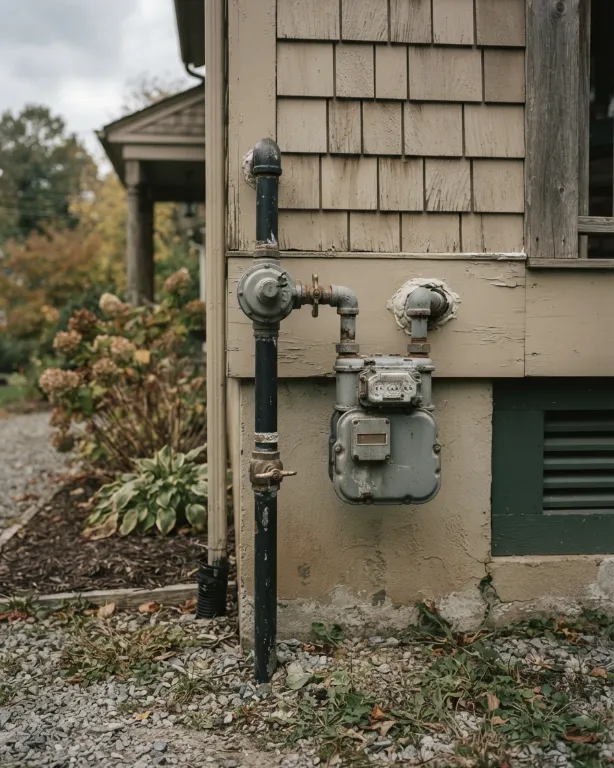
Raw gas smells. Carbon monoxide does not. Any house with a gas appliance needs a working CO alarm on every level, and a backdrafting water heater or furnace is an emergency even when nothing smells wrong.
A quarter-turn valve on the pipe at the meter, needing a wrench or a meter key. Locate it, confirm you have the tool, and leave the tool nearby. Then never use it as a substitute for calling the utility.
For anything that is not an active leak. Active leaks go to the utility first.
Scope
Everything downstream of the meter is the homeowner’s pipe, and all of it is permitted, inspected work.
A line to a range, a dryer, a water heater, a fireplace insert, a pool heater, a generator or a patio grill. Each has a BTU demand that has to be added to the existing load and sized for.
The most common real finding on a survey. Adding a tankless water heater or a large range to a house whose branch pipe was sized for a 40,000 BTU tank means new pipe, and sometimes a larger meter from the utility.
Pressure testing the system, isolating the section that fails, and repairing or replacing it. This is also what a real estate transaction or an insurance question needs documented.
Moving a line for a kitchen remodel, or capping and removing an abandoned run properly rather than leaving a dead leg full of gas behind a wall.
Flexible CSST is fast to install and widely used, but it requires correct bonding to the electrical grounding system. A lightning strike near an unbonded CSST system has caused fires. If your house has yellow flexible gas tubing, bonding is worth verifying.
Buried lines to a generator, a pool heater or an outdoor kitchen, with correct depth, tracer wire, sleeving at penetrations and an accessible shutoff.
Gas piping is not a DIY category, and not only for the obvious reason. Sizing is a calculation, total connected load, pipe diameter, developed length, fitting count and allowable pressure drop, and an undersized line does not fail dramatically. It starves appliances, which produces incomplete combustion, soot, and carbon monoxide. The failure is invisible and the consequence is not.
Every jurisdiction in Virginia permits and inspects gas work, including a pressure test held for the inspector. That record is what a future buyer, an insurer and an appliance manufacturer’s warranty department will all want to see.
Before buying an appliance, not after. It decides whether the job is a connection or a new run.
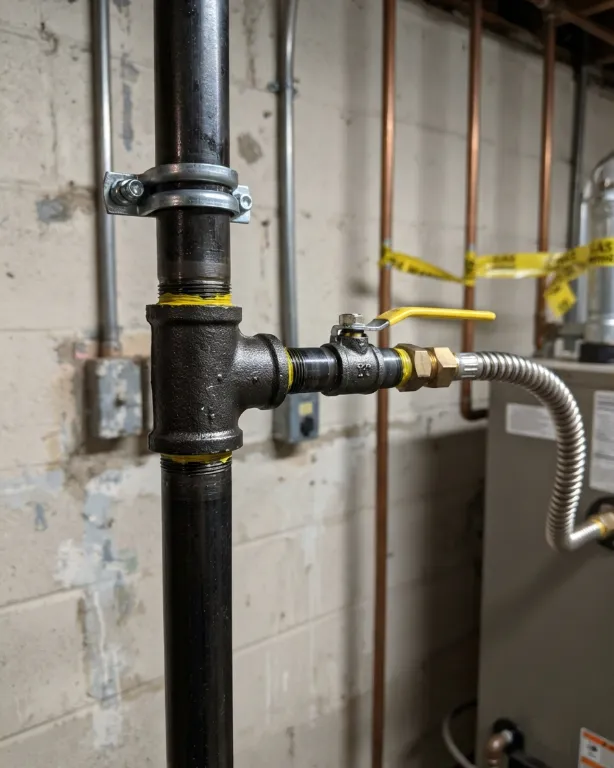
Teeing a large new appliance into a convenient nearby branch because it is close. Convenience is not capacity, and the appliance that suffers is often the one that was already there.
Sizing
A gas line either delivers enough cubic feet per hour at adequate pressure with everything running, or it does not.
| Appliance | Approx. input |
|---|---|
| Storage water heater, 40. 50 gal | 35,000. 50,000 BTU |
| Tankless water heater | 150,000. 199,000 BTU |
| Furnace | 60,000. 120,000 BTU |
| Range with oven | 50,000. 90,000 BTU |
| Clothes dryer | 20,000. 35,000 BTU |
| Fireplace insert or log set | 25,000. 60,000 BTU |
| Pool heater | 200,000. 400,000 BTU |
| Standby generator | 65,000. 250,000 BTU |
| Outdoor grill | 35,000. 60,000 BTU |
Add up what a house actually has and the arithmetic gets tight quickly. A furnace, a range, a dryer and a storage water heater is around 200,000 BTU of connected load. Swap the tank for a tankless unit and it becomes 350,000. A demand most existing branch layouts and some residential meters were never sized to meet.
The outcomes of a load calculation are usually one of four: the existing pipe is adequate and the job is a simple connection; a branch needs upsizing from half-inch to three-quarter or one inch; a new dedicated run from the meter is needed; or the meter itself must be upgraded, which is a utility request with its own lead time. Finding out which before you buy the appliance is the difference between a scheduled job and a stalled kitchen.
Materials
Six details that separate a compliant installation from one that gets red-tagged.
One further item that gets missed on retrofits: combustion air and venting. Adding a gas appliance to a small closet or a tightly sealed newer house can starve every appliance in the space. Any gas installation is also a venting review. See the venting section of water heater installation for how that plays out on heaters specifically.
Process
Six steps, and the middle two are the ones you should not let anyone skip.
That last step matters more than it sounds. A gas job is not finished when the pipe holds pressure; it is finished when every appliance on the system burns correctly and vents correctly. A plumber who leaves without relighting and checking each appliance has handed you an unknown.
A witnessed pressure test and combustion readings at every appliance. That is what a finished gas job looks like.
Cost
Gas work is priced by run length, diameter, access and the number of appliances affected.
| Work | Typical range |
|---|---|
| Survey and load calculation | $150. $400 |
| Leak test of the whole system | $200. $500 |
| Locate and repair one leak | $350. $1,200 |
| New appliance run, short and accessible | $400. $900 |
| New appliance run, long or through finished space | $900. $2,500 |
| Branch upsize for a tankless heater | $600. $1,800 |
| New dedicated run from the meter | $1,200. $3,500 |
| Buried line to a generator or pool heater | $1,500. $5,000 |
| CSST bonding correction | $250. $700 |
| Cap and remove an abandoned line | $200. $600 |
| Permit and inspection | $60. $250 |
Meter upgrades are handled by the gas utility rather than the plumber, are often at little or no cost to the homeowner, and can carry a lead time of weeks. If a load calculation says you need one, start that request early. It is frequently the critical path on a tankless or generator project.
Utility emergency line from outside the building. No switches, no phone indoors, no searching for the source. They come at no charge.
Raw gas announces itself. Carbon monoxide does not, and an undersized gas line or a backdrafting appliance produces it silently.
A load calculation before purchasing a tankless heater, a pro range or a generator tells you whether the job is a connection or a new run. It is the cheapest hour in the project.
Questions
Leave the building immediately and take everyone with you. Do not touch light switches, thermostats, appliances or your phone while inside. A switch arc is an ignition source. Do not try to find the leak. Once outside and away, call your gas utility’s emergency number; they respond to suspected leaks at no charge and can shut the service. Do not go back in until they say it is clear.
Natural gas is odourless in its natural state, so utilities add a sulphur compound called mercaptan specifically so that leaks are detectable by smell at concentrations far below the dangerous range. If you can smell it, the odourant is doing its job, and the correct response is to leave and call, not to investigate.
No, and the reason is not only explosion risk. Gas pipe sizing is a calculation involving total connected load, pipe diameter, run length and fitting count, and an undersized line does not fail visibly. It starves appliances, causing incomplete combustion and carbon monoxide. Gas work is permitted and inspected in every Virginia locality, with a witnessed pressure test, and that record protects your warranty and your insurance.
Because of the volume it demands. A conventional 40-gallon tank draws around 40,000 BTU and lives happily on a half-inch branch. A whole-house tankless unit draws 150,000 to 199,000 BTU. Delivering that at adequate pressure while a furnace and a range also run usually requires three-quarter-inch or one-inch pipe, and sometimes a larger meter from the utility.
CSST is corrugated stainless steel tubing. A flexible gas line that is quick to route and widely code-accepted. It is safe when properly installed, but it must be bonded to the home’s electrical grounding system with a correctly sized conductor. Unbonded CSST has been implicated in fires following nearby lightning strikes, and older installations frequently lack the bond. It is worth having verified.
It is a short capped length of pipe below the tee at an appliance connection, which catches scale, rust and moisture before they reach the appliance’s gas control valve. Debris in a control valve causes erratic operation and unsafe failures. Traps are required at appliance connections and a missing one is among the most common gas inspection failures.
Symptoms include appliances that underperform when others are running, a furnace or water heater that short-cycles, a yellow rather than crisp blue burner flame, soot around an appliance, or a new appliance that never reaches its rated output. None of them are conclusive on their own. The definitive answer is a load calculation against the actual pipe diameters and run lengths.
Yes. Every Virginia locality permits gas piping work and requires an inspection, including a pressure test held while the inspector watches. Beyond compliance, that record is what an appliance manufacturer’s warranty department, your insurer, and a future buyer’s home inspector will all ask about.
Yes, and it is a common request. Outdoor lines need correct burial depth, tracer wire, sleeving where they pass through a foundation, approved coated pipe, and an accessible shutoff at the appliance. A generator in particular needs its demand added to the whole-house load calculation, since it can be the largest single appliance in the house.
You should be equipped for it. Any house with gas appliances needs a working CO alarm on every level. CO has no smell and the early symptoms (headache, nausea, drowsiness) are easily mistaken for illness. If symptoms improve when you leave the house, that is a strong signal. A backdrafting water heater or furnace is an emergency even when nothing smells wrong.
Related work
Gas capacity decides what appliances a house can actually run.
The appliance that most often triggers a gas line upgrade, and why.
Read moreVenting, combustion air and gas connections on heater replacements.
Read moreWhat counts as an emergency, and the order to do things in.
Read moreBefore you buy the appliance
It costs an hour and it tells you whether your new range, tankless heater or generator is a simple connection or a new run from the meter. Finding out afterwards is how kitchens stall.
(866) 683-0244Statewide, 24 hours. Independent licensed professionals.