Hydro Jetting
The correct clearance for grease-coated commercial kitchen lines.
Read more
Commercial · Statewide
On a commercial property the pipe repair is rarely the expensive part. The closed doors, the spoiled stock and the inspection finding are. Which is why commercial plumbing is mostly about scheduling, isolation and documentation, and why the three things that cause most emergencies are all calendar items.
Tell us the property type and your trading hours. Scheduling is usually the first real constraint on the job.
Dollar ranges here are typical Virginia costs, given for planning only. They are not a quote. The independent plumber who takes your job sets the price and gives it to you before work begins.
The difference
Same physics, entirely different constraints. On a commercial property the plumbing failure is rarely the expensive part.
When a pipe fails in a house, the cost is the repair and the damage. When a pipe fails in a restaurant, a clinic or a twelve-unit building, the cost is the repair, the damage, the closed doors, the spoiled stock, the staff sent home and, in regulated premises, a health inspection that now has a finding in it. The plumbing is often the smallest line on the invoice.
That changes what good work looks like. Four things matter more than they do residentially:
Scale is not the defining feature. A small café can have a more demanding plumbing profile than a large house. What defines commercial work is that the plumbing exists to keep an operation running, and every decision is measured against that.
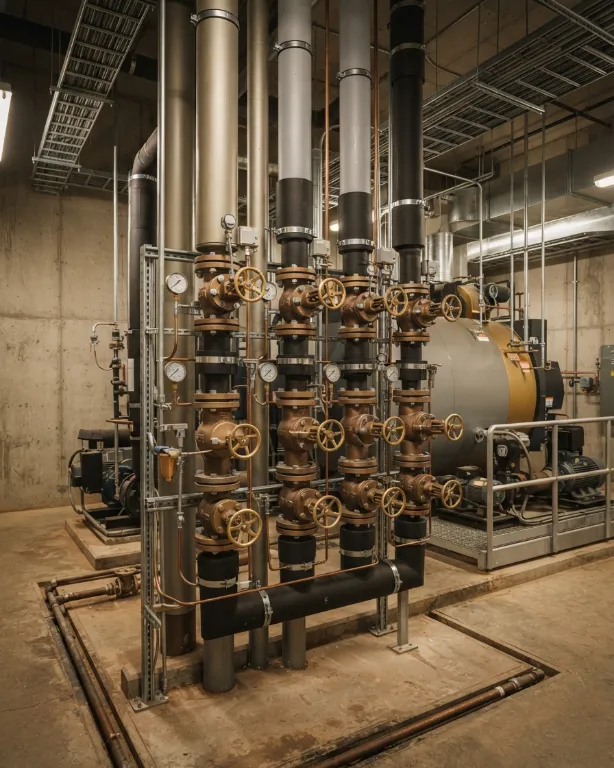
Knowing which valve isolates which part of the building, and that each one still works, converts a two-day shutdown into a two-hour repair. Most properties have never had it done.
Tell us the property type and the trading hours. Scheduling is usually the first real constraint.
Sectors
Each sector has a characteristic set of problems and a characteristic failure that closes it.
Grease is the defining problem: interceptor sizing, cleaning frequency and documentation, plus kitchen drain lines that need jetting rather than cabling. Add high-demand hot water, floor drains and trap primers, and a health inspection regime that treats a backed-up drain as a closure issue.
Fewer fixtures per square foot but zero tolerance for disruption during trading. Restroom reliability, ADA compliance, water heater capacity for cleaning, and roof drainage. Often multi-tenant, so isolation and metering matter.
Shared risers, shared responsibility boundaries and shared consequences, one failure affects units below. Repiping programmes, unit-level isolation, laundry rooms, and a documentation trail for the board.
Sterilisation equipment, specific backflow protection, vacuum and air systems, and infection-control constraints on when and how work is done. Downtime is measured in cancelled appointments.
Long idle periods punctuated by intense use, which produces dry traps, stagnant water and freeze exposure in winter. Seasonal winterisation and pre-term commissioning are the pattern.
Process water, floor drains, oil and sediment interceptors, backflow protection on process connections, and long horizontal drain runs that need jetting on a schedule.
Across all of them, the same three items generate most emergency calls: grease and solids in drain lines, water heater capacity or failure, and backflow devices that fail their annual test. All three are schedulable. That is the case for a maintenance agreement rather than a phone number.
Jetting, backflow testing and water heater service on a calendar beats all three as emergencies.
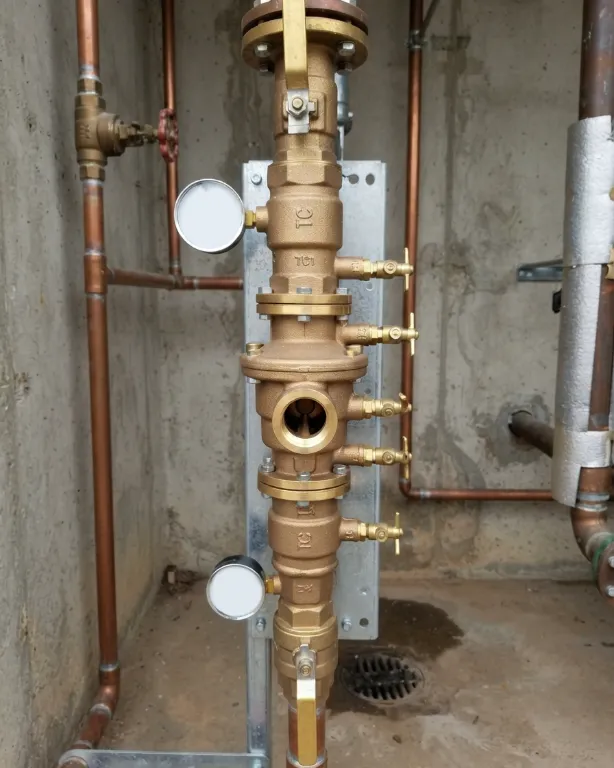
Testable assemblies must be tested annually by a certified tester and the results filed with the water authority. A lapsed test can mean enforcement action and, in some localities, disconnection, and it is entirely avoidable with a calendar reminder.
Compliance
Four obligations that come with commercial premises, each with an inspection attached.
Two documentation habits pay for themselves. Keep a compliance calendar, backflow test dates, interceptor cleaning dates, water heater service, and any local inspection cycle, because every one of these is an avoidable emergency if it is tracked and an expensive surprise if it is not. And keep a current riser and valve diagram, updated whenever work is done. The single largest driver of commercial repair cost is time spent working out how the building is plumbed while the water is off.
Response
The order of operations that limits the damage and gets the doors open.
Landlord and tenant boundaries are worth settling before an emergency rather than during one. In most commercial leases the demarcation sits at the point where service enters the demised premises, but it varies and the lease governs. Know which valves are yours, which are the landlord’s, who holds the keys to the mechanical room out of hours, and who is authorised to approve emergency work at 2am. Businesses lose more time to that question than to the plumbing.
For the general order of operations in any water emergency, our emergency plumbing page covers the residential and commercial basics together.
Prevention
The three items that cause most commercial emergencies are all schedulable, which makes them cheap.
| Item | Frequency | Why |
|---|---|---|
| Kitchen drain line jetting | Quarterly to annually | Grease coats the line; cabling only bores a hole through it |
| Grease interceptor cleaning | Monthly to quarterly | Regulated, documented, and the main cause of kitchen blockages |
| Backflow assembly testing | Annually | Legal requirement, filed with the water authority |
| Water heater service and flush | Annually | Capacity loss and failure are top emergency causes |
| Floor drain and trap primer check | Quarterly | Dry traps release sewer gas into occupied space |
| Fixture and flush valve service | Annually | High duty cycle; small leaks scale up on a commercial meter |
| Valve exercise and survey update | Annually | Valves seize unused; the diagram drifts out of date |
| Sewer camera survey of main lines | Every 2. 3 years | Finds root intrusion and bellies before they close you |
| Roof drain and interior leader check | Twice yearly | Blockages surface inside the building |
| Winterisation of idle areas | Seasonally | Intermittently used buildings freeze first |
The economics are straightforward. Quarterly jetting of a restaurant kitchen line costs a fraction of one Friday night closure, and the closure brings a health inspection finding with it. Annual backflow testing costs a fraction of an enforcement notice. Annual water heater service costs a fraction of a Saturday with no hot water in a food premises, which is not a repair problem but a trading one.
Ask for the programme in writing, with dates, and ask for the reports filed somewhere you can retrieve them. When an inspector, an insurer or a prospective buyer asks how the building has been maintained, that folder is the answer.
Dates, scope and filed reports. It is the difference between maintenance and hope.
Cost
Ranges vary far more than residential, because access, hours and scale dominate.
| Work | Typical range |
|---|---|
| Valve survey and riser diagram | $400. $1,500 |
| Backflow assembly test and certification | $100. $250 per device |
| Backflow assembly repair or replacement | $500. $2,500 |
| Kitchen line jetting, scheduled visit | $400. $1,200 |
| Emergency drain clearance, after hours | $500. $1,800 |
| Grease interceptor cleaning | $250. $900 |
| Grease interceptor replacement | $3,000. $15,000 |
| Commercial water heater replacement | $3,500. $15,000 |
| Restroom fixture replacement, per fixture | $450. $1,400 |
| Sewer camera survey | $400. $1,200 |
| Multi-family riser repipe, per unit | $3,000. $9,000 |
| Annual maintenance agreement | $1,200. $8,000 per year |
After-hours and overnight attendance carries a premium, and on a trading property it is almost always the cheaper option overall. The premium is smaller than a day of lost revenue. That trade-off is worth making explicitly rather than by default.
Labelled, exercised, documented isolation valves are what turn a building-wide shutdown into a localised repair. Nothing else you spend has a bigger effect on future downtime.
Jetting, backflow testing and water heater service. Those three account for most commercial emergencies and all three are calendar items.
A fixture used four hundred times a day is not doing the job a domestic one was designed for. The saving lasts about a year.
Which valves are yours, who holds the mechanical room key out of hours, and who can approve work at 2am. Businesses lose more time to that than to pipe.
Questions
Yes, and for most commercial properties it is the right choice. Overnight and early-morning attendance carries a premium, but the premium is almost always smaller than a day of lost trading. Particularly in food service and retail. Tell us your hours when you call and we will scope the work around them rather than around a standard working day.
Quarterly for a busy kitchen, annually at the outside for a light one. Grease coats the whole inside surface of the line, and cabling only bores a hole through the deposit. It will close again within weeks. Jetting scours the pipe wall back to bare surface. Combined with a correctly sized and regularly cleaned grease interceptor, it is what keeps a kitchen open.
Testable backflow prevention assemblies must be tested annually by a certified tester, with the results filed with the water authority. It is a legal obligation, not a recommendation, and a lapsed certification can bring enforcement action or in some localities disconnection. It is also cheap and quick, usually $100 to $250 per device, so it belongs on a calendar rather than in a drawer.
Usually one of three things: it is undersized for the kitchen’s actual output, it is not being cleaned often enough, or the cleaning is not being documented so nobody notices the interval has slipped. Undersized interceptors cannot be cleaned into compliance. The fixture load and flow have to be assessed against the unit’s capacity. Keep the cleaning manifests; the health inspector will ask.
The lease governs, and it varies. Commonly the demarcation sits where service enters the demised premises, with the landlord responsible for building systems and risers and the tenant for everything inside. Settle it before an emergency: know which valves are yours, who holds the mechanical room key out of hours, and who is authorised to approve emergency work in the middle of the night.
Because the largest single driver of commercial repair cost is time spent working out how the building is plumbed while the water is off. A survey labels and exercises every isolation valve and produces a riser diagram, so a future failure is isolated to one unit or one floor instead of shutting the building. Most properties have never had it done, and it is the cheapest downtime insurance available.
It is a false economy in almost every case. Commercial fixtures are engineered for a duty cycle measured in hundreds of uses per day, and residential-grade equipment in that service typically fails within a year or two, at which point you pay for the replacement, the labour and the disruption. Commercial water heaters in particular are sized for recovery rate rather than tank volume, which residential units cannot match.
Immediately urgent, and it is a trading question rather than a comfort one. Food premises have hot water requirements for hand washing and sanitation, and an inspection during an outage produces a finding. Call it in as an emergency, and ask about a temporary measure while a replacement is sourced; a portable unit or a rented heater can keep you open.
Yes. The characteristic issues are shared risers, isolation at unit level, responsibility boundaries between the association and the owners, and phased repipe programmes that have to run while people live in the building. Documentation matters more than usual, because a board needs a record it can present to owners and to an insurer.
At minimum: scheduled kitchen line jetting where applicable, grease interceptor cleaning with manifests, annual backflow testing and filing, annual water heater service, quarterly floor drain and trap primer checks, annual valve exercise with a diagram update, and a sewer camera survey every two or three years. Ask for it in writing with dates, and for the reports to be filed somewhere you can retrieve them.
Related work
The commercial issues that generate the most calls have dedicated pages.
The correct clearance for grease-coated commercial kitchen lines.
Read moreSurveying main lines before a blockage closes the premises.
Read moreThe order of operations when something fails during trading hours.
Read moreDowntime is the real cost
Kitchen line jetting, backflow certification and water heater service cause most commercial plumbing emergencies, and all three are schedulable. Ask us for a written programme with dates.
(866) 683-0244Statewide, 24 hours. Independent licensed professionals.